

Light Luxury A5 Spiral Notebooks: What Changes from Mass-Produced to Small-Batch
Leave a message
A light luxury A5 spiral notebook is not a mass-market notebook with a nicer cover. It has a different specification: paper chosen for how it handles ink, binding sized to the finished page block, a page size you can state accurately after the page is torn out, and packaging claims you can back up. This guide is for brand, retail and corporate-gift buyers who already have a custom A5 spiral notebook and are deciding whether to move it to a premium spec, often in smaller runs. It covers which specs change, how to read a quote for the higher unit cost, and how to lock the approved sample so the bulk order matches it.
One point first, because the rest of the guide depends on it: run size and spec level are separate decisions. A large order can use premium paper, twin-wire binding and a hardcover. A small order can use standard materials. A smaller run mainly changes two things. It changes the economics, because each design's setup cost is spread over fewer notebooks. It also gives you more room to adjust a spec between sample rounds. Premium quality comes from the specification. It is not something only small batches can deliver.
What "light luxury" means for an A5 spiral notebook
In their 2003 Harvard Business Review article, Michael Silverstein and Neil Fiske described "new luxury" goods: products for middle-market buyers that are well designed and well made, and priced well above mass-market goods without reaching traditional luxury prices (Luxury for the Masses).
Small makers in this tier tend to sell construction rather than logos. Galen Leather, for example, sells its A5 notebooks as hand-bound and names the paper stock, such as Tomoe River (Galen Leather).
For a buyer, a working definition is more useful than a price band. Light luxury is a set of specs the end customer can feel and you can verify. If the paper, binding, cover, page size and details stay the same, a higher price is just a higher price.
The A5 that ships is not always 148 × 210 mm
Nominal A5 is 148 × 210 mm (5.83 × 8.27 in) (papersizes.io). The A series is defined in ISO 216. The current edition dates from 2007 and was confirmed again in 2021 (ISO). The standard allows ±1.5 mm on dimensions up to 150 mm and ±2 mm from 150 to 600 mm. Those are permissible deviations for the paper size itself. The manufacturing tolerance for a finished notebook is a separate number that buyer and supplier agree between them.
That matters because ISO 216 describes trimmed paper sizes. A page torn from a spiral notebook is a converted product with a perforation in it. If your product page or packaging promises "A5 pages", write the torn-out width and its tolerance into the purchase spec. Don't assume the standard covers it. If "A5" only describes the notebook's format, state the actual page size so customers are not misled.
A spiral notebook has at least three different "A5" sizes. Buyers often agree on one while the end customer measures another:
- The inner sheet with its tear-off strip. This is the full sheet, including the strip punched for the coil.
- The sheet after it is torn out. This is what a customer puts in a binder or refill system.
- The cover, with or without the coil. This decides gift boxes, display stands and carton sizes.
The figures below come from YPS's A-series spec sheet. They are supplier-stated, and the spec sheet notes a tolerance of 1–2 mm.
| Measurement | YPS A5 spec (supplier-stated) | What to check on the sample |
|---|---|---|
| Inner sheet including tear strip | 160 × 210 mm | Matches the agreed spec |
| Sheet after tear-out | Set by the perforation position, which you specify in your order (see below) | Width against 148 mm nominal and against your contract tolerance |
| Cover excluding coil | 187 × 217 mm | Print area and cover artwork |
| Cover including coil | 190 mm or 203 mm wide × 217 mm, depending on whether the coil sits inside or outside the cover line | Fits the box, display or carton |
The torn-out width comes from simple arithmetic: torn-out width = inner sheet width − the strip that stays on the coil. On a 160 mm sheet, a 12 mm strip leaves a full 148 mm page. A 14 mm strip leaves 146 mm. That is 2 mm under nominal and just below the 146.5 mm lower limit implied by the ±1.5 mm deviation. Two millimetres of perforation position decide whether "A5 pages" is accurate.
If you sell the notebook as having A5 pages, state the torn-out width you need in your inquiry. We will quote the sheet width and perforation position to match, and record both numbers, strip width and torn-out width, on the sample for you to measure before you approve it. Ask any supplier for the same two numbers in writing, and measure them on the sample rather than taking them from a spec sheet.
Page width is also not the same as binder fit. If customers will move torn-out pages into a ring binder or refill system, check hole pattern and hole position separately.
Measure the cover with the coil on the actual sample before you size boxes or displays. For grain direction and hole pitch in more detail, see how A5 spiral notebook dimensions shift between the spec sheet and the shipment.
Basic spec vs premium spec: what actually changes
The differences a customer notices come down to six areas: paper, binding, cover, corners, functional pages and the tear-out margin. The middle column below lists what a basic spec sheet often leaves open, for example on a repeat order where only the headline figures are carried over. It does not describe any particular product. The right column is one premium configuration from YPS's product documents for a twin-wire hardcover A5. It is a supplier configuration, not an industry standard, and either column can be ordered at any run size. Most of these options are listed on YPS's customization page.
| Spec area | What a basic spec often leaves open | Premium example (YPS twin-wire hardcover A5, supplier spec) | What to put in your inquiry |
|---|---|---|---|
| Paper | Paper given by weight (gsm) only | 100 gsm woodfree paper, 5 mm grid | A pen-test record with the pens your customers use |
| Binding | Binding size carried over from a previous order | Twin-wire, round-back hardcover | Binding system, hole pitch and wire diameter for the final block, confirmed in writing |
| Cover | Cover chosen mainly for print area | 157 gsm matte coated paper wrapped over board | Wrap material, board thickness and surface finish; rub and corner-wear check on a production-material sample |
| Corners | Square-cut | R8 mm rounded corners | Radius consistent across the cover and the page block |
| Functional pages | Often left out | 200 gsm pocket; 250 gsm writable index pages | Pocket glue strength; tab alignment and print registration |
| Tear-out margin | Not specified | 7 mm tear-safe margin | The reference point it is measured from, and how much of the printed area remains after tear-out |
Paper: test with the pen, not the GSM
GSM measures the paper's weight, not how ink behaves on it. One of the main factors that keeps ink on the surface is sizing, a treatment that lowers the paper's tendency to absorb liquid. Better writing papers get extra surface sizing (Wikipedia). Surface finish and the ink itself also matter. That is why a heavy sheet can still feather while a lighter, well-sized sheet stays clean.
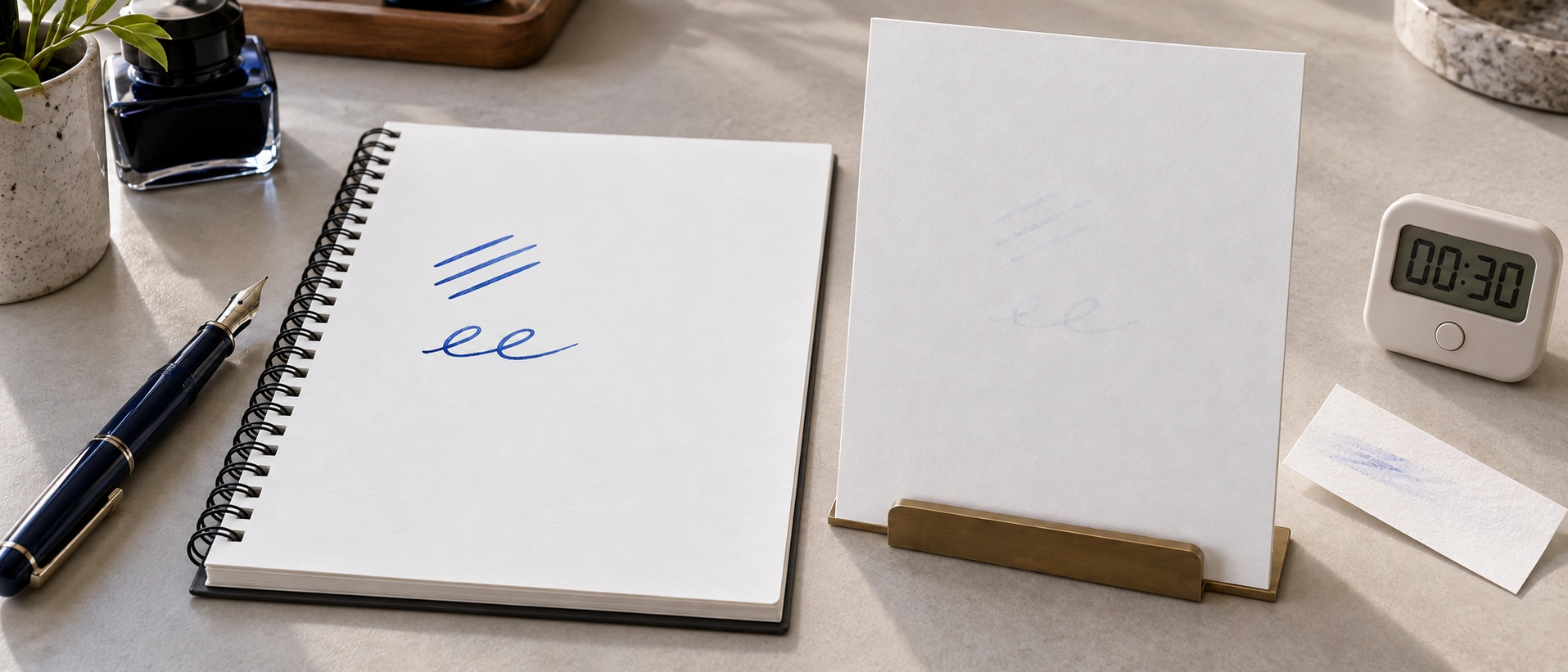
In practice, write a pen test into the spec instead of a weight alone, and make it repeatable so you can run the same test on bulk:
- Record: paper batch, pen model and ink colour, which side of the sheet, drying time, and the date.
- Pen list: the pens your customers actually use, for example a gel pen, a ballpoint, a fountain pen with a medium nib and a highlighter.
- Judge: feathering, bleed-through, show-through on the reverse and smearing after the agreed drying time, on both sides of the sheet.
- Pass condition: you set it against a signed reference sheet from the approved sample. For example: no bleed-through with any pen on the list, and feathering and show-through no worse than the reference.
Send your pen list with your inquiry, and the sample can be tested against it before you approve.
Binding: spiral and twin-wire are different systems
"Coil" covers two different binding systems, and they should not be specified interchangeably:
- Spiral coil: a single continuous coil, plastic (such as PET) or metal, wound through a row of round holes. A common pitch for plastic spiral is 4:1, four holes to the inch (YPS). Other pitches exist, so confirm the pitch and hole shape on the actual punch tooling.
- Twin-wire (twin-loop, also called wire-o): a wire formed into double loops, inserted through the holes and then closed. It uses its own hole pitch and wire sizes, so a block punched for spiral cannot simply be switched to twin-wire.
Whichever system you use, re-check the binding when the paper or sheet count changes. Heavier paper makes a thicker block, and binding that fitted the old block can make pages catch when they turn. In one YPS project, a 160-sheet A5 hardcover with a spiral coil moved from 80 gsm to 120 gsm paper, and the coil went from 20 mm to 32 mm. That was YPS's own project, and YPS states the figures are not a formula for another notebook. A different paper caliper, sheet count or cover could give a different answer (why YPS re-specified the coil on a premium A5 hardcover).
The general rule is to ask the supplier to confirm, in writing, the binding system, diameter and pitch for the final paper and sheet count. Re-checking does not always mean changing. If the existing size still turns cleanly through the full page range on the sample, it can stay.

When the higher unit cost is worth it, and when it isn't
A simplified way to see why small batches cost more per notebook:
Unit cost ≈ fixed setup costs for each design (plates, tooling, proofing, line changeover) ÷ quantity of that design + per-unit materials, labour and finishing
At low quantities the setup costs are spread over fewer notebooks, and a premium spec raises the per-unit part. This is a model, not a way to read a quote. In a real quote, per-unit costs also move with quantity because of material buying, line efficiency, waste allowance and freight. Two unit prices at different quantities therefore can't tell you how much of the cost is setup.
The reliable comparison is an itemised quote. Ask each supplier to quote the same spec at two quantities, your planned run and a larger one, with each line shown separately:
| Quote line | Fixed or per unit | Why it matters |
|---|---|---|
| Plates, moulds, cutting tools | Fixed, per design | Repeats for every new design, so the number of designs matters as much as the total quantity |
| Proofing and sample rounds | Fixed | Each extra round adds cost and time; agree how many are included |
| Line set-up and changeover | Fixed | Charged per run or per design |
| Paper, cover board and wrap, binding wire | Per unit | Where a premium spec raises cost; may change with quantity |
| Functional pages and finishing (pockets, tabs, rounded corners, manual steps) | Per unit | Easy to add, easy to underestimate |
| Packaging | Per unit | Gift boxes can cost more than the notebook upgrade |
| Defect and rework allowance | Per unit | Ask how rejected units are handled and who pays |
| Freight, duties and landed cost | Per unit | Compare landed cost, not ex-works price |
Splitting one total quantity across several designs is not automatically cheaper. Each design brings its own fixed lines, so 1,000 notebooks in four designs carry more setup cost than 1,000 in one. Then compare the landed unit cost with your target retail price or per-recipient gift budget. YPS's notebook page lists format, punch tooling, cover material, paper stock and the number of cover designs as the factors that set the workable quantity (YPS notebook range). There is no single minimum. Send your spec and design count to get the figure for your order.
Whether the higher unit cost pays off depends on who ends up holding the notebook.
- Personal gifts and keepsakes: where a handmade positioning has research support. Across four studies, consumers found products labelled handmade more attractive, largely because they saw them as symbolically containing love. The effect appeared when people bought gifts for loved ones, but not for more distant recipients (Fuchs, Schreier & van Osselaer, Journal of Marketing, 2015). The studies did not test notebooks, and they don't show that a premium notebook will sell better. The label also only counts when the handmade steps are real.
- Corporate gifts to clients or partners: decide on specs, not on the handmade label. A client is usually closer to the "distant recipient" in that research, so the handmade effect is weak evidence here. The case for upgrading rests on what the recipient can see and use: paper that takes their pen, a cover that survives a bag, a page that fits their binder.
- Giveaways at volume: usually budget-led. For conference packs or promotional runs, volume products already cover the need. One supplier lists branded A5 spiral notebooks from 50 units (Sense2). A premium spec mainly adds cost unless the recipients are a small, high-value group likely to keep the notebook.
- In between: upgrade the spec that fixes a known problem. Start from complaints or returns on the current product. Ink bleeding points to paper. Pages catching point to binding. Worn corners point to the cover build. Upgrading everything at once raises cost without telling you which change mattered.
For planning a small-batch collection beyond one SKU, see the seven decisions brands make before producing premium custom notebooks in small batches.
Claims you can print on a light luxury notebook
Light luxury lines lean on eco and handmade claims, and different rules apply to each. Environmental claims have specific rules in the US and the EU. "Handmade" is not covered by those green-claims rules, but general advertising and consumer-protection law still requires it to be true. For every claim, keep the evidence on file before it goes on the packaging.
- "Recyclable" in the US. Under the FTC Green Guides, an unqualified recyclable claim is acceptable only when recycling facilities are available to a substantial majority, at least 60%, of the consumers or communities where the item is sold. Otherwise the claim has to be clearly qualified (eCFR, 16 CFR 260.12). Three claims are easy to confuse: that a material such as PET is recyclable, that the coil can actually be recycled where the notebook is sold, and that the whole notebook is recyclable. A notebook combines paper, board and a plastic or metal coil, and each goes into a different stream, so evidence for one claim does not support the others.
- Environmental claims in the EU. Directive (EU) 2024/825 amends the EU's consumer-protection directives to prohibit misleading environmental claims, and it requires such claims to be verifiable (European Commission). It has applied since 27 September 2026 (European Commission). Member states put it into effect through national law, and as of late October 2026 several had not yet adopted their national measures (Mayer Brown). The rules govern claims made to consumers, so they matter most for a notebook that will be sold at retail. Check requirements market by market. Calling a whole notebook "eco-friendly" because its coil is PET is the kind of unverifiable, whole-product claim to avoid.
- "Handmade". Use it only for steps that are actually done by hand, and say which steps they are.
| Claim to avoid | More defensible wording | Evidence to keep on file |
|---|---|---|
| "Eco-friendly notebook" | A claim limited to the pages, naming the certified paper and its certification scheme | Paper certificate and chain-of-custody number for the paper actually used |
| "100% recyclable" | A plain material statement, such as "Coil: PET plastic", with no recyclability claim unless you have evidence for each market | Material declaration for the coil; for any recyclability claim, recycling availability in each market where it appears |
| "Handmade" | The specific steps done by hand | A written process description |
If you plan to print environmental or handmade claims, list them in your inquiry, and ask the supplier which material declarations and process descriptions it can supply for your order. This is a summary for sourcing teams, not legal advice. Check final packaging copy with counsel in each market you sell into.
Approving an A5 small-batch sample: a checklist
A premium spec only pays off if the bulk order matches the approved sample. Run these checks on the sample, record the results, and agree that bulk will be checked the same way. Where a check says "agreed", the limit is the one written in your purchase spec or shown by the signed reference sample. Set those limits before sampling, not after.
| Check | How | Record | Approve if |
|---|---|---|---|
| 1. Sheet size | Measure the sheet before and after tear-out | Both widths, strip width, measuring method | Within the size and tolerance in your purchase spec |
| 2. Cover with coil | Measure; place in the actual box, display or carton | Outer dimensions; fit photo | Fits without forcing |
| 3. Paper | Pen test on both sides with the agreed pen list | Pen-test record (see Paper section) | Meets your pass condition against the reference sheet |
| 4. Binding | Turn every page through the full range the design allows; check coil or wire ends | Binding system, diameter, pitch; any catching pages | Nothing catches; ends closed and tucked |
| 5. Grain direction | Check on a test sheet. ISO 216 provides for indicating machine direction (ISO), but it does not tell you which direction to choose | Direction relative to the binding edge | Matches the direction written in your spec (usually parallel to the binding edge) |
| 6. Cover finish | Rub-test corners and surface; compare colour with the approved proof under the same light | Notes and photos | No wear beyond the reference; colour matches the proof |
| 7. Functional pages | Check pocket glue, index-tab alignment and print registration | Notes | Pocket holds; tab alignment within the limit in your spec |
| 8. Claims | Match every packaging claim to its evidence | Evidence list | Every claim has evidence on file |
| 9. Reference sample | Sign and date two identical samples, one kept by each side, labelled with the spec version | Spec version, date, signatories | Both parties hold the same reference |
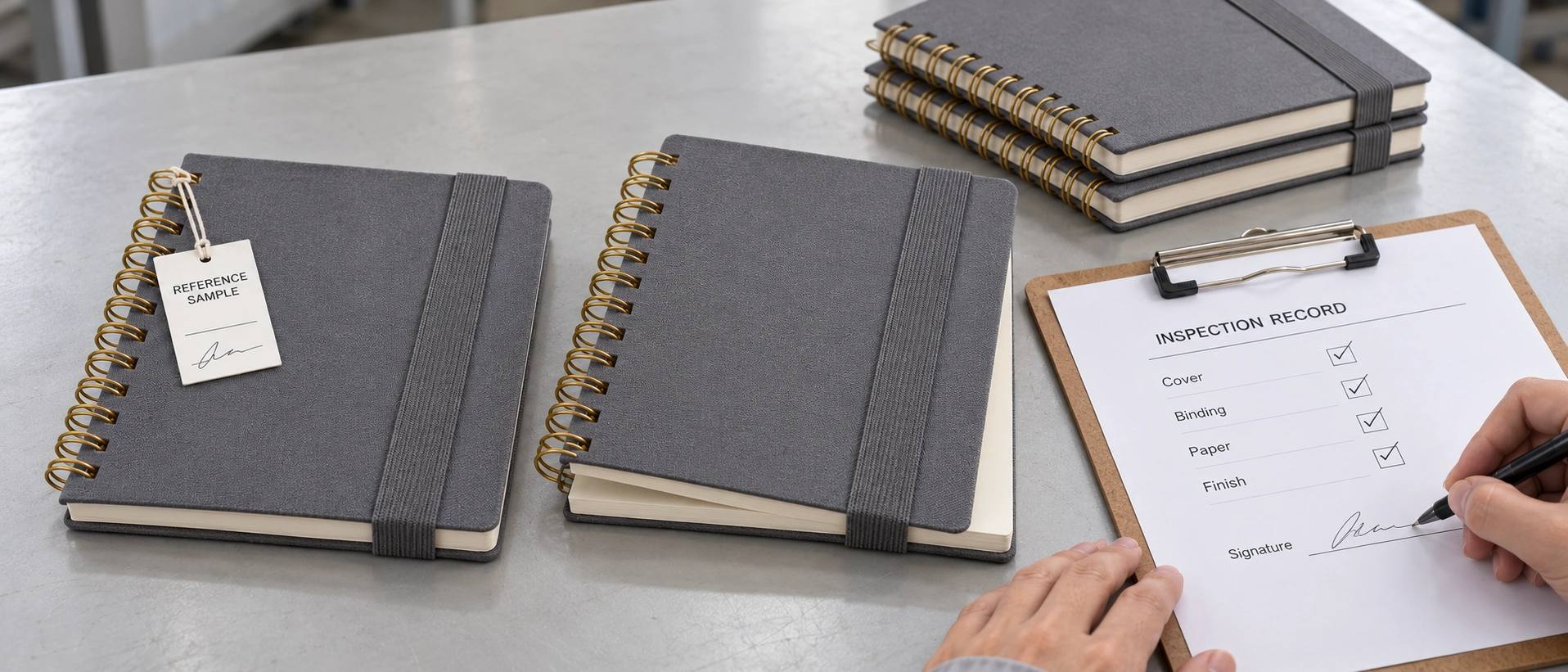
For bulk, check pre-production and production samples against the signed reference, not against the spec sheet alone. Agree a sampling plan for the shipment and name who signs off on each side. Put in writing what happens if bulk fails a check: rework, replacement, or acceptance at an agreed adjustment. For cover materials and finishing in particular, see auditing a supplier on what fails after sign-off.
Next step: send us your A5 spec
If you are moving an A5 line to a premium spec or a smaller run, start from the spec you have now. The more of these you include, the more precise the reply:
- Page size: the sheet size, and the torn-out width you need if you sell "A5 pages"
- Inner pages: sheet count, paper and ruling (lined, dot, grid or blank), and your pen list for testing
- Binding and cover: spiral or twin-wire, coil inside or outside the cover line, hardcover or softcover, wrap material and finish
- Extras: rounded corners, pocket, index pages, other functional pages
- Quantity: quantity per design and number of designs
- Packaging: gift box, sleeve or bulk carton, with the box size if it is already fixed
- End use and market: retail, personal gift, corporate gift or giveaway, and the countries you sell into
- Claims: any environmental or handmade claims you want to print
Compare it with YPS's A5 spiral hardcover notebook, then send it through the YPS inquiry form. In the reply we will set out which specs would change, split the quote into fixed and per-unit lines, and list the checks we propose for the sample, including the measured tear-out width.
Sources
- Standards and reference: ISO 216:2007 · papersizes.io – A5 · Wikipedia – Sizing
- Research: Silverstein & Fiske (2003), Luxury for the Masses, HBR · Fuchs, Schreier & van Osselaer (2015), The Handmade Effect, Journal of Marketing
- Regulation: 16 CFR 260.12 · European Commission – sustainable consumption · European Commission – Directive (EU) 2024/825 · Mayer Brown on Directive (EU) 2024/825
- Commercial examples: Galen Leather · Sense2 A5 spiral


