Aesthetic Meets Function: Planning a Premium Spiral-Bound Notebook Range for Brands Before 2027
Leave a message
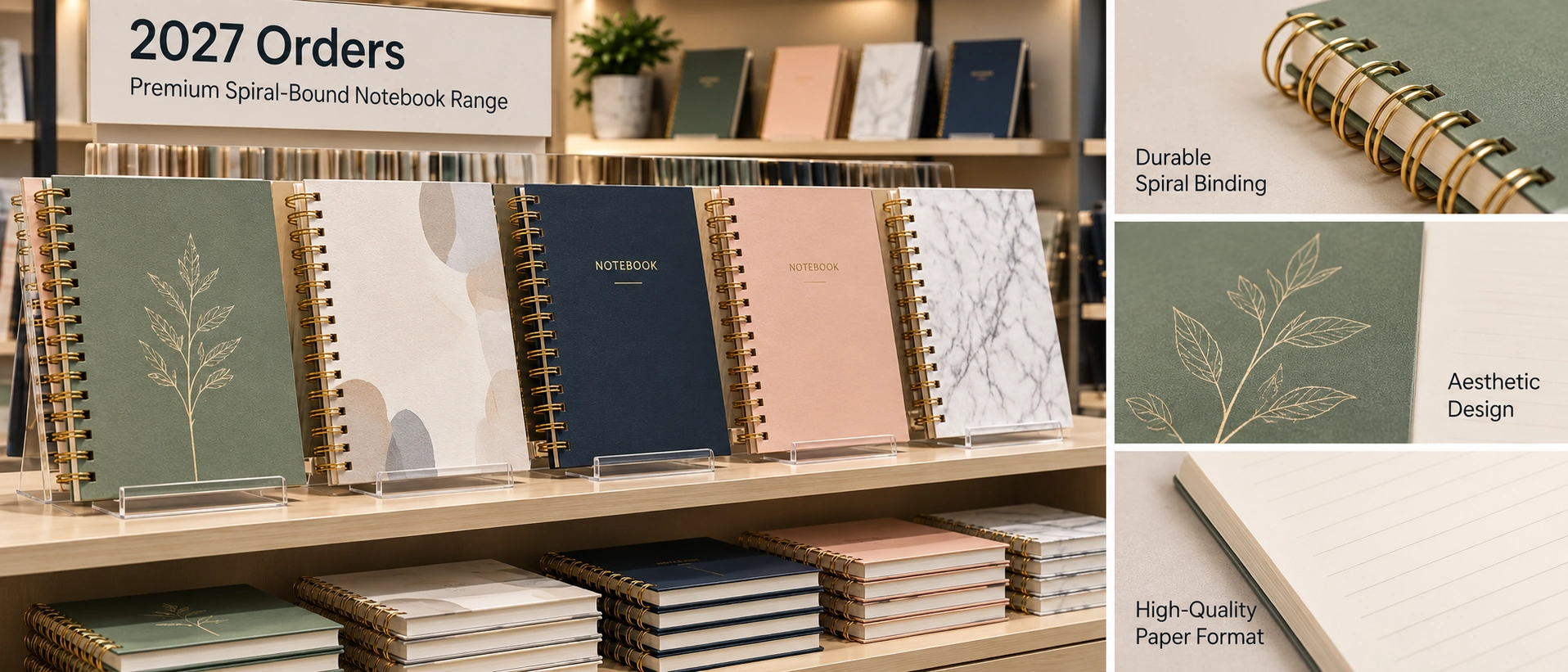
A premium spiral-bound notebook can earn a place in a brand's collection when its appearance, writing experience and intended use support the price. The available market evidence does not establish a broad shift toward higher-priced spiral notebooks. It gives buyers a reason to scrutinize value, then test the proposition with their own customers.
For brands planning 2027 orders, the practical question is which product differences deserve investment and which material, packaging and import decisions need evidence before approval. This guide connects those decisions without replacing a detailed notebook specification.
The Demand Signals Behind Premium Spiral Notebooks, and Their Limits
Fewer Units, Higher Prices
In its July 9, 2026 forecast, Circana projected that US office supplies sales would reach $11.1 billion in 2026, down 0.1% from 2025. Unit sales were expected to fall 2.8%, while average selling prices rose roughly 2.8%. These are forecasts for the wider US office supplies category, not measured results for premium notebooks. (Circana's 2026 office supplies forecast)
Higher average prices alongside falling volume do not prove that consumers are trading up. Cost increases, changes in the product mix and promotional behavior can influence the result. A brand should therefore avoid treating category price growth as permission to raise its notebook price without a clear product reason.
Approve a defined premium proposition against a commercial hurdle: the price it must achieve, the margin after landed costs and the response needed to justify a repeat order. A buyer should be able to identify the proposed advantage in a physical sample before committing to a wider collection.
What the Market Reports Do and Don't Show
Paper notebooks, luxury stationery, writing instruments and office supplies are different markets. A forecast for one does not establish growth in another. Combining their headline figures can create a market story that the underlying research never measured.
The evidence reviewed for this article does not establish a reliable, directly verified public growth rate or market-share gain for premium spiral notebooks. Broad market estimates are background rather than an order forecast.
For a specific collection, the more useful questions concern the brand's own channel. Have comparable notebooks sold at the proposed price? Did buyers reorder? Were returns related to writing performance, binding or appearance? If those records do not exist, describe the launch as a proposition to test rather than a response to proven category-wide demand.
Where Aesthetic Meets Function in a Spiral Binding
Single Coil vs Twin-Loop Wire Hardcover
A single continuous coil and twin-loop wire (Wire-O) are distinct constructions, even though both may be grouped under "spiral notebooks" in retail descriptions. A hardcover is a separate cover-construction choice; it does not, by itself, identify the binding system.
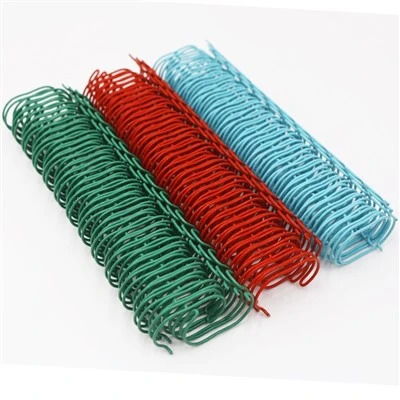
For brand buyers, the first decision is how the notebook should look and behave in use. A visible colored coil can become part of the collection's identity. A twin-loop wire hardcover offers a different spine appearance and handling experience. Neither construction should be assumed to deliver a higher retail price or better durability without a comparison relevant to the proposed product.
Compare samples using the same format, page block and intended writing task wherever possible. Examine opening, page turning and fold-back behavior, including whether the covers obstruct the movement customers expect. YPS's existing guide to specifying a spiral notebook for a luxury stationery collection covers the more detailed specification and acceptance questions.
A change from single coil to twin-loop wire after sampling should trigger a compatibility review. Nominal pitch alone is not a complete compatibility check. Confirm the hole geometry, punch pattern, binding system and assembly requirements against the actual production specification before changing the binding method. Use the coil diameter, pitch and spine-length specification guide to define the production requirements, then approve the revised finished sample.
Details Users Notice: Corners, Tear-Out Margin and Left-Hand Use
Small details become meaningful when they solve a recognizable task. Rounded corners affect the outline and handling of the book. A perforated sheet needs enough retained material to remain usable after removal. A binding position that works for one writing posture may obstruct another.
These are sample-comparison questions rather than automatic premium features. Try writing near the binding, removing a perforated sheet, turning a full page block and carrying the closed notebook. If left-hand use is part of the product brief, compare side-bound and top-bound samples with the intended users before choosing a format.
For PET coils and metal spiral coils, approve material identity, appearance and end finishing separately from any strength or environmental claim. A resin name does not establish recycled content, local recyclability or a performance advantage. Each claim needs its own supporting evidence.
Four Regulatory and Trade Checks for 2026–2027 Orders
The following checks serve different purposes: marketing claims, supply-chain due diligence, packaging and import scope. Some involve new application dates; the US lined-paper orders are existing trade measures. This overview supports procurement planning and is not legal advice or a product-specific customs determination.
1. Green Claims on the Coil and Paper
The European Commission confirms that Directive (EU) 2024/825 entered into application on September 27, 2026. Check the implementing rules in the intended Member State when approving consumer-facing environmental wording. (European Commission sustainable consumption information)
Keep a specific component statement separate from a broad product claim. "The coil contains a stated percentage of recycled PET" identifies a component and a measurable attribute. "Eco-friendly notebook" makes a much broader assertion. Do not treat an ordinary material test as sufficient authorization for that broader wording, or describe a detachable coil as proof that the whole notebook is recyclable.
For US marketing, the FTC Green Guides link unqualified recyclable claims to suitable facilities being available to at least 60% of consumers or communities where the item is sold. That threshold concerns recycling access, not recycled content. Components, size or construction can also prevent an item from being accepted for recycling. (16 CFR 260.12, recyclable claims)
Use a claim review before packaging artwork is released:
| Proposed wording | Evidence decision |
|---|---|
| "PET coil; coil can be separated from the pages" | Verify material identity and separation on the finished product. This describes construction, not recycling acceptance. |
| "Coil contains a stated percentage of recycled PET" | Verify the percentage, calculation basis and supply records. Identify that the claim concerns the coil. |
| "Recyclable notebook" | Review the entire construction and actual collection and processing availability in the sales market. Qualify the claim where appropriate. |
| "Eco-friendly notebook" or "100% recyclable everywhere" | Do not approve from a material description or an ordinary test report alone. Obtain a market-specific review of the wording and supporting evidence. |
Keep the exact wording, relevant component, evidence and approval responsibility in one record. The guide to evidence for sustainable notebook material claims provides the related documentation framework.
2. EUDR Timing and the Product-Scope Decision
The European Commission lists application of the EU Deforestation Regulation (EUDR) from December 30, 2026 for large and medium operators, and June 30, 2027 for micro and small operators. Micro and small operators already covered by the EU Timber Regulation have the earlier date. Certain newly added products have a separate timetable. (European Commission EUDR overview)
Before approving an EU-bound order, give the responsible importer or operator the finished-product description, proposed customs classification and paper fibre records. Ask them to identify the requirements and application date for the actual transaction. Keep their assessment with the order documents.
Do not describe an actual SKU as EUDR-compliant or exempt solely because it is a notebook, contains printed pages or uses recycled paper. This guide does not determine the legal status of an individual product.
3. PPWR and the Packaging Around the Notebook
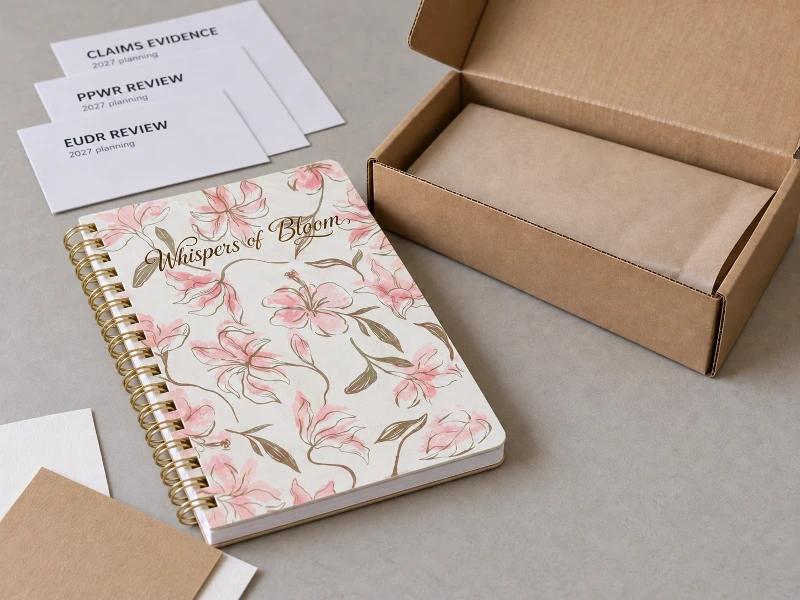
The EU Packaging and Packaging Waste Regulation (PPWR) has a general application date of August 12, 2026. Its requirements have phased timelines; this date does not mean every later design, labeling or recycled-content requirement already applies. (European Commission packaging information)
Review the gift box, sleeve, protective wrap and shipping carton while the pack is being designed. Use the following document plan to establish what is available and who must confirm the applicable requirements:
| Procurement record | What to request or agree |
|---|---|
| Packaging bill of materials | Identify each packaging component and its material specification. |
| Supplier information | Collect material declarations and supporting information relevant to the selected packaging. |
| Applicable test evidence | Identify which requirements need testing and whether the reports cover the proposed materials and construction. |
| Compliance review | Ask the responsible party to identify the requirements, supporting records and documentation needed for the proposed packaging and destination. |
| Role and change approval | Identify the relevant manufacturer and importer roles, document ownership and who approves material or artwork changes. |
Use this table to organize supplier discussions. Ask the responsible compliance contact to confirm the requirements for the actual packaging and supply arrangement; the table is not a complete legal checklist.
Keep the notebook bill of materials and packaging record distinct. Evidence about the notebook's paper does not automatically establish a claim about its box or film wrap.
4. US Lined-Paper Trade Scope, Origin and Page Size
Commerce's August 2023 continuation notice covers antidumping duty (AD) orders for certain lined-paper products from China and India, and a countervailing duty (CVD) order for such products from India. These are origin-specific measures, not a uniform notebook tax on every country. (US Department of Commerce continuation notice)
The scope includes horizontal and/or vertical ruling, ten or more sheets, with no minimum page requirement for looseleaf filler paper, a shorter paper dimension of 6–15 inches and a longer dimension of 8¾–15 inches, subject to the full wording and exclusions.
Measure pages as they appear in the finished notebook. Do not substitute advertised or tear-out dimensions. Measure rounded or tapered pages at their longest and widest points.
As a dimensional screening exercise, nominal A5 paper at 148 × 210 mm falls below both lower thresholds; A4 at 210 × 297 mm falls within the bands. For B5-labeled notebooks, check the specified dimensions rather than relying on the format name. Page dimensions of 176 × 250 mm or 182 × 257 mm both fall within these bands. These are dimensional screening comparisons, not SKU rulings.
A rigid cover alone does not establish the case-bound exclusion, which specifies a construction incorporating binders board, a spine strip and a cover wrap. Give the importer's trade adviser the customs origin, measured pages, ruling and finished construction. Confirm current scope interpretations and applicable duties before approving landed costs.
Turning the Signals Into a Product-Line Decision
Use the following scenarios to decide what must be resolved before approval. They are a planning framework, not predictions of sales or legal classifications.
| Proposed range | Product decision | Evidence gate before commitment |
|---|---|---|
| Design-led boutique or museum collection | Compare the visual identity and writing experience of single-coil and twin-loop wire samples. | Customer or buyer response at the proposed price, plus an approved finished sample. |
| EU collection carrying an environmental message | Choose claims alongside notebook and packaging materials. | Claim-specific evidence, packaging review and a documented EUDR scope assessment. |
| US-bound lined notebook range | Confirm actual page size, ruling, construction and customs origin early. | Product-specific import-scope advice and landed-cost assumptions reviewed by the importer. |
| Range intended to accommodate different writing postures | Compare binding positions and opening behavior. | Feedback from intended users on physical samples rather than a presumed accessibility benefit. |
A compact notebook may suit a portable collection; a larger notebook may better serve an extended desk-writing task. Those uses should drive the format choice alongside commercial and compliance considerations. The discussion of A5 notebook dimensions and cost trade-offs supports that narrower decision.
Set Three Approval Gates
For a private-label launch or wholesale range, define the approval criteria before comparing quotations.
| Approval gate | What the brand should decide | Record needed |
|---|---|---|
| Market | Intended customer, channel, target retail price and the product difference that supports it. | Comparable sales, buyer feedback or a defined trial plan if trading history is unavailable. |
| Cost | Acceptable commercial result after purchase, packaging, freight, applicable duties, inspection, sampling and artwork costs. | A landed-cost model that distinguishes recurring unit costs from development costs. |
| Reorder | The sales response, return patterns and product feedback required to justify another order. | A review point and brand-defined criteria for repeating, revising or discontinuing the SKU. |
If an unresolved duty assumption or packaging change could alter the cost decision, keep commercial approval conditional until that input is settled. If the market evidence is limited, define the initial launch as a test and agree how its results will be reviewed.
No universal margin, saving or payback period can be inferred without the brand's own project inputs.
Before You Request Samples
Prepare a brief that allows samples and quotations to answer the same questions:
- Sales countries, distribution channel, intended retail positioning and private-label requirements.
- Actual page and cover dimensions, orientation and binding position.
- Sheet count, ruling or page layout, paper specification and intended writing instruments.
- Single-coil or twin-loop wire construction, material and desired finish.
- Cover, perforation, pocket and index requirements, where relevant.
- Proposed packaging and exact environmental wording for review.
- Quantity by SKU, target delivery window and destination.
- Sample acceptance criteria, required documents and the person approving changes.
- Proposed country of manufacture and documented customs origin.
- Paper fibre source, virgin and recovered-material status, and supporting supplier records.
- For EU orders, the responsible importer or operator and the product-scope assessment needed for the transaction.
- For US orders, measured finished-page dimensions, ruling and construction details for trade-scope review.
YPS's published notebook offering includes PET coil, metal spiral and twin-loop wire constructions for brand and gift programs. These are supplier-described options; suitability and the final specification should be confirmed against the proposed project.
Submit the brief through YPS custom notebook development to discuss samples and a quotation against the same requirements. Ask the quotation to identify material assumptions, packaging details, document availability and any items still awaiting confirmation.