

Leather Journal Cover Materials and Binding Compatibility for High-End Journals
Leave a message
A leather journal cover specification needs to identify three things: the material, the cover construction and the finished notebook it must work with. Approve those together in an assembled sample. A material swatch alone cannot establish fit, opening behaviour or the performance of decorated and folded areas.
| 01 MATERIAL Article code, composition, finish, backing and thickness. |
02 CONSTRUCTION Removable cover, covered case or flexible bound cover. |
03 FINISHED NOTEBOOK Dimensions, binding and the required opening behaviour. |
For stationery brands and custom notebook buyers, the task is to turn an appearance brief into requirements that suppliers can quote and demonstrate. Start with the construction, compare identifiable materials, then check the finished product before approving production.
This guide covers both removable covers and covers integrated into complete journals. For sourcing, treat a removable natural-leather cover and a PU-covered bound notebook as separate briefs; availability of one does not establish supply capability for the other.
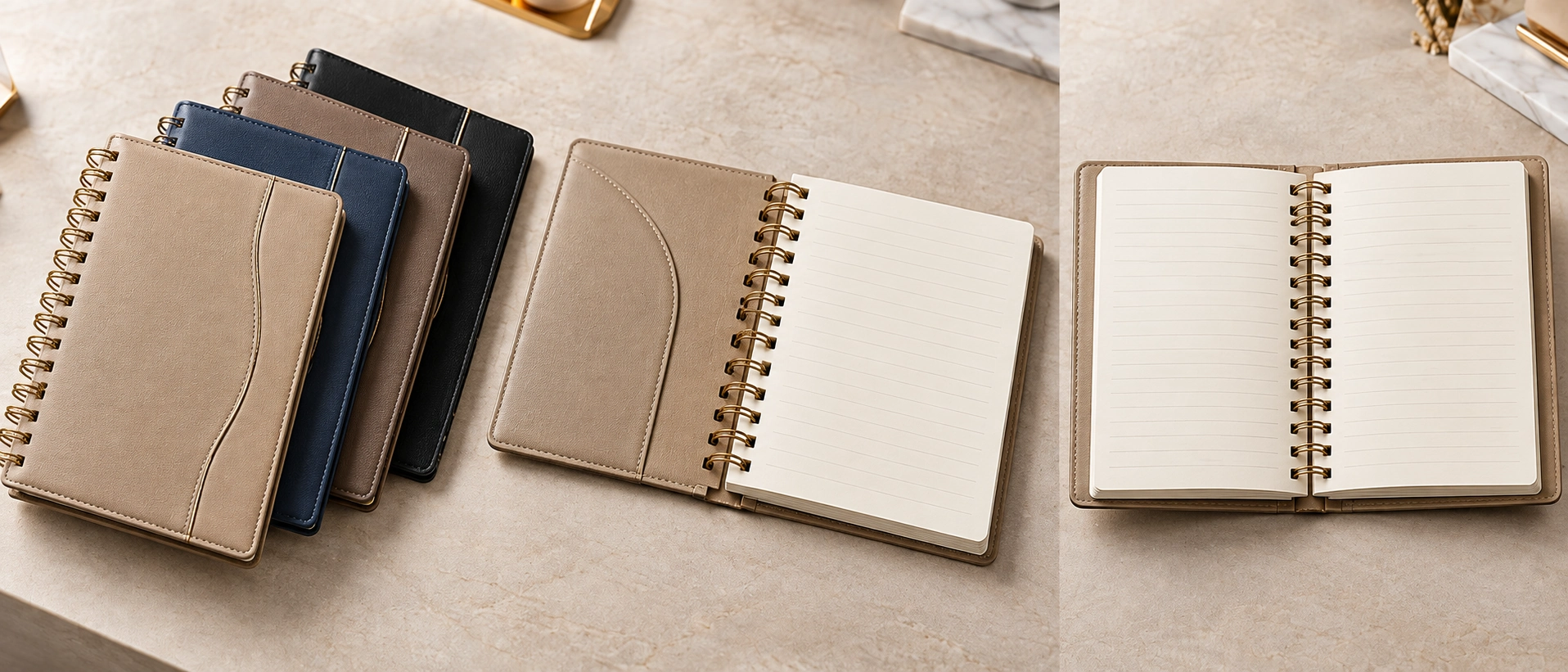
High-end leather journal cover materials and finished notebook assembly inspection.
Key Takeaways:
Construction first: decide between a removable cover and a complete bound journal before comparing materials.
Name the material precisely: "leather" alone is not a specification - record article code, substrate, finish and thickness.
Approve the assembly: fit, binding movement and decoration must be confirmed on an assembled sample.
Read test reports within their limits: a material test result is not a lifespan or whole-notebook claim.
Define the Cover Construction Before Choosing the Material
Removable Covers and Bound Covers
First decide whether the order is for a separate cover or a complete journal. These products require different fitting and inspection decisions.
| Construction | How the Components Relate | What the Buyer Needs to Approve |
|---|---|---|
| Removable cover | A separate outer cover holds a replaceable notebook or insert | Insert retention, insertion and removal, closure and fit across the specified insert range |
| Case covering | A surface material covers a rigid case attached to the book block | Wrapped edges, corners, joints and movement of the assembled case |
| Flexible bound cover | A flexible cover forms part of the bound journal | Attachment, spine movement and the intended opening behaviour |
These are construction categories, not quality grades. A removable cover suits a product concept built around replacing the insert. A bound journal requires approval of the cover and book block as one product.
Hardcover and softcover describe broad cover forms; they do not identify the attachment or binding system. Specify those separately, including whether the notebook must open flat or fold back.
Turn Material Names Into Verifiable Specifications
Natural Leather, Coated Materials and Leather Fibres
"Leather" alone does not provide enough information for sample approval or repeat orders. Record the material construction and supplier reference alongside the appearance.
Leather Working Group distinguishes full grain, corrected grain and split leather. Full grain preserves the grain surface without corrective mechanical removal. Corrected grain involves partial surface removal and finishing. Split leather comes from the flesh or middle layers separated from the hide or skin. These descriptions identify materials; they do not establish finished notebook performance. (Leather Working Group)
A PU coating also needs its substrate identified. PU-coated fabric and PU-coated natural leather are different constructions. A leather-fibre sheet needs its composition, binder, coating and backing documented rather than inferred from its texture.
| Material Family | Request From the Supplier | Confirm in the Sample |
|---|---|---|
| Natural leather | Article code, animal origin, grain or split description, tanning and finish information, thickness range | Appearance, flexibility and behaviour at the actual folds and edges |
| PU-coated material | Article code, substrate, coating, backing and total thickness | Surface appearance, backing behaviour and performance in the intended construction |
| Leather-fibre sheet | Article code, declared composition, binder, coating and backing | Handling, edge construction and performance of the assembled cover |
Choose Against the Product Brief
If genuine animal-origin leather is part of the product promise, make that identity a purchasing requirement. Confirm the material and supplier capability before approving a leather-look alternative.
If the brief prioritizes a specified colour, texture and branded finish, include PU-coated materials in the comparison. Approve the actual colour and decoration sample, and define acceptable variation for repeat orders. A PU description alone does not guarantee consistency or successful finishing.
For leather-fibre materials, evaluate the declared construction and finished sample. Do not treat the presence of leather fibres as equivalent to intact natural leather.
Note: Compare specific candidates in the same notebook construction, with the same decoration and intended use. Neither natural leather nor PU supports a universal durability ranking.
Agree acceptance criteria before sampling: identify unacceptable surface defects, edge separation, colour variation and interference with the intended movement. Record how each condition will be checked. If a sample fails, document the defect, revise the affected material or construction and repeat the relevant checks before approval.
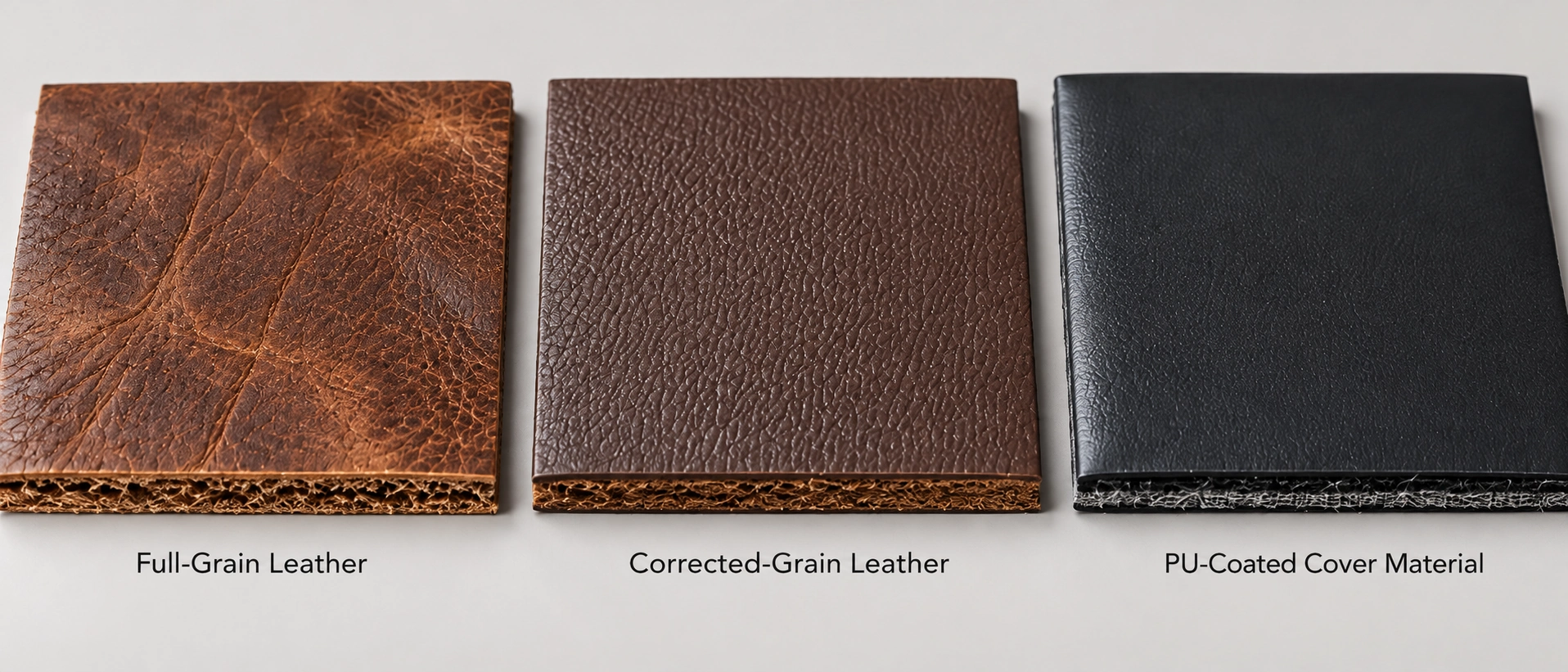
Comparing natural leather, PU-coated materials and leather-fibre sheet options against product briefs.
Check Fit Against the Finished Notebook
Dimensions, Thickness and Binding Projection
An "A5" description does not establish removable-cover fit. Page dimensions, external cover dimensions, closed thickness and projecting binding must be recorded separately.
Measurement Sequence for Drawings and Samples:
Measure the pages: Record trimmed page width and height.
Measure the finished cover: Record external width and height independently of the pages.
Measure the binding envelope: Identify any projection beyond the cover and state whether overall width includes it.
Measure closed thickness: Define the measurement location and treatment of closures or accessories.
Define capacity and tolerances: For a removable cover, specify the accepted insert dimensions and thickness range. Agree allowable variation for each measurement.
The relationship between cover width and overall width depends on the actual layout. Record the measurement locations on the project drawing rather than transferring allowances from another design.
For each dimension, record the drawing revision, measurement location, unit, nominal value, agreed allowable deviation, measurement method and observed sample value. Use one agreed unit throughout the drawing. For thickness, specify whether the measurement includes closures or accessories and how the notebook is held during measurement.
For removable covers, check inserts at the agreed limits of the thickness range. They should insert and remove as intended, remain retained during use and allow the closure to work without distorting the notebook.
For bound journals, review the drawing alongside cover movement. Geometry describes the product; an assembled sample demonstrates how it opens.
Avoid: Do not transfer fitting allowances from another notebook merely because both use the same size name.
Evaluate the Cover and Binding as an Assembled Product
Spiral and Wire-O Checks
Approve the intended material, backing, board, punched edge and binding together. Changes after approval require review of the affected functions.
For spiral and Wire-O projects, use the following as proposed sample checks, not a standardized certification procedure:
| Binding | Structural Distinction | Focus of the Assembled-Sample Check |
|---|---|---|
| Spiral | A continuous coil passes through the punched edge | Check coil projection, end clearance, hole-edge contact and cover movement around the coil |
| Wire-O | Paired wire loops pass through the punched edge | Check loop closure and alignment, clearance at the cover edge and catches during page turning |
For either system, demonstrate any required flat opening or fold-back position on the specified assembled sample. The binding name alone does not establish that the finished cover can make that movement.
Assembled Sample Handling Checklist:
Open and close the notebook through the required range, observing resistance and contact between components.
Turn pages individually and in groups, checking for catches at the punched edge.
If fold-back use is required, demonstrate it with the actual cover installed.
Inspect hole edges, wrapped margins and nearby coating for tearing, lifting or separation after the agreed handling sequence.
Check contact between the binding, decoration, pen loop and closure.
For removable covers, confirm that pockets or retaining features do not obstruct the binding or page movement.
Record the sample identity, actions, repetitions, observations and acceptance criteria. A requirement such as "opens flat" should identify the demonstrated position and conditions.
If the sample catches, pulls at the punched edge or obstructs the closure, revise the affected geometry or construction and repeat the relevant checks. Approval of appearance alone should not close an unresolved functional issue.
Other Constructions Require Separate Samples
A successful spiral sample does not validate a casebound or sewn journal. For a covered case, inspect joints, turn-ins, corners and attachment to the book block. For a flexible bound cover, inspect its attachment and spine movement against the required opening behaviour.
Keep untested combinations as evaluation tasks. Do not describe a material as compatible with all bindings.
Explore YPS Cover and Binding Options for Custom Journals
YPS's customization page lists PU materials, hardcover and softcover constructions, spiral and Wire-O binding, decoration and pre-production samples. These are published options; specific combinations require confirmation.
| Project Direction | Brief to Submit | Approval Focus |
|---|---|---|
| Branded PU-cover journal | Cover rigidity, finish, logo and opening requirements | Actual decorated cover and assembled movement |
| Spiral notebook | Cover flexibility, coil position and intended fold-back use | Coil clearance, hole edges and closure interference |
| Wire-O gift journal | Cover construction, wire appearance and decoration | Loop alignment, page turning and decorated edges |
These are inquiry directions, not confirmed product combinations. Compare starting formats in the YPS notebook collection, then request the selected format's material specification and sample.
Note: Natural leather and removable-cover projects require explicit supply confirmation. Do not infer those capabilities from PU notebook options.
Approve Decoration on the Actual Material Stack
A logo proof establishes artwork and placement. It does not establish how debossing, foil stamping or printing will perform on the production cover.
Request decoration on the specified material and supporting layers. Inspect detail definition, colour, edge quality and placement, then examine the decorated area while the cover is opened and handled as intended.
For a rigid cover, include the actual board and backing. For a flexible cover, evaluate the decorated sample in its intended bending position. A proof on a different material or construction remains a visual reference until the proposed combination has been sampled.
Record the material article code, finish, decoration method and sample reference. If one changes, review the affected approval rather than assuming the earlier result still applies.
Read Durability Evidence Within Its Limits
Flexing, Rubbing and Accelerated Ageing
A test report is useful when it answers a defined question about an identified material. It cannot replace inspection of the assembled notebook.
ISO 5402-1:2022 describes dry or wet flex testing for leather and its finishes, covering flexible leather below 3.0 mm thick. This is a method boundary, not a recommended journal-cover thickness.
ISO 11640:2018 addresses leather surface behaviour under rubbing with wool felt. Confirm the applicable edition with the laboratory before commissioning testing.
ISO 1419:2019 describes accelerated-ageing methods for coated fabrics. The laboratory should confirm the applicable method and conditions for the proposed material.
ACT explains that PU-coated upholstery can deteriorate under heat and humidity, while unsuitable cleaning exposure can cause similar cracking or flaking. A photograph alone therefore does not establish hydrolysis as the cause. ACT also states that accelerated-test weeks do not directly correspond to years of service. Its upholstery guidance comes from another application and should not be adopted as a notebook acceptance threshold. (Association for Contract Textiles)
Use the risk you need to evaluate to decide which evidence to request:
| Procurement Question | Evidence to Discuss With the Laboratory | What It Does Not Establish |
|---|---|---|
| How does leather or its finish respond to flexing? | An applicable leather flex-resistance report, such as ISO 5402-1 | Finished hinge movement or cover fit |
| How does the leather surface respond to rubbing? | An applicable rubbing report, such as ISO 11640 | A universal wear rating or service life |
| How does a coated fabric respond to accelerated ageing? | An applicable ageing report, such as ISO 1419, with stated conditions | Years of notebook use or whole-product approval |
When Reviewing a Test Report, Check:
Material article code, colour, finish and batch identification.
Test method, edition, specimen preparation and conditions.
Sample quantity, test date and laboratory identity.
Observations, results and the project's agreed acceptance criteria.
Whether the report covers material specimens or the finished product.
A standard's existence does not mean a supplier's material has passed it. Without applicable evidence, request testing or restrict the performance claim. Do not turn a material result into an unsupported lifespan, warranty or whole-notebook claim.
Build a Comparable RFQ and Sample Approval Record
Supplier quotations become comparable when they refer to the same product definition.
| RFQ Field | Information to Provide |
|---|---|
| Use and environment | Intended handling, storage, transport and cleaning expectations |
| Cover construction | Removable, covered case or flexible bound cover |
| Material | Article code, composition, finish, backing and thickness |
| Dimensions | Measurement drawing, insert range and agreed tolerances |
| Binding | Type, position, projection and required opening behaviour |
| Decoration | Artwork, method, placement and approved material combination |
| Evidence | Required material reports and assembled-product checks |
| Commercial scope | Quantity per design, packaging, delivery basis, sampling and tooling charges, included tests and rework responsibilities |
| Approval record | Sample reference, drawing revision, measurement methods, allowable deviations, agreed handling repetitions, defect criteria, results and responsible approver |
Compare material purchasing, processing, sampling, tooling, packaging and agreed rework responsibilities on the same basis. A lower unit price does not explain differences in construction or evidence. Without comparable quotations, a savings percentage would be speculative.
Retain the approved sample and specification revision. Require proposed changes to materials, backing, binding or decoration to be identified before production, so affected checks can be repeated. If a sample fails, record the issue, revised specification and replacement sample reference. Close the issue against the agreed criteria before production approval.
Start Your Custom Journal Project
To discuss a custom notebook project, send YPS your material and binding brief. Include target dimensions, page count and paper requirements, cover construction, material preference, binding type, quantity, logo artwork and delivery destination.
Use the inquiry to confirm available options, sampling feasibility and quotation scope. If the brief is still preliminary, identify the decisions that remain open.


