

Premium Custom Notebook Cover Materials: A B2B Selection Guide
Leave a message
Notebook cover materials dictate the strength and the perceived market value of the final product. We developed this engineering and purchasing guide to help premium stationery brands manage the trade-offs between fabric, polyurethane, specialty paper, and rigid board setups. Buyers can use these detailed specs to avoid common manufacturing defects. They can also set practical quality standards for premium production partners like YPS.
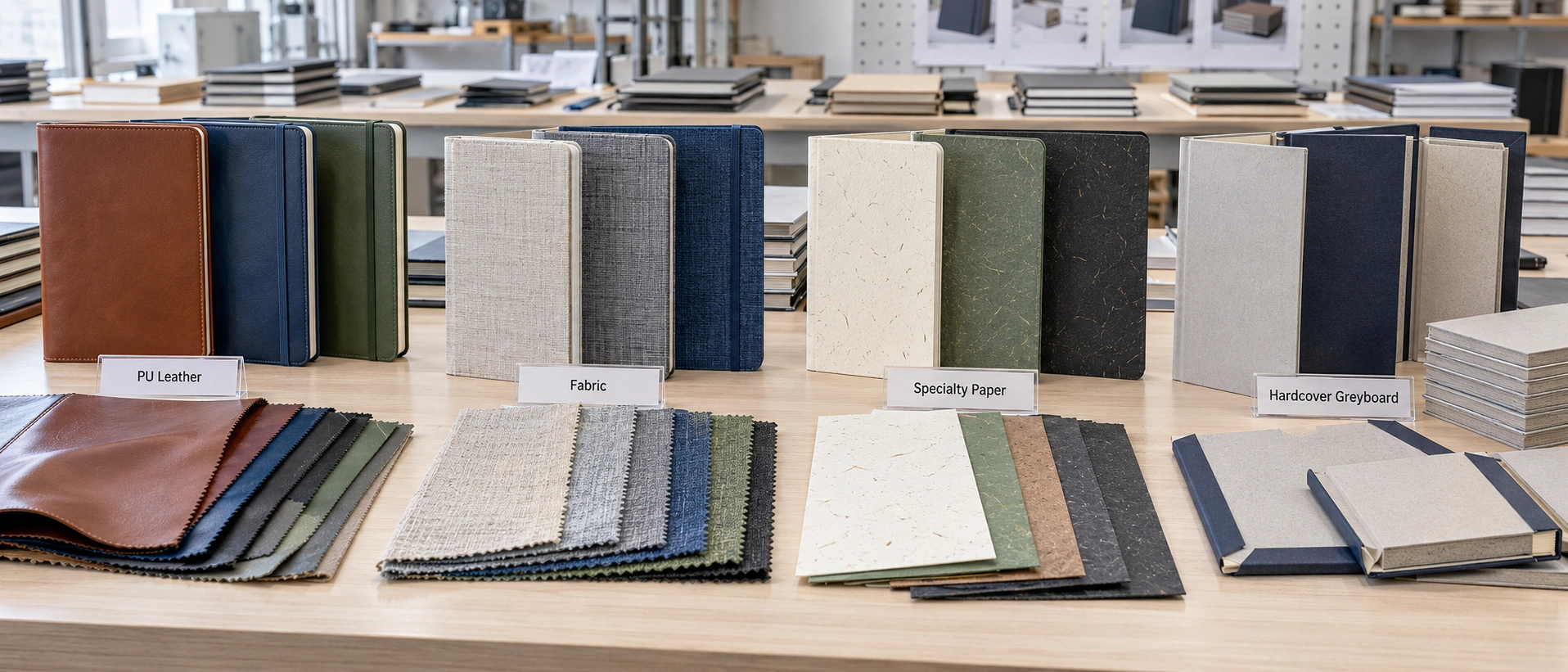
Engineered cover materials dictate physical durability and perceived value in custom stationery production.
Why material selection drives manufacturing complexity
The physical properties of notebook cover materials directly control factory complexity. They also control the working lifespan of the finished stationery product. Flexibility, thickness, and stiffness must align precisely with the chosen binding method and edge finishing techniques. Low-cost promotional stationery uses standard assembly lines. In contrast, premium custom notebooks demand precise material matching and structural engineering.
Manufacturers like YPS test cover materials based on how well they hold up during production. The materials must handle die-cutting, corner wrapping, and binding without breaking down. A boutique journal feels high-end only when the outer wrap works smoothly with the rigid paperboard underneath. Buyers must check the physical limits of their chosen substrates before finalizing the design or asking for samples.
A poor match between the cover wrap and the board stiffness often causes problems. The notebook may warp outward or fray at the edges during daily use. The factory must adjust its glue application and pressing machines for the density and porosity of the chosen cover material. Successful premium stationery brands always put material compatibility ahead of pure appearance during initial product development.
How woven fabrics affect tactile experience and production
Fabric covers create specific production challenges with color consistency and edge finishing, even though buyers love their high-end feel. Woven materials like cotton and linen need special barrier glues. These barriers stop liquid glue from leaking through during automated board wrapping. Buyers report that fabric textures create a luxury feel that suits boutique collections and executive journals.
Woven surfaces limit your cleaning options. Standard cleaning liquids can soak into the open fibers and weaken the board glue underneath. Screen printing and foil stamping on linen require higher pressure settings. They also need heavy-duty foils to bridge the gaps in the fabric weave. Fabric wrapping requires exact tension control at the corners. This step prevents bulky overlaps that stop the inside endpapers from laying flat.
| Specification Metric | Exact Value | Practical Application |
|---|---|---|
| Fabric Cut Size | 11 in × 23 in | Outer cloth dimension for manual cover wrapping |
| Felt Cut Size | 10 in × 15 in | Protective lining layer dimension |
| Seam Allowance | 1/2 in | Border width required for folding over edges |
| Hardbound Wrap Paper | 157 GSM silk paper | Standard decorative outer wrap specification |
| Rigid Core Base | 1,000 GSM greyboard | Core board for hardbound structural rigidity |
| Cover Stock Range | 135–300 GSM | Standard weight threshold for flexible covers |
| Light Cover Conversion | 10pt. = 250 GSM | Paper thickness benchmark (1pt = 0.001 in) |
| Medium Cover Conversion | 12pt. = 300 GSM | Standard thickness benchmark for card covers |
| Heavy Cover Conversion | 14pt. = 350 GSM | Heavyweight board thickness benchmark |
| Text Page Weight (Light) | 55 lb = 80 GSM | Standard interior writing paper weight |
| Text Page Weight (Medium) | 70 lb = 105 GSM | Opaque book block page weight |
| Text Page Weight (Heavy) | 85 lb = 128 GSM | Heavyweight interior page stock |
| Text Page Weight (Coated) | 105 lb = 157 GSM | Coated art paper insert weight |
| Filler Paper Caliper | 3.9pt | Standard filler leaf thickness |
| Standard Form Factor | 5.5 in × 8.5 in | Classic finished notebook dimension |
| Hardcover Leaf Count | 144 pages | Standard block capacity for cased notebooks |
Cloth covers often feature a scratch-resistant finish or a fitted slipcase to protect the woven exterior. The fabric must be backed with paper before it enters the production line. This backing keeps the material stable when workers pull it across the rigid greyboard. When ordering fabric covers, specify the exact thread count and weave density. Doing so ensures even ink coverage during the printing stage.
Managing the physical stretch rates of polyurethane covers
Polyurethane covers often bow outward when a factory ignores stretch rates. The synthetic material and the rigid paperboard do not expand at the same speed. When humidity shifts, the PU layer grows or shrinks faster than the internal board. However, PU leather provides a reliable, uniform surface texture. It takes blind debossing and heated foil stamping much better than natural leather.
The flexibility of synthetic leather allows for smooth corners and clean turned edges on hardcovers. The quality of the polyurethane base dictates how well it resists surface scuffs and edge cracks over time. YPS controls these uneven stretch rates by adjusting glue thickness. They also manage room moisture levels during the final curing stage.
| Specification | Metric Value | Imperial / Caliper Equivalent | Application Standard |
|---|---|---|---|
| Paper Thickness Unit | 0.0254 mm | 1 pt (0.001 inches) | Base measurement standard |
| Hardbound Core Board | 1,000 GSM | Greyboard core | Rigid cover construction |
| Hardbound Cover Wrap | 157 GSM | 105lb. text | Exterior paper laminate |
| Standard Cover Range | 135–300 GSM | Multi-weight stock | Flexible-to-rigid covers |
| Light Cover Stock | 250 GSM | 10pt. Cover | Lightweight softcover |
| Mid-Weight Cover Stock | 300 GSM | 12pt. Cover | Standard softcover |
| Heavy Cover Stock | 350 GSM | 14pt. Cover | Heavy-duty softcover |
| Lightweight Text Stock | 80 GSM | 55lb. text | Thin filler pages |
| Medium Text Stock | 105 GSM | 70lb. text | Standard interior pages |
| Heavy Text Stock | 128 GSM | 85lb. text | Heavy interior pages |
| Premium Text Stock | 200 GSM | 135lb. text | High-opacity leaf stock |
| Custom Filler Sheet | 3.9pt | Filler paper caliper | Standard 80-page interior |
| Classic Notebook Size | 139.7 x 215.9 mm | 5.5" x 8.5" | 144-page custom journal |
| Fabric Cut Dimension | 279.4 x 584.2 mm | 11" x 23" | DIY wrapped exterior |
| Felt Cut Dimension | 254.0 x 381.0 mm | 10" x 15" | DIY protective liner |
| Assembly Seam Allowance | 12.7 mm | 1/2 inch | Perimeter stitch line |
Buyers must state their required surface treatments clearly. You must check that the PU grade can handle hot stamping dies without melting. The crosswise stretch of the polyurethane must match the grain direction of the greyboard underneath. If it does not, the cover will twist after assembly. Test the PU for oil migration as well. Leaking oils can make the cover sticky or damage the printed pages inside.
Specifying specialty paper for complex surface decorations
Specialty paper covers require careful structural planning. They must support full-color offset printing and detailed surface art without weakening the notebook hinge. Factory records show that 157gsm matte coated art paper works well for premium hardcovers when paired with an embossed scratch-resistant finish. Textured papers, kraft papers, and coated sheets each have unique visual traits. These traits directly change how fast ink absorbs and dries during printing.
Specialty papers have real physical limits. Deep embossing or heavy foil stamping can tear the paper fibers if the sheet lacks strength. A scratch-resistant finish provides necessary physical protection for coated art papers. Without it, the books will show visible scuffs from normal shipping and handling. Buyers must match the paper grade to the art design. Rough, highly textured papers often blur the fine text printed by standard offset presses.
Using 157gsm matte coated art paper with an embossed finish shows how smart material choices support advanced surface treatments. The paper coating must work well with the binding glue. If it does not, the cover will peel apart at the hinge stress points. Uncoated specialty papers need deeper score lines and extra folding space. These steps keep the printed ink from cracking along the spine edge.
Calculating board thickness and paper grammage for hardcovers
Paper grammage measures the weight of the outer wrap rather than the thickness of the rigid board inside. A standard hardbound paper cover uses 157g silk paper wrapped over 1,000gsm greyboard. This mix provides the strength needed for daily use. Cover stock weights usually range from 135 to 300 GSM. The exact choice depends on how flexible the design must be and how it folds.
The paper industry uses points (pt) to measure board thickness, where 1 point equals 0.001 inches. Standard conversions show that a 10pt. Cover equals 250 GSM. A 12pt. Cover equals 300 GSM, and a 14pt. Cover equals 350 GSM. Inside text pages follow a different scale. Here, 55lb. text equals 80 GSM, 70lb. text equals 105 GSM, and 85lb. text equals 128 GSM.
Heavier text weights scale to 105lb. text (157 GSM) and 135lb. text (200 GSM) for custom notebook cover materials that need higher opacity and stiffness. The board thickness sets the final strength of the cover. It must scale up as the notebook dimensions grow. A larger notebook needs a thicker greyboard core. Otherwise, the cover will bend under its own weight when held by the edge.
Matching cover rigidity to mechanical binding specifications
The thickness of the finished book block and the stiffness of the cover set the required coil size. They also decide hole placement for mechanical binding. A classic notebook measures 5.5" x 8.5". It usually holds 144 pages or 80 filler sheets, depending on the chosen layout. The inside filler paper measures 3.9pt per sheet. This thickness sets the total spine width and the required wire size.
Twin-wire binding places different physical stresses on the cover edge than plastic spiral coils do. Plastic spirals bend easily and resist crushing. In contrast, twin-wire setups create a stiffer hinge that needs clean, automated hole punching. Buyers often worry about coils wearing down the binding edge. To prevent this, leave enough space between the punched holes and the edge of the board.
The total cover thickness must fit within the wire opening. If it is too thick, the notebook will not lay flat on a desk. Punching dies must stay sharp. Sharp dies cut cleanly through the outer wrap, the greyboard, and the inner lining all at once. We require factories to set their binding tools for the exact density of the cover material. This step prevents tearing at the punch holes.
Verifying material compatibility for premium edge finishing
Special finishes and edge treatments raise the value of luxury stationery only when they fit the base material. Factory documents show that R8mm rounded corners protect notebooks from early edge wear. Embossing, debossing, and foil stamping demand a dense cover core. The substrate must hold the stamped shape without tearing the paper or crushing the board underneath.
Matte lamination changes the surface tension of the cover. It can keep hot foils from sticking if the chemical layers clash. Always check finish compatibility with the factory after picking your cover material. Never assume that every decorative method works on every surface. Cover stiffness and outer wrap texture work together. They decide how the notebook performs and holds up on retail shelves.
Careful checks on corner radius and stiffness ensure the product meets luxury market standards. They also ensure the book survives regular shipping. Die-cutting rounded corners requires heavy equipment. This machinery can easily crack dry specialty papers if factory moisture levels drop too low. Test edge treatments under real store conditions. This test confirms that the lamination will not peel away from the paperboard over time.
Comparing cover materials across critical engineering dimensions
A clear review of notebook cover materials shows distinct production advantages and care needs for different retail tiers. The matrix below compares cloth, polyurethane, specialty paper, and hardcovers to guide commercial purchasing choices.
| Material Type | Appearance & Tactile Feel | Decoration Compatibility | Maintenance & Durability | Relative Cost Factors | Best Product Positioning |
|---|---|---|---|---|---|
| Cloth & Linen | Woven texture with matte visual depth | Requires specialized foil and screen printing | Susceptible to stains and fluid penetration | Moderate to high material and labor costs | Boutique retail and luxury corporate gifts |
| PU Leather | Consistent synthetic grain with high flexibility | Excellent for blind debossing and standard foil | Resists water and minor surface abrasions | Moderate material costs with efficient processing | Professional journals and premium corporate merchandise |
| Specialty Paper | Variable textures ranging from smooth to heavily embossed | Supports full-color offset printing and complex lamination | Prone to edge wear unless treated with scratch-resistant finishes | Lower material costs but higher setup fees for custom finishes | Everyday premium stationery and private-label retail |
| Paper-Wrapped Hardcover | Rigid structure with crisp folded edges | Compatible with all standard printing and stamping techniques | High structural durability with vulnerable paper hinges | High labor costs for board wrapping and corner finishing | Archival journals and high-end institutional notebooks |
Use this comparison table to remove bad options before asking for physical samples or formal supplier quotes. Relative costs depend heavily on minimum order quantities and the factory's automated equipment. Choosing a material just for its looks without checking this chart causes problems. It often leads to production delays and weak covers.
Testing physical samples for structural and visual defects
Checking physical samples is the only reliable way to confirm material quality and binding fit before starting mass production. Buyers must separate their own lab checks from the routine quality tests run on the factory floor. A thorough sample review checks for scuff resistance, flat corners, and straight alignment on all printed or stamped art.
Board warping is a major failure. It points to poor moisture control or the wrong glue on the assembly line. You must also test page turning by hand. Make sure the cover opens a full 360 degrees without catching on the wire coils. Digital proofs and photos cannot show how a hinge feels or how heavy the notebook feels in hand.
Sample Inspection Checklist:
Measure the finished cover dimensions against the approved mechanical specifications using digital calipers.
Evaluate the board flatness by placing the notebook on a level glass surface to check for outward or inward warping.
Inspect the corner wrapping for excess material buildup, loose folds, or exposed internal greyboard.
Test the binding hinge by opening and closing the cover repeatedly to check for mechanical resistance or paper tearing.
Verify the alignment, pressure depth, and edge clarity of all debossed or foil-stamped surface decorations.
Assess the surface abrasion resistance by applying standard handling pressure across the printed or laminated areas.
Structuring your request for quote to ensure accurate production
Custom notebook production depends on material supply, artwork complexity, and minimum order rules. Some sellers list transit windows of 3 to 6 Business Days, while others state 5-10 days. Official documentation remains unclear on a single standard. YPS and other premium factories need a complete Request for Quote. Detailed requests help them quote accurate production schedules and choose the right packing boxes.
The weight of hardbound books changes shipping costs and dictates how strong outer cartons must be. Material availability shifts based on the chosen cloth weave or PU grain, which can stretch out early sampling. Buyers must send complete specs for thickness, internal board type, and surface finishes. These details ensure an accurate price quote.
RFQ Template Fields:
Target Cover Material: Specify the exact fabric type, PU texture, or specialty paper grammage required for the outer wrapping.
Board Construction: Indicate the required greyboard caliper or the target stiffness for the internal hardcover structure.
Notebook Dimensions: Provide the exact width and height of the finished book block in millimeters or inches.
Internal Pages: Specify the exact page count, filler paper thickness, and the precise ruling style for the interior block.
Binding Method: Select twin-wire, plastic spiral, or Smyth-sewn construction based on the intended page count and usage.
Surface Decoration: Detail all required embossing, foil stamping, or full-color offset printing locations and dimensions.
Edge Finishing: Specify mechanical corner treatments such as R8mm rounded corners or traditional square edges.
Estimated Quantity: Provide the target production volume to ensure the manufacturer applies the correct automated pricing tiers.
Packaging Requirements: Detail any individual shrink-wrapping, custom belly bands, or retail display box requests.
Sample Approval: Confirm the strict requirement for physical pre-production samples before authorizing the mass manufacturing run.


