Best Paper for Notebook Printing: A B2B Buyer’s Guide
Leave a message
Book paper serves as the focus of this technical guide for stationery brands, corporate gift buyers, and procurement managers scaling notebook production. We analyze how physical paper traits affect writing performance and print registration across different manufacturing methods. Buyers will find a complete decision matrix from initial sample checks to the final request for quotation. This process ensures predictable results in commercial production setups.
Paper Selection Fundamentals: Decoding GSM, Caliper, and Grain
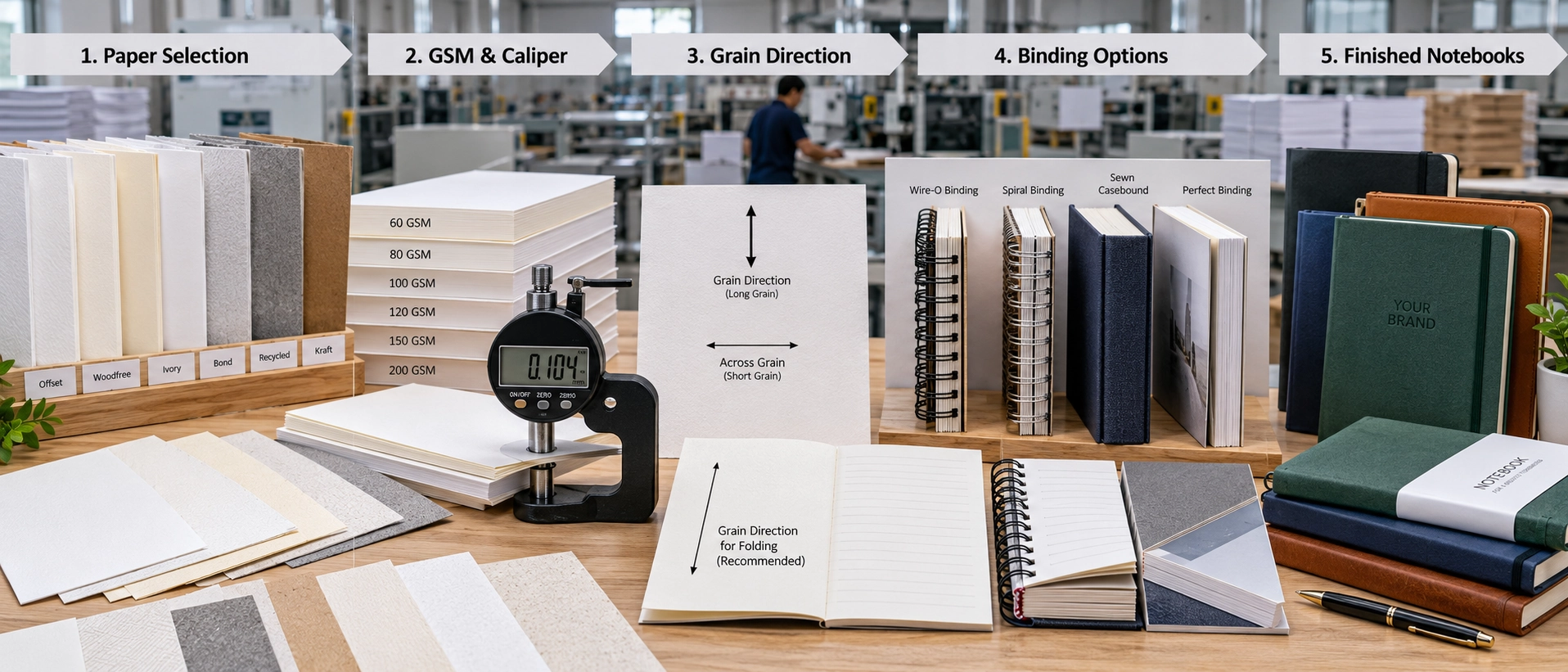
Grammage alone cannot predict how a sheet of paper will perform during writing or commercial printing. We evaluate notebook printing paper through a matrix of grammage, caliper, opacity, smoothness, absorbency, and surface sizing. Grammage measures the physical mass of the sheet in grams per square meter rather than its actual thickness. Caliper measures the exact thickness of that sheet in micrometers. Two papers with identical grammage often show different calipers depending on how tightly the mill compresses their fibers.
| Application / Specification | Recommended Standard / Metric | Functional Impact on Project |
| Notebooks and novels | 70–90 g/m2 | Provides standard opacity and handling for readable text blocks. |
| Thin flyers, menus, and posters | 120–150 g/m2 | Delivers moderate stiffness without requiring heavy card scoring. |
| Magazine covers and premium flyers | 200–300 g/m2 | Resists edge curling and protects interior text pages from wear. |
| Greeting cards and postcards | 350–450 g/m2 | Ensures rigid structural durability for standalone handling and mailing. |
| Comic book interiors | 80# matte text | Balances vibrant image reproduction with minimal page glare. |
| Children's book pages | 100# gloss text | Maximizes full-color ink holdout and resists tearing from frequent handling. |
| Bookbinding grain alignment | Short grain cut | Keeps fiber direction parallel to the spine to prevent buckling along folds. |
| Ruled template borders | 0.3 mm width | Renders precise layout guidelines without distracting from handwritten text. |
To set a baseline for commercial materials, 35–55 g/m2 represents the typical weight for newspapers. Moving up the scale, 90–100 g/m2 serves as the typical weight for recreational office/home printers. Paper grain direction determines how the sheet folds and acts under mechanical stress during the binding process. Surface sizing involves adding starches or synthetic polymers to the paper surface to control water absorption. This sizing chemistry dictates whether liquid ink sits on the surface to dry or bleeds rapidly into the raw wood fibers. Smoothness affects how evenly ink moves from a printing blanket or pen nib onto the page. This step requires a careful balance between surface grip and clean ink holdout.
Balancing weight and cost of notebook pages
Selecting interior pages requires balancing writing performance against finished product weight and total production cost. Increasing paper thickness improves the perceived quality of the notebook. However, it directly increases shipping expenses and binding complexity. The 70–90 g/m2 range serves as the typical weight for notebooks and novels. Many premium journals use uncoated papers to provide a tactile drag that users link to high-quality writing. For custom projects, 70 lb. is a common uncoated paper weight used for personalized notebooks.
Planners demand slightly higher caliper to prevent daily entries from showing through on the other side of the page. Standard notebooks can operate at lower grammages to keep unit costs low for bulk retail sales. Heavyweight paper reduces the total number of pages you can fit inside a standard wire coil or glued spine. Buyers must calculate the total shipping weight of the finished product early in the sourcing process to avoid unexpected freight surcharges. Opting for a high-bulk paper allows brands to keep a thick spine without adding extra mass to the shipping box.
Fountain Pen Compatibility: Evaluating Bleed, Feathering, and Ghosting
Checking fountain pen compatibility requires destructive physical tests using multiple ink formulas and nib sizes. Supplier claims about ink resistance require independent checks under real writing conditions before starting mass production. Feathering occurs when ink spreads sideways along the paper fibers, creating rough edges around letters instead of crisp lines. Bleed-through happens when ink penetrates the entire thickness of the sheet and permanently stains the page below it. Ghosting refers to the visibility of writing on the back of the page, even if no ink has soaked through the sheet.
Surface sizing controls the ink absorption rate. This treatment increases drying time but prevents ink from spreading sideways across the page. Evaluating production samples demands a systematic approach to find weak points in the paper chemistry.
Feathering resistance requires lines to retain sharp edges when tested with wet-flowing inks and broad nibs.
Bleed-through prevention demands that ink must not physically transfer to the reverse side of the sheet under heavy application.
Ghosting tolerance dictates that writing on the front should not interfere with reading the blank grid on the back.
Drying time evaluation ensures ink dries within roughly 15 seconds to prevent smudging during rapid page turning.
Surface drag assessment verifies the pen nib experiences slight resistance without catching on loose surface fibers.
Paper dust generation must remain minimal, as the surface must not shed fibers that can clog precision writing instruments.
Printing Requirements for Custom Notebook Pages
The physical requirements for optimal writing paper conflict directly with the needs of high-precision commercial printing. Writing paper needs a slightly porous surface to absorb liquid ink. Printing paper requires a sealed surface to keep halftone dots sharp. Custom notebook pages often feature printed grids, dots, or ruled lines that require precise alignment across the entire press run. The standard 0.3mm border width for ruled paper templates demands tight control over sheet movement through the press.
Absorbent paper causes printing ink to spread on contact. This spread can blur fine lines and reduce the clarity of full-color interior illustrations. Consider choosing a light surface sizing that balances printing dot retention with writing ink absorption. Uncoated papers need specific prepress print profiles that limit total ink coverage to prevent paper soaking and sheet warping. Commercial printers must adjust their press dampening systems to match the higher water absorption rates typical of premium writing stocks.
Paper Opacity Standards for Double-Sided Printing
Double-sided notebook designs require paper with high opacity. This density keeps printed grids and written notes from showing through to the other side. Identical grammage papers can show very different light transmission rates based on their mineral fillers and smoothing treatments. Opacity relies entirely on light scattering within the inner paper structure. Manufacturers increase opacity by adding fillers like titanium dioxide or calcium carbonate. These minerals scatter light much better than raw cellulose fibers.
Heavy calendering presses the sheet and increases surface smoothness. However, this process forces fibers closer together and reduces the internal air pockets that scatter light. So, a highly calendered smooth paper will consistently show lower opacity than a rougher paper of the exact same weight. We advise setting a minimum opacity threshold between 88% and 93% for any notebook intended for two-sided use. Evaluating opacity requires viewing the printed sample under standard D50 daylight lamps rather than variable office lighting.
Material Specifications for Notebook Components (YPS Examples)
A premium custom notebook requires different material specs for each part based on its main mechanical job. Using a single heavy paper stock across all parts makes a stiff product that resists natural opening. To give context for commercial thickness baselines, 120–150 g/m2 is the typical weight for thin flyers, menus, and movie posters. The 200–300 g/m2 range serves as the typical weight for magazine covers and high-quality flyers. For rigid structural parts, 350–450 g/m2 represents the typical weight for greeting cards, business cards, and postcards.
The cover needs flexibility and durability. The interior needs writeability. The internal dividers demand structural stiffness. We use documented specs from YPS Binding to show functional material allocation in commercial manufacturing.
| Notebook Component | YPS Material Example | Primary Function | Key Material Requirement |
| Interior Pages | 98–100gsm smooth writing paper | Daily writing and reading | High opacity and moderate ink absorbency |
| Soft Cover | 157gsm matte-coated cover paper | Protection and branding | Flexibility and vibrant color reproduction |
| Storage Pocket | 200gsm pocket paper | Document retention | Tear resistance and folding endurance |
| Section Dividers | 250gsm uncoated divider paper | Structural separation | High stiffness and die-cutting stability |
Notebook Construction: How Paper Dictates Binding
The physical dimensions and grain direction of your chosen paper dictate which binding methods will work for the finished notebook. Incorrect grain direction causes stiff pages that refuse to lay flat. It also creates permanent wrinkles along glued spines. Community consensus suggests short grain is preferred for bookbinding to ensure the grain runs parallel to the spine, while most standard printer paper is long grain. In commercial B2B orders, buyers must explicitly state that the grain direction runs parallel to the spine to protect product strength.
Standard dimensions provide a baseline for calculating optimal sheet yield on a press. The 8.5" x 11" dimension represents the standard US Letter paper size. The 21cm x 29.7cm dimension represents the European A4 paper size. For domestic prototyping, the 8.5" x 14" (Legal size) sheet is recommended by community members as a source for cutting to create short-grain paper for home printing. Thick paper requires larger twin-wire loops or plastic spirals so the pages turn freely without catching on the wire. High page counts paired with thick paper will quickly exceed the physical limits of standard saddle stitching machines.
Cost Comparison of Offset Versus Digital Paper
The choice between offset and digital printing alters both the acceptable paper specs and the unit costs of notebook production. Offset printing handles large volumes well, but it puts severe mechanical strain on the paper surface during the run. The offset printing speed for standard 2-sided paper reaches 240,000 sheets per hour. In contrast, digital printing speed operates closer to 7,200 pages per hour. The fast speed and sticky inks of offset presses require paper with high tensile strength to prevent web breaks.
Offset paper must also show low surface linting. Loose fibers will dirty the printing plates and degrade image quality over time. Digital printing uses toners or liquid inks that need specific moisture levels and electrical resistance to transfer cleanly. Digital presses offer low costs for short runs. However, they restrict buyers to certified paper lists, which limits custom material options for niche stationery brands. Heat from digital fusing units can also curl lightweight papers. This risk requires careful humidity control inside the production plant.
Application-Based Paper Selection Framework
Different retail uses require specific paper profiles that favor visual reproduction, tactile feel, or mechanical strength. These baseline recommendations serve as starting points for physical sampling. They are not universal manufacturing rules for every single project. For specialized publications, 80# matte text is the recommended paper for comic books to prevent glare. Conversely, 100# gloss text serves as the recommended paper for children's books to maximize illustration vibrancy.
Premium journals favor uncoated textures that pair well with pencil and liquid inks without smearing. Student notebooks need durable, lightweight paper that keeps the product light enough for daily backpack carry. Corporate gifts often pair smooth writing surfaces with higher grammages to show quality through physical weight and firmness. Sketchbooks require heavy surface sizing. This sizing allows the sheet to survive repeated erasing and light watercolor washes without paper breakdown.
| Notebook Application | Recommended Paper Type | Suggested GSM Range | Priority Performance Metric |
| Premium Journal | Uncoated smooth text | 90–120 g/m2 | Fountain pen compatibility |
| Student Notebook | Uncoated standard text | 70–80 g/m2 | Low unit cost and low weight |
| Corporate Gift | Matte coated or premium uncoated | 100–120 g/m2 | High opacity and brand perception |
| Custom Planner | Uncoated opaque text | 100–140 g/m2 | Minimal ghosting for double-sided use |
| Sketchbook | Vellum or textured drawing | 120–160 g/m2 | Erasure tolerance and tooth |
Quality Verification: Evaluating Physical Production Samples
Buyers must set up a standard inspection process to verify that production samples match the agreed material specs. Relying only on digital proofs or supplier spec sheets introduces unacceptable risk into large manufacturing runs. Consider requesting blank paper dummies alongside printed press proofs. This step lets you check both structural mechanics and visual reproduction.
Measure sheet caliper using a digital micrometer across multiple pages to verify thickness consistency throughout the text block.
Perform destructive ink tests using standard office pens, high-flow rollerballs, and fountain pens to verify sizing performance.
Inspect the trimmed edges of the text block for fiber tear, which indicates dull cutting blades or inappropriate paper density.
Evaluate punch-hole cleanliness on spiral-bound samples to ensure the paper cuts cleanly without fraying around the wire.
Compare the opacity of printed grids against the approved baseline under standardized D50 lighting conditions to ensure text remains legible.
Purchasing Checklist and RFQ Preparation
A clear Request for Quotation prevents supplier misunderstandings. It also ensures all competing plants bid on identical material specs. Matching paper choices with final notebook dimensions and prepress services keeps production on schedule and avoids costly late revisions. The market supports various standard formats, with 8.5" x 3.5", 5.5" x 4.25", 8.5" x 5.5", 11" x 8.5" representing widely available notebook sizes. Turnaround time for personalized notebook printing frequently averages 3 business days after the client approves the final production proof.
Prepress services often carry extra fees that buyers should clarify during the initial RFQ stage. The fee for Manual File Review service typically runs $9.90 per document. For clients requiring structural design assistance, the starting price for Layout Service is generally $39.90. Buyers must state the exact paper grade, grammage, finish, and opacity targets before asking for bulk price tiers.
Paper specifications: List exact grammage, caliper, and surface finish requirements for both the cover and interior pages.
Notebook dimensions: Specify the final trimmed size, total sheet count, and page count.
Binding method: Define whether the project requires wire-o, plastic spiral, case binding, or saddle stitching.
Printing requirements: Detail the line colors, grid spacing, bleed margins, and specific Pantone color matches.
Sampling terms: Establish the cost and delivery timeline for physical production proofs before full manufacturing begins.
Order quantities: Request tiered pricing structures for different volume thresholds to calculate optimal inventory levels.
Frequently Asked Questions
Procurement managers and independent creators often run into similar technical questions about paper compatibility and sheet formatting. We address the most common operational questions about notebook sourcing and material performance below.