

Spiral Binding vs Wire-O Binding: How to Choose the Right Binding
Leave a message
When comparing spiral binding vs wire-o binding, many buyers are not simply asking which one looks better. They are trying to choose the right binding method for a real product, such as a notebook, calendar, manual, cookbook, planner, or children's book.
Both binding methods can help pages lay flat and turn smoothly, but they are different in material, appearance, specification, application, and production requirements. Spiral binding usually uses a plastic coil, while wire-o binding uses metal double loop wire. Choosing the wrong option may affect not only the finished look, but also page turning, machine compatibility, binding efficiency, packing stability, and bulk production quality.
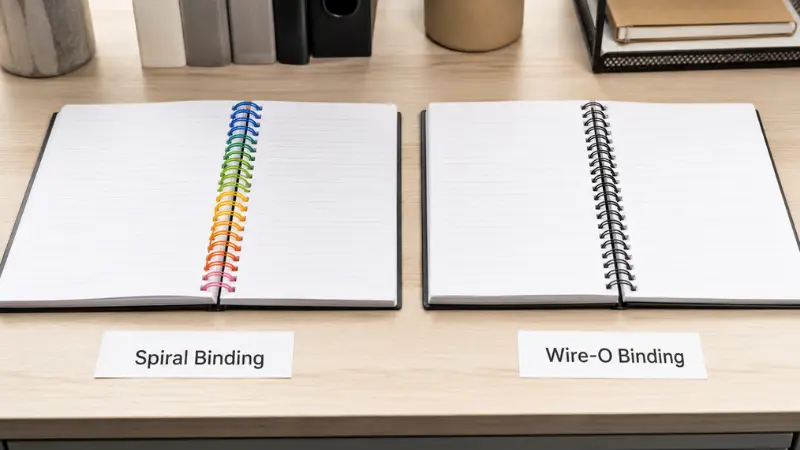
This guide explains the key differences between spiral binding and wire-o binding from a practical buyer's perspective. You will learn how they work, where each binding method is best used, how page count and book thickness affect binding size, what to consider for bulk production, and what to confirm before ordering binding supplies.
Spiral Binding and Wire-O Binding: Key Differences at a Glance
Although spiral binding and wire-o binding can both help books lay flat and turn pages smoothly, they are different in material, appearance, application, and production requirements. The table below gives a quick comparison for buyers who need to choose the right binding option for notebooks, calendars, manuals, planners, or other printed products.

| Comparison Point | Spiral Binding | Wire-O Binding |
|---|---|---|
| Binding material | Plastic coil / spiral coil | Metal double loop wire / wire-o binding wire |
| Appearance | Flexible, practical, and casual | Clean, professional, and premium |
| Page turning | Supports easy 360-degree page rotation | Supports smooth 360-degree page rotation |
| Lay-flat ability | Good lay-flat performance | Good lay-flat performance with neat page alignment |
| Durability | Strong for frequent use and repeated handling | Durable, but the wire may bend if pressed or packed improperly |
| Best for | Manuals, cookbooks, children's books, workbooks, training materials | Notebooks, calendars, planners, reports, catalogs, premium stationery |
| Custom options | Coil color, diameter, pitch, material, and length | Wire color, size, pitch, loop count, coating, and packing |
| Common buyer | Print shops, schools, manual producers, educational publishers | Notebook factories, calendar manufacturers, stationery brands, commercial printers |
| Production consideration | Suitable for flexible use, small runs, and frequent-handling products | Better for neat presentation, automatic production, and premium product lines |
As a general rule, choose spiral binding when the product needs flexibility, frequent use, and practical handling. Choose wire-o binding when the product needs a cleaner spine, better shelf appeal, or a more professional presentation.
For buyers comparing materials, the next step is usually to look at the specific binding supply: plastic spiral binding coil for spiral binding, or double loop wire for wire-o binding.
What Is Spiral Binding?
Spiral binding is a practical binding method that uses a continuous plastic coil to hold pages together. It is commonly used for printed products that need frequent page turning, flexible handling, and reliable lay-flat performance. For buyers, the key is not only understanding how spiral binding works, but also knowing how the coil material, diameter, color, and quality affect the final product.

How Spiral Binding Works?
In spiral binding, a row of holes is punched along the edge of the printed pages. A plastic coil is then inserted through these holes and formed into a continuous spiral spine. This coil works like a flexible spring, keeping the pages together while allowing them to turn smoothly.
One major advantage of spiral binding is that pages can lay flat and rotate nearly 360 degrees. This makes it useful for products that need to stay open during use, such as training manuals, cookbooks, instruction books, and workbooks.
For example, a cookbook may need to stay open on a kitchen counter, while a training manual may be used repeatedly in a workshop or classroom. In these cases, spiral coil binding provides practical handling and good page movement without making the book difficult to use.
Common Materials Used in Spiral Binding
The most common material for spiral binding is plastic coil. For B2B buyers, the material choice affects flexibility, color consistency, surface smoothness, diameter stability, cost, and export requirements.

| Material | Buyer Concern | Suitable Use |
|---|---|---|
| PVC plastic coil | Cost, color options, flexibility, general availability | Manuals, workbooks, notebooks, training materials |
| PET plastic coil | Stability, appearance, and possible environmental requirements | Educational products, branded stationery, export orders |
PVC plastic coil is widely used because it is cost-friendly, flexible, and available in many colors. It is a common option for manuals, workbooks, notebooks, and other frequently used printed products.
PET plastic coil can be considered when buyers need a more stable or specific material option, especially for export orders or projects with clearer material requirements. However, buyers should avoid choosing material based only on name. It is better to confirm actual samples, coil flexibility, surface finish, color consistency, and diameter tolerance before bulk production.
If you are sourcing from a plastic spiral binding coil supplier, it is helpful to confirm whether you need standard colors, custom colors, or Pantone color matching before placing an order.
Best Applications for Spiral Binding
Spiral binding is best suited for products that are handled frequently, opened repeatedly, or used in practical working environments. It is not only about appearance; it is about how the product will be used after production.
| Application | Why Spiral Binding Works Well |
|---|---|
| Manuals | Pages can lay flat and turn easily during repeated use |
| Cookbooks | The book can stay open while users follow recipes |
| Children's books | Plastic coil offers flexibility and color options |
| Training materials | Suitable for classroom, workshop, and repeated reference use |
| Workbooks / instruction books | Easy page turning and comfortable writing experience |
For manual binding, spiral coil is useful because users often need to keep the book open while reading instructions or operating equipment. For cookbook binding, the ability to lay flat is especially important because users may need to follow a recipe hands-free.
For children's book binding and educational materials, spiral binding can also be a practical option because of its flexibility and color choices. However, buyers should pay attention to material quality, smoothness, coil ends, and color stability, especially when the product is designed for frequent handling.
Spiral binding is also suitable for workbooks, training guides, instruction books, and other products that need to balance durability, usability, and cost.
Advantages and Limitations of Spiral Binding
Spiral binding has several clear advantages for practical-use printed products. It is flexible, durable for frequent handling, and allows smooth page turning. It also offers many color options, making it useful for branded materials, educational products, and custom stationery projects. For thicker documents, spiral binding can also be a good choice when the correct coil diameter is selected.
However, spiral binding is not the best option for every project. Compared with wire-o binding, it usually gives a more casual appearance and may not provide the same premium spine presentation for high-end notebooks, planners, or calendars.
Buyers should also pay attention to coil quality. Low-quality plastic coils may deform, show unstable colors, have rough surfaces, or lose shape during packing and transportation. A common mistake is choosing a coil only by price while ignoring diameter stability, color consistency, and surface smoothness.
If you are not sure which coil size or material is suitable, ask for a size or material recommendation before bulk production. Sharing your application, page count, paper thickness, color requirement, and order quantity can help the supplier recommend a better option.
What Is Wire-O Binding?
Wire-O binding is a binding method that uses metal double loop wire to hold punched pages together. It is widely used for printed products that need a clean spine, neat page alignment, and a more professional appearance. Compared with spiral binding, wire-o binding is often chosen for notebooks, calendars, planners, reports, and premium stationery products.

For buyers, understanding wire-o binding is not only about knowing how it looks. It is also important to confirm the correct wire size, pitch, loop count, coating, color, packing method, and machine compatibility before production.
How Wire-O Binding Works?
In wire-o binding, printed pages are first punched along one edge. A piece of double loop wire is then inserted through the punched holes. After insertion, the wire is closed by a binding machine, forming a neat round spine that holds the pages together.
Depending on the machine and product design, wire-o binding may use round holes or square holes. The finished book can lay flat and turn pages smoothly, while keeping a cleaner and more structured appearance than many flexible binding methods.
This is why wire-o binding wire is often used for products where presentation matters, such as notebooks, planners, calendars, business reports, catalogs, and branded stationery.
Wire-O, Double Loop Wire and Twin Loop Wire: Are They the Same?
In the binding industry, the terms wire-o, double loop wire, and twin loop wire are often used in closely related ways, but buyers should understand the difference in how these terms are used.
Wire-O usually refers to the binding method or finished binding style. It describes the look and function of a book bound with metal wire loops.
Double loop wire and twin loop wire usually refer more directly to the binding material itself. They describe the metal wire element that passes through the punched holes and is closed to form the book spine.
In many purchasing conversations, these terms may point to the same type of wire binding system. However, buyers should not confirm an order based on the name alone. The actual product must be confirmed by specification.
When ordering wire-o binding wire, confirm:
- Pitch, such as 2:1 or 3:1
- Wire size or loop size
- Wire diameter
- Loop count or book length
- Wire color and coating
- Packing method, such as spool, pre-cut wire, or boxed packing
- Machine compatibility
A common issue in B2B orders is that the buyer and supplier use similar terms but refer to different specifications. To avoid this, always provide the application, page thickness, punch pattern, and required finished book size before bulk production.
2:1 Pitch vs 3:1 Pitch
One of the most important specifications in wire-o binding is pitch. Pitch refers to the number of punched holes per inch along the binding edge. The two common options are 2:1 pitch and 3:1 pitch.
| Pitch Type | General Meaning | Common Use |
|---|---|---|
| 3:1 pitch wire-o binding | More holes per inch | Usually used for thinner books and documents |
| 2:1 pitch wire-o binding | Fewer holes per inch | Usually used for thicker books and documents |
In general, 3:1 pitch wire-o binding is often used for thinner notebooks, reports, planners, and presentation documents. Because there are more holes per inch, it can create a neat appearance for lighter products.

2:1 pitch wire-o binding is often used for thicker books or products with heavier paper. Since there are fewer holes per inch, it can better support larger wire sizes for thicker book blocks.
However, buyers should not choose pitch only by page count. The correct pitch also depends on page thickness, cover thickness, paper weight, binding size, and the hole pattern of the punching machine. A book with fewer pages but thick paper may require a different binding choice than a book with more pages but thin paper.
A common mistake is ordering 3:1 wire while the punching machine uses a 2:1 punch pattern. Even if the wire size looks correct, the product cannot be bound properly if the pitch does not match the punched holes. Before ordering bulk wire-o binding supplies, confirm both the wire specification and the machine punching pattern.
Best Applications for Wire-O Binding
Wire-O binding is often used when the final product needs a clean, professional, and premium appearance. It is especially suitable for printed products where the spine is part of the product presentation.
| Application | Why Wire-O Binding Works Well |
|---|---|
| Notebooks | Clean spine, neat page alignment, and strong brand presentation |
| Calendars | Works well with calendar hangers for wall and desk calendars |
| Planners | Premium look and smooth page turning |
| Reports / presentations | Professional appearance for business use |
| Premium stationery | Better shelf appeal and a more polished finish |
For notebook binding, wire-o binding is a strong option when the product needs a more refined look, especially for branded notebooks, planners, journals, and retail stationery.
For calendar binding, wire-o is commonly used together with a calendar hanger, especially for wall calendars. This combination helps the calendar turn pages smoothly while also allowing it to hang properly.
For planners, reports, catalogs, and presentation materials, wire-o binding gives a cleaner spine and a more professional finish. The metal wire also helps improve the perceived value of the finished product, especially when the color and coating match the product design.
Advantages and Limitations of Wire-O Binding
The main advantage of wire-o binding is its professional appearance. It provides clean page alignment, good lay-flat performance, and a polished spine, making it suitable for premium notebooks, calendars, planners, reports, and branded stationery products.
Wire-O binding also supports smooth page turning and can create a strong visual impression for retail or business use. With custom wire colors and coatings, it can match different product designs and brand requirements.
However, wire-o binding also has limitations. Metal wire can bend if it is pressed, packed, or transported improperly. For bulk orders, packing quality is important to reduce deformation during shipping. Buyers should also confirm the correct pitch, wire size, loop count, and machine compatibility before production.
Another common mistake is choosing wire only by size while ignoring the punch pattern. If the pitch does not match the punching machine, the binding process will not work correctly. Thick books also require careful selection of pitch and wire size, because the wrong specification can affect page turning and spine appearance.
If you are unsure which wire specification is suitable, send your page thickness, book size, pitch requirement, and machine type before ordering. A supplier can then recommend a more suitable double loop wire option for your project.
Spiral Binding vs Wire-O Binding by Application
The best choice between spiral binding and wire-o binding often depends on the final product. A notebook, calendar, manual, children's book, and cookbook may all need different binding performance. Buyers should consider not only appearance, but also page turning, writing comfort, hanging requirements, user age, product positioning, and production cost.

| Application | Recommended Binding | Main Reason |
|---|---|---|
| Premium notebooks / planners | Wire-O binding | Clean spine, neat alignment, and better brand presentation |
| School exercise books | Spiral binding or wire-o binding | Depends on budget, durability, and target market |
| Wall calendars | Wire-O binding with calendar hanger | Better hanging function and professional appearance |
| Manuals / training materials | Spiral binding | Good for frequent use and lay-flat reading |
| Children's books | Plastic spiral binding | Flexible handling and color options |
| Cookbooks / workbooks | Spiral binding | Easy page turning and practical lay-flat use |
For Notebooks
For notebook binding, wire-o binding is often a strong choice for premium notebooks, planners, journals, and branded stationery. The metal double loop wire creates a clean spine, neat page alignment, and a more polished appearance, which can help improve the perceived value of the final product.
However, spiral binding can also be suitable for some notebooks, especially school exercise books, workbooks, or products designed for frequent daily use. A spiral notebook binding may offer more flexibility and easier handling, while a wire-o notebook binding may look more refined for retail or corporate stationery.
The right choice depends on the notebook's market position, target users, budget, writing experience, page count, and expected use frequency. For example, a premium planner for a stationery brand may be better with wire-o binding, while a student workbook that will be opened and folded repeatedly may work well with plastic spiral coil.
For Calendars
For calendar binding, wire-o binding is usually the more common professional option, especially when the product needs to hang on a wall or maintain a clean display appearance. A typical wall calendar often uses wire-o binding together with a calendar hanger, allowing the pages to turn smoothly while the calendar hangs properly.
For desk calendars, wire-o binding can also provide a neat spine and good page alignment. The metal wire gives the calendar a more structured look, which is important for branded, promotional, or retail calendar products.
Spiral binding may be used for some flip-style calendars, but the appearance and hanging method will be different. Buyers should confirm the calendar format before choosing the binding method.
Before ordering wire-o calendar binding supplies, it is helpful to confirm:
- Calendar width
- Wire size and pitch
- Wire color
- Calendar hanger size
- Wall calendar or desk calendar format
- Packing method for bulk shipping
For Manuals and Training Materials
For manual binding and training materials, spiral binding is often the practical choice. Manuals are usually opened, folded, referenced, and handled many times during use. They may be used in factories, classrooms, kitchens, workshops, training centers, or field service environments.
In these situations, the binding needs to support frequent page turning and comfortable lay-flat reading. Plastic spiral coil is flexible and allows users to keep the book open on a desk or workbench while reading instructions or following steps.
For example, an equipment manual may need to stay open beside a machine, while a training workbook may need to be used repeatedly during lessons. In both cases, spiral coil binding can provide practical handling and reliable usability.
For Children's Books and Educational Materials
For children's book binding and educational materials, plastic spiral binding can be a practical option because it offers flexibility, color variety, and easy page turning. These products are often handled frequently, opened widely, and used in classrooms, homes, or learning centers.
However, buyers should be careful not to choose only by color or price. For children's products, it is important to check the coil surface, coil ends, material stability, color consistency, and resistance to deformation. A bright color may look attractive, but poor material quality can affect the product's appearance and user experience after repeated handling.
A common mistake is focusing on color matching while ignoring the smoothness and shape stability of the coil. If the product is designed for children or educational use, sample confirmation before bulk production is especially important.
For Cookbooks and Workbooks
For cookbook binding and workbook binding, spiral binding is often a suitable choice because these products need to stay open during use. A cookbook may need to lie flat on a kitchen counter while the user follows a recipe, while a workbook may need to stay open for writing, exercises, or classroom activities.
Spiral binding supports frequent page turning and practical lay-flat use, making it a good fit for hands-on reading and writing situations. It is especially useful when the product is expected to be opened, folded back, or used repeatedly.
Wire-o binding can also be used for some premium workbooks or branded educational products, but buyers should consider cost, wire deformation risk, and the required presentation style. For practical daily-use books, plastic spiral coil is often easier to handle and more forgiving in repeated-use environments.
After choosing the best binding style by application, the next step is to select the correct size. Page count alone is not enough; paper thickness, cover material, and binding diameter all affect the final result.
How to Choose the Right Binding Based on Page Count and Thickness?
After choosing between spiral binding and wire-o binding, the next step is selecting the correct binding size. For B2B buyers, this is where many ordering mistakes happen. Page count matters, but it is not the only factor. Paper thickness, cover material, coating, inserts, and binding style can all affect the final book thickness and the required coil diameter or wire size.

Why Page Count Alone Is Not Enough?
When choosing a binding size, many buyers start with page count. This is useful, but it is not enough. Two books with the same number of pages may have very different spine thicknesses if they use different paper weights, covers, or finishing methods.
For example, a 200-page manual printed on thin paper may require a smaller binding size than a 200-page product catalog printed on thick coated paper. If the catalog also has a laminated cover, divider pages, or insert sheets, the final book thickness will increase even more.
That is why buyers should not choose coil diameter or wire size based only on the number of pages. The better approach is to measure the actual book thickness or provide a physical sample when possible.
Before confirming the binding size, check:
- Page count
- Paper weight and thickness
- Cover and back cover thickness
- Lamination or coating
- Inserts, dividers, or tabs
- Required page-turning space
- Finished book thickness
This helps avoid common problems such as tight page turning, loose binding, or an uneven spine.
How to Choose Plastic Coil Diameter?
For spiral binding, plastic coil diameter should be selected based on the actual thickness of the book block, not only the page count. A thicker book usually needs a larger coil diameter, while a thinner book needs a smaller coil to keep the spine neat and easy to handle.
The coil should allow pages to turn smoothly without feeling too tight. If the coil is too small, the pages may not turn easily, and the book may feel difficult to open. If the coil is too large, the spine may look loose, oversized, or less professional.
When choosing plastic coil diameter, buyers should consider:
- Actual book thickness
- Paper type and paper weight
- Cover and back cover thickness
- Required page-turning flexibility
- Coil material and flexibility
- Coil color and finish
- Pitch and hole pattern
- Order quantity and packing method
Color and material can also affect the final product experience. For example, a flexible coil may be better for books that are opened frequently, while color consistency is important for branded stationery or educational products.
For bulk orders, it is better to confirm a sample before mass production. A sample can help check whether the plastic spiral binding coil size, color, flexibility, and page-turning performance are suitable for the final product.
How to Choose Wire-O Size?
For wire-o binding, choosing the correct wire-o size requires checking both the book thickness and the binding system. Buyers should confirm whether the project uses 2:1 pitch or 3:1 pitch, because the pitch must match the punched holes and the binding machine.
In general, wire-o size selection should consider:
- 2:1 or 3:1 pitch
- Actual book thickness
- Wire diameter or loop size
- Page count and paper weight
- Cover thickness
- Hole shape and hole spacing
- Binding machine compatibility
- Required spine appearance
The wire size should provide enough space for smooth page turning while keeping the book spine neat. If the wire is too small, pages may turn poorly or press tightly against the spine. If the wire is too large, the finished book may look loose and less refined.
Machine compatibility is especially important for bulk production. A buyer may choose the correct wire size, but if the pitch does not match the punching pattern, the wire cannot be used properly. For example, double loop wire made for 3:1 pitch will not work with pages punched for a 2:1 system.
Before placing a bulk order, confirm the finished book thickness, pitch, wire size, loop count, and machine type with your supplier.
Common Mistakes When Choosing Binding Size
Choosing the wrong binding size can affect page turning, appearance, production efficiency, and shipping quality. Most problems can be avoided if buyers check the real book thickness, pitch, and packing requirements before ordering.
Common mistakes include:
- Choosing a coil that is too small
This can make the pages difficult to turn and may cause the book to feel tight when opened. - Choosing a coil that is too large
This may make the spine look loose, bulky, or less professional. - Ignoring wire-o pitch
A wire may look correct in size, but it cannot be used if the wire-o pitch does not match the punching machine. - Checking sample color but not bulk color consistency
For custom colors, buyers should confirm sample approval and bulk production consistency. - Ignoring packing requirements
Poor packing may cause plastic coils to deform or metal wire to bend during transportation. - Not confirming machine compatibility
The binding supply must match the punching pattern, hole shape, binding machine, and production process.
Before ordering, it is helpful to send your sample, book thickness, page count, paper type, pitch requirement, and machine information to the supplier. This allows the supplier to recommend a more suitable binding size and reduce the risk of production problems.
Once the correct size is clear, the next factor to consider is production method. Manual binding, small-batch orders, automatic notebook production, and OEM projects may require different binding supply formats and packing options.
Which Binding Is Better for Bulk Production?
For bulk production, the better binding choice is not only about appearance or durability. Buyers also need to consider production method, machine compatibility, packing format, order quantity, and custom requirements. A binding option that works well for small manual production may not be the best choice for automatic notebook or calendar production.

For Manual or Small-Batch Binding
For manual or small-batch binding, buyers usually care more about flexible operation, available sizes, easy handling, and color options. This type of production is common for print shops, schools, training centers, and short-run projects.
For example, a small print shop producing training manuals may choose standard plastic coil sizes because they are easy to handle and suitable for frequent-use documents. For smaller wire-o projects, pre-cut wire can also be convenient because it is easier to manage during manual or semi-manual binding.
In small-batch binding, the focus is usually not on maximum production speed. Instead, buyers should confirm whether the binding supply is easy to use, available in the required color, suitable for the book thickness, and compatible with the punching pattern.
For Automatic Notebook or Calendar Production
For automatic notebook production and calendar production, binding choice becomes more technical. The material must match the machine, the punching pattern, the required speed, and the final product format. A small mismatch in pitch, wire size, coil diameter, or hole spacing can slow down production or cause binding failures.
For wire-o production, buyers should confirm whether they need wire in spool packing, pre-cut wire, or another packing format. Spool packing is often used for continuous or automatic production, while pre-cut wire may be more suitable for certain semi-automatic or manual workflows. The right choice depends on the binding machine and production process.
Important factors include:
- Machine hole pattern and pitch
- Wire size, wire diameter, and loop count
- Plastic coil diameter and pitch
- Punching accuracy
- Wire forming and closing stability
- Spool packing or pre-cut wire format
- Calendar hanger size for wall calendars
- Finished notebook or calendar width
- Production speed and waste control
For calendar production, the buyer may also need to match wire-o binding with a calendar hanger. The hanger size, wire color, calendar width, and packing method should be confirmed together, not separately.
A common mistake is ordering the right-looking binding material without confirming machine compatibility. For example, if the wire pitch does not match the punching machine, the production line may stop even though the wire size itself seems correct. For automatic production, buyers should always check the binding supply together with the punching machine, binding machine, and finished product specification.
For OEM and Custom Orders
For OEM and custom orders, the binding choice should be confirmed together with product positioning, brand requirements, packaging, and production schedule. Buyers are not only purchasing spiral coil or double loop wire; they are purchasing a binding solution that must match the finished product and the target market.
Common custom requirements include:
- Custom color or Pantone color matching
- Custom packaging
- Specific coil diameter or wire size
- 2:1 or 3:1 pitch
- Material requirements
- MOQ
- Sample confirmation before bulk production
- Lead time
- Destination market requirements
- Bulk order consistency
For branded stationery, planners, notebooks, children's books, or calendars, color consistency is especially important. A sample may look acceptable, but the buyer should also confirm whether the bulk order can maintain the same color, surface finish, shape, and packing quality.
For custom binding supplies or OEM binding supplies, avoid confirming an order with only a product name. Instead, provide the application, book size, page thickness, pitch, color requirement, packing method, quantity, and machine information. This helps the supplier recommend a suitable option and reduces the risk of production delays.
Before bulk production, request a sample or pre-production confirmation whenever possible. This is especially important for custom colors, new product sizes, export orders, or automatic production projects.
Buying Checklist: What to Confirm Before Ordering Binding Supplies
Before ordering binding supplies, buyers should confirm the key specifications that affect product appearance, binding performance, machine compatibility, and bulk production quality. Whether you are sourcing plastic spiral coil or double loop wire, a clear specification can help the supplier recommend the right option and reduce the risk of production mistakes.
Use the checklist below before requesting a quote.
| Item to Confirm | Why It Matters |
|---|---|
| Binding type | Confirm whether you need spiral binding, wire-o binding, plastic coil, or double loop wire. |
| Application | A notebook, calendar, manual, planner, children's book, or cookbook may require different binding performance. |
| Size / diameter / wire size | The correct coil diameter or wire size affects page turning, spine appearance, and usability. |
| Pitch | Pitch must match the punched holes and the binding machine, such as 2:1, 3:1, or other coil pitch options. |
| Page count and paper thickness | Page count alone is not enough; paper weight, cover thickness, and inserts affect the final book thickness. |
| Color / Pantone number | Custom colors should be confirmed by sample or Pantone number to improve bulk order consistency. |
| Material | Confirm PVC, PET, nylon-coated wire, metal wire, or other material requirements according to the product and market. |
| Packing method | Spool, pre-cut wire, boxed packing, or carton packing can affect production efficiency and shipping protection. |
| Machine compatibility | Binding supplies must match the punching pattern, hole shape, pitch, and binding machine. |
| Quantity / MOQ | Quantity affects production planning, pricing, packing, and lead time. |
| Sample requirement | Samples help confirm size, color, flexibility, finish, and binding performance before bulk production. |
| Destination country / shipping preference | Export packaging, shipping method, and delivery schedule may affect the final order plan. |
For a faster and more accurate quotation, prepare as much information as possible before contacting the supplier. A useful inquiry usually includes the product application, finished book size, page count, book thickness, pitch, color, material, packing method, quantity, and machine type.
If you are not sure which specification to choose, send a sample photo, book thickness, or current binding supply details. The supplier can then help recommend a suitable plastic spiral binding coil or double loop wire based on your actual project.
To move from comparison to sourcing, you can request a quote for custom plastic spiral coil or double loop wire and confirm the sample before bulk production.
FAQ About Spiral Binding vs Wire-O Binding
1. Is spiral binding better than wire-o binding?
Spiral binding is not always better than wire-o binding. It depends on the application. Spiral binding is often better for manuals, cookbooks, workbooks, and training materials that need frequent page turning and flexible handling. Wire-o binding is often better for notebooks, calendars, planners, reports, and premium stationery that need a cleaner and more professional appearance.
2. Is wire-o binding the same as double loop wire binding?
Wire-o binding, double loop wire binding, and twin loop wire binding are closely related terms in the binding industry. Wire-O usually refers to the finished binding style, while double loop wire or twin loop wire usually refers to the metal wire material used for binding. When ordering, buyers should confirm the pitch, size, wire diameter, loop count, color, and packing method instead of relying only on the name.
3. Which binding is better for notebooks?
For premium notebooks, planners, journals, and branded stationery, wire-o binding is usually a better choice because it gives a cleaner spine and neater page alignment. For student notebooks, workbooks, or frequently used exercise books, spiral binding can also be suitable because it offers flexibility and easy page turning. The best choice depends on product positioning, budget, page count, and target users.
4. Which binding is better for calendars?
Wire-o binding is usually the preferred choice for calendars, especially wall calendars and desk calendars. Many calendar products use wire-o binding together with a calendar hanger so the pages can turn smoothly and the calendar can hang properly. Before ordering, buyers should confirm the calendar width, wire size, pitch, wire color, and hanger size.
5. What is the difference between 2:1 and 3:1 Wire-O binding?
The difference is the number of punched holes per inch. 3:1 pitch wire-o binding has more holes per inch and is usually used for thinner books. 2:1 pitch wire-o binding has fewer holes per inch and is usually used for thicker books. Buyers should also confirm the punching machine pattern, because the wire pitch must match the punched holes.
6. Can spiral binding and wire-o binding both lay flat?
Yes. Both spiral binding and wire-o binding can provide good lay-flat performance and smooth page turning. Spiral binding is often more flexible for frequent use, while wire-o binding provides a cleaner and more professional spine appearance. The better option depends on how the finished product will be used.
7. What information should I provide when ordering binding coils or wire-o?
When ordering binding coils or wire-o binding supplies, provide the application, finished book size, page count, book thickness, pitch, coil diameter or wire size, color, material, packing method, quantity, and machine type. If possible, send a sample photo or current binding specification to help the supplier recommend the right option.
8. Which binding is more durable for frequent use?
Spiral binding is often more suitable for frequent use because the plastic coil is flexible and supports repeated page turning. It is commonly used for manuals, cookbooks, workbooks, and training materials. Wire-o binding is also durable, but the metal wire may bend if it is pressed, packed, or transported improperly.
9. Can I customize the color of spiral coil or wire-o binding?
Yes. Spiral coil and wire-o binding wire can usually be customized in different colors. For branded products, buyers can provide a Pantone number or color sample for matching. Before bulk production, it is best to confirm a sample to check color consistency, surface finish, and overall appearance.
10. Which binding is better for automatic binding machines?
The better option depends on the machine type, punch pattern, pitch, book size, and production process. For automatic wire-o binding, buyers should confirm 2:1 or 3:1 pitch, wire size, loop count, and whether spool packing or pre-cut wire is required. For spiral binding, buyers should confirm coil diameter, pitch, material, and machine compatibility before production.


