How To Bind Thick Documents: Choose The Right Spine, Pitch And Punching Setup
Leave a message
Thick-document binding problems usually begin with one misleading number: page count. Two documents with the same number of pages can require different binding sizes because paper caliper, cover thickness, dividers, inserts and coatings change the finished book block.
The practical starting point is therefore not "How many pages do I have?" but "How thick is the complete compressed binding edge, and how must the finished document open?"
This guide explains how to bind thick documents using spiral coil or Wire-O, how to think about pitch and punching, and what to check before a long production run. For a broader introduction to coil construction, see YPS's coil manufacturer's guide to coil binding.
1. Measure the Complete Book Block
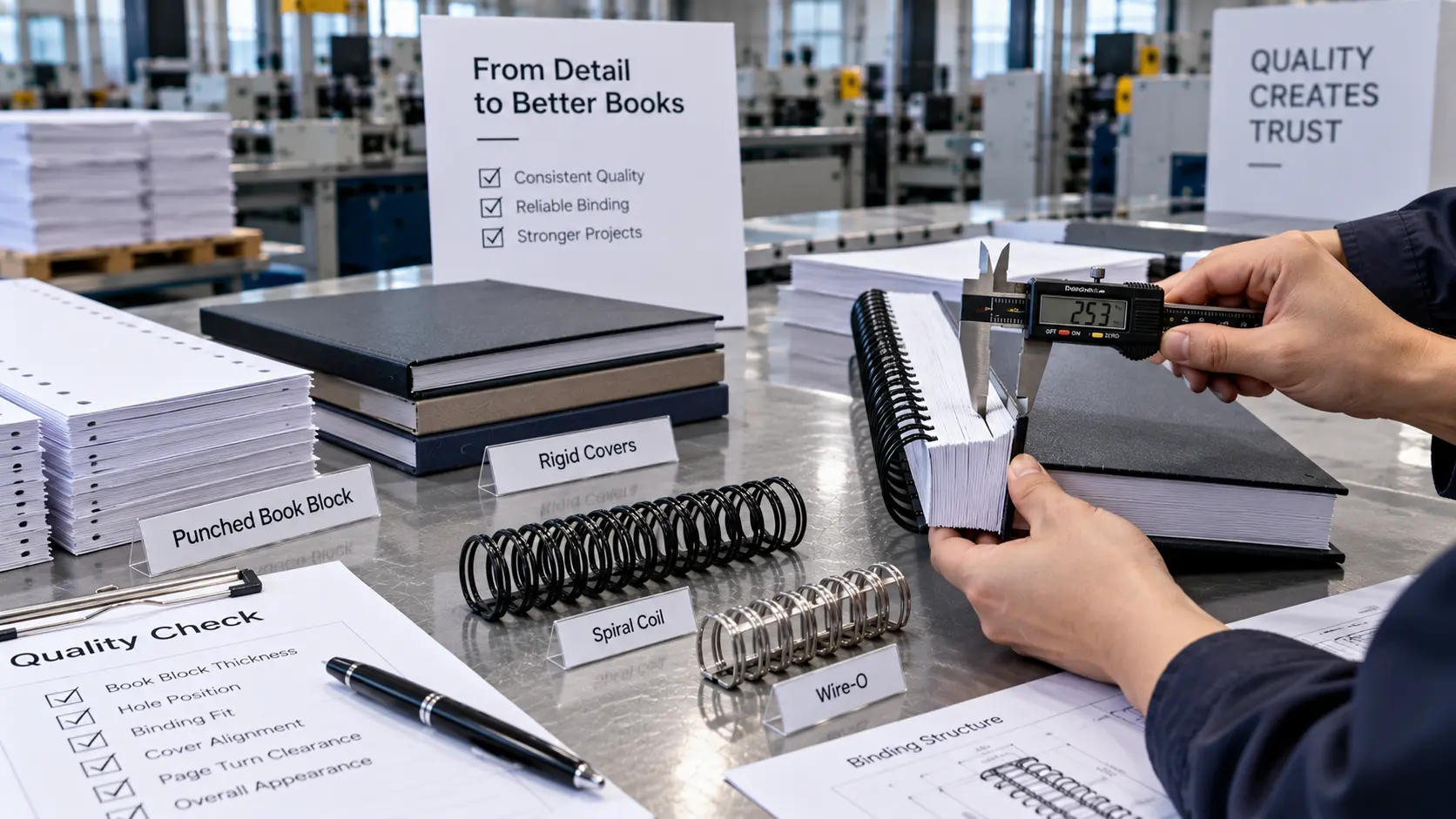
Build the document exactly as it will be bound. Include the interior paper, front and back covers, section dividers, tabs, foldouts and any inserts near the spine. Compress the binding edge enough to represent the assembled book without crushing it.
This measured thickness is more useful than a page-count estimate because it reflects the actual materials in the job.
Why page count alone fails
- Heavier paper increases block thickness.
- Plastic or rigid covers add more thickness than light card.
- Tabs and dividers can make the spine edge thicker than the fore edge.
- Printed coatings or laminated components can change stiffness and turning behavior.
- Different paper mills can produce sheets with the same nominal weight but different caliper.
2. Decide What the Document Must Do When Open
Binding method is partly a capacity decision and partly a use decision.
Ask whether the document must:
- lie flat on a desk;
- rotate pages fully behind the book;
- look formal for client presentation;
- survive repeated field use;
- allow future page replacement;
- fit into a defined package or shelf space.
For many thick manuals, workbooks and notebooks, spiral coil is attractive because the continuous helix can be specified in larger diameters and supports full page rotation. Wire-O provides a more structured double-loop appearance but must remain within the size and pitch range supported by the selected wire and equipment.
YPS compares these systems in Wire-O vs. plastic coil binding.
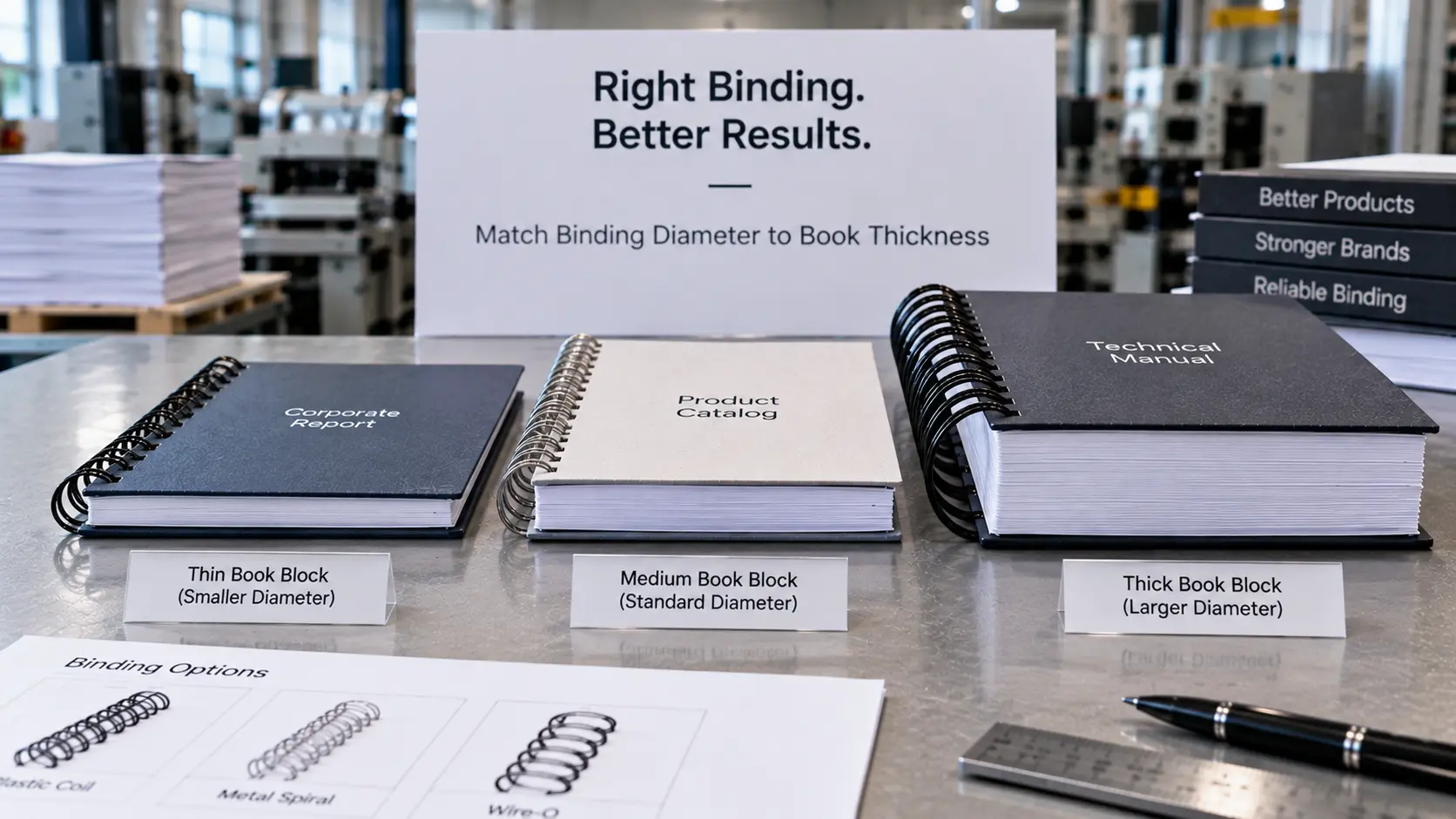
3. Choose Spine Diameter From Thickness, Not From Habit
A spine should provide enough clearance for the pages to move without placing the book block under unnecessary tension.
If the spine is too small:
- pages can bind against one another;
- covers may resist opening;
- holes experience more stress during page turning;
- the finished document can feel overfilled.
If the spine is excessively large, the document can look loose and the pages may move more than intended.
YPS's spiral binding coil sizes, diameter and pitch guide explains the variables to match. Final selection should still be tested on the actual job rather than taken from a generic page-count chart.
4. Understand Pitch Before You Commit to the Punch
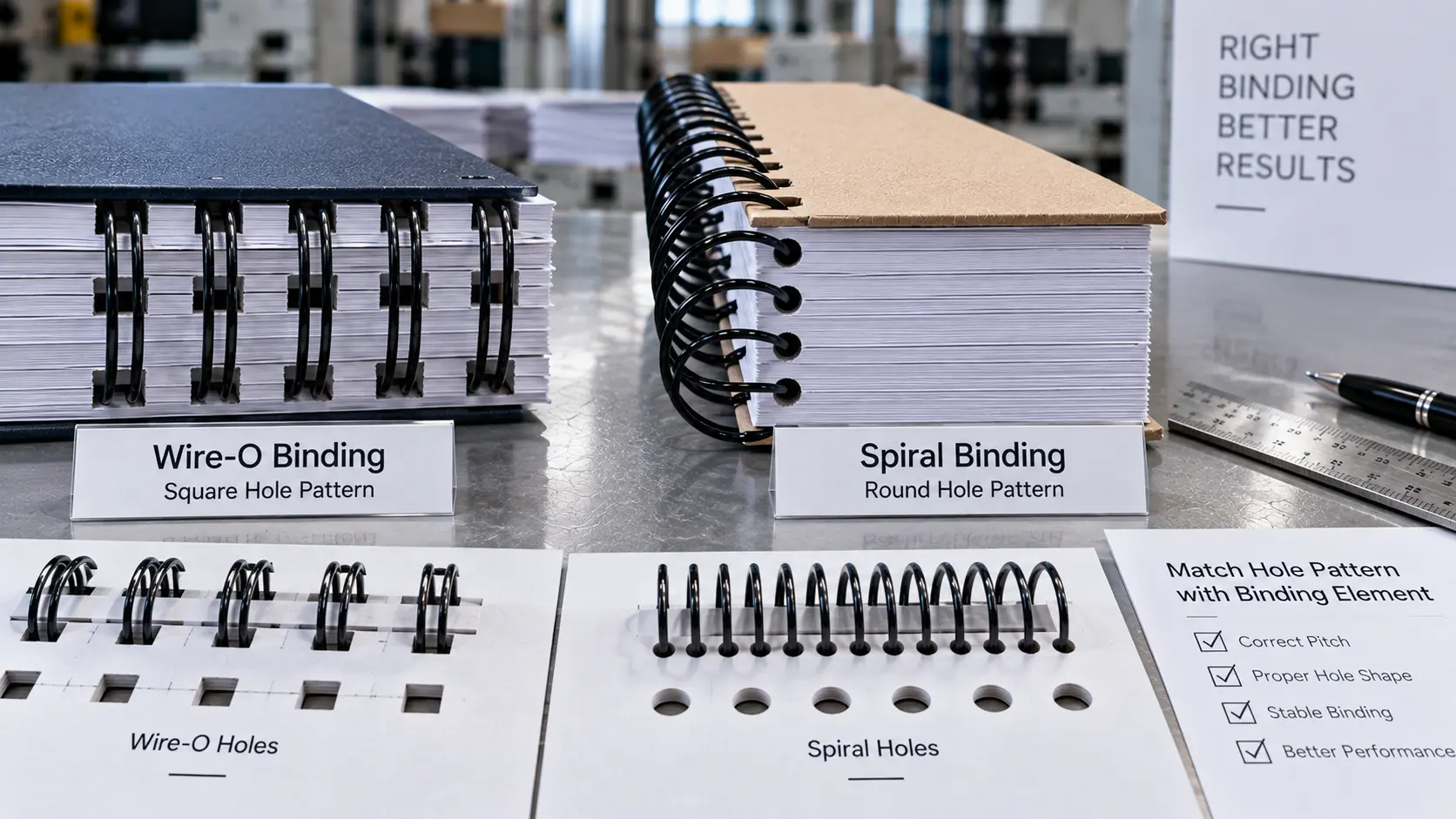
Pitch determines the spacing relationship between the punched holes and binding element. It affects compatibility, spine geometry and the equipment that can be used.
For Wire-O, common systems include 3:1 and 2:1 pitch, with the appropriate choice depending on the required wire size and product specification. Spiral coil likewise must match the punch pattern used by the factory.
The key production rule is simple: do not select the punch independently from the spine. Confirm the binding element, pitch and die as one set before production tooling is locked.
YPS's bulk buyer's guide to types of spiral binding provides additional context on materials and specifications.
5. Punch Thick Documents in Controlled Stacks
The complete document may be thick, but that does not mean it should be punched in one thick stack. Punching quality depends on the machine, material and die.
Production approach
- Jog the sheets so the binding edges are square.
- Separate covers if they are much harder or thicker than the interior paper.
- Punch repeatable stacks within the machine's approved capacity.
- Keep the side guide and depth setting locked between stacks.
- Inspect a sample of holes before the full document is assembled.
- Re-stack the punched sections carefully so the hole line remains aligned.
A thick finished book with excellent binding can still fail if the punch pattern wanders between stacks. The problem becomes obvious during coil insertion or when a Wire-O spine will not seat evenly.
For production punching equipment, see the YPS paper hole punching machine category.
6. Watch the Binding Edge on Covers, Dividers and Tabs
Thick documents often contain more than plain paper. Covers and dividers can create local thickness or stiffness around the binding edge.
Keep bulky attached items away from the punch zone. For laminated covers, test whether the film stays bonded around the holes. For dividers, check that tabs do not interfere with page rotation or extend into handling areas where they can catch.
If one component is responsible for most of the thickness, it may be better to redesign that component than to oversize the entire binding system.
7. Decide When Wire-O Is Still the Right Choice
Wire-O can be an excellent choice for manuals, calendars, presentations and notebooks where its double-loop appearance is part of the product. For thicker work, buyers need to confirm that the required wire diameter, pitch and closer capability are available as a compatible set.
Do not assume that a larger wire alone solves a thick-document problem. The punch die must match the pitch, and the closer must be able to form that wire consistently.
Use the wire binding machine compatibility checklist before approving a new thick Wire-O specification.
8. Decide When Coil Gives More Practical Flexibility
Coil is often considered for thick books because it can support a wide range of diameters and maintains a continuous spiral structure. The final choice still depends on hole pattern, coil material, inserter capability and end finishing.
For B2B projects, specify:
- plastic/PET or metal spiral;
- pitch;
- required diameter based on the actual book block;
- binding-edge length;
- color or finish;
- machine compatibility.
YPS offers both plastic spiral binding coil and metal spiral coil categories for different product directions.
9. Consider Splitting the Document Instead of Forcing One Volume
There is a point where making one book thicker creates more problems than value. The spine becomes visually dominant, punching and handling become harder, and the document may be uncomfortable to use.
For manuals or training content, dividing the job into Volume 1 / Volume 2 can improve handling and reduce binding stress. This is a product-design decision, not a production failure.
Ask whether the user actually benefits from carrying the complete content in one physical block.
10. Approve a Thick-Document Sample With a Functional Test
| Check | What to Look For |
|---|---|
| Page turning | Pages rotate without dragging heavily against the spine |
| Hole quality | No progressive tearing, partial holes or stack-to-stack shift |
| Spine fit | Adequate clearance without an unnecessarily loose appearance |
| Cover movement | Front and back covers open without binding against the spine |
| Alignment | Hole line and page edges remain consistent across the full block |
| Handling | The document can be opened, carried and used as intended |
For general finished-book quality, YPS's factory-side explanation of a spiral-bound book provides additional context on how construction decisions show up in the final product.
Common Mistakes When Binding Thick Documents
- Using page count instead of measured thickness.
- Choosing the spine before paper and covers are final.
- Running thick punch stacks just because the machine can move through them.
- Mixing a binding pitch with an incompatible die or closer.
- Ignoring inserts and dividers near the spine.
- Forcing one volume when two smaller books would work better.
FAQ
Q: What Binding Is Best For A Very Thick Document?
A: There is no universal best method. Spiral coil is often useful when larger diameter flexibility and full page rotation matter. Wire-O can be suitable when the required diameter, pitch and closer are available as a compatible system. Measure the finished block and test the actual sample.
Q: How Do I Choose A Coil Size For A Thick Book?
A: Measure the complete compressed binding edge, including covers and inserts, then select a diameter that provides page-turn clearance. Do not rely only on a generic page-count chart.
Q: Can I Use 3:1 Wire-O For Every Document Thickness?
A: No. Wire-O pitch and size ranges are linked. The required wire must match the punch die and closer. Confirm compatibility for the actual book thickness before production.
Q: Should A Thick Document Be Punched In One Stack?
A: Usually the punching plan should follow the machine's approved capacity and the material being processed. Consistent smaller stacks can produce better hole quality and alignment than pushing the machine to its limit.
Q: Can YPS Help Specify A Thick Coil-Bound Project?
A: Yes, the most useful starting information is finished size, paper, covers, measured book-block thickness, binding-edge length, preferred binding material and target quantity. Send these details through the YPS inquiry form.