

Custom Notebook Change Control: When A Spec Change Requires Re-Sampling
Leave a message
An approved notebook sample is evidence for one defined construction. Change the construction, and the old approval may no longer answer the same question.
That does not mean every small revision requires rebuilding the entire sample. It means every revision should be traced through the parts of the notebook it can affect before production is released. A paper change may alter writing behavior and book-block thickness. A page-count change may alter binding clearance. A cover finish change may alter handling and packaging contact. A new divider can affect both navigation and the outer profile.
This is the job of notebook change control: identify what changed, identify which earlier approvals depend on it, then choose the smallest revalidation that still proves the revised product.

Freeze the Approved Version Before You Change It
A change cannot be controlled if the approved baseline is vague. "Same as sample" is not enough when several people, suppliers or future reorders need to understand what the sample represented.
Before reviewing a revision, identify the version that was previously approved. The record should be specific enough to distinguish:
- finished size;
- paper reference and intended page or sheet count;
- interior artwork version;
- cover construction, material and finish;
- binding system and the relevant physical specification;
- dividers, pockets, closures or other integrated features;
- packaging construction when it affects the finished product;
- the physical sample or approval record that corresponds to that version.
The goal is not paperwork for its own sake. The goal is to know exactly what evidence becomes stale when one input changes.
Ask What the Change Touches, Not How Small It Sounds
A visually small change can be structurally important. A larger-looking artwork revision can sometimes leave the construction untouched. Classify the change by its interfaces rather than by how dramatic it appears in an email.
| Changed item | Possible affected decisions | Typical recheck |
|---|---|---|
| Paper stock | Writing behavior, opacity, printed appearance, book-block thickness, punching, binding clearance | Paper test + printed-sheet check + thickness/binding review |
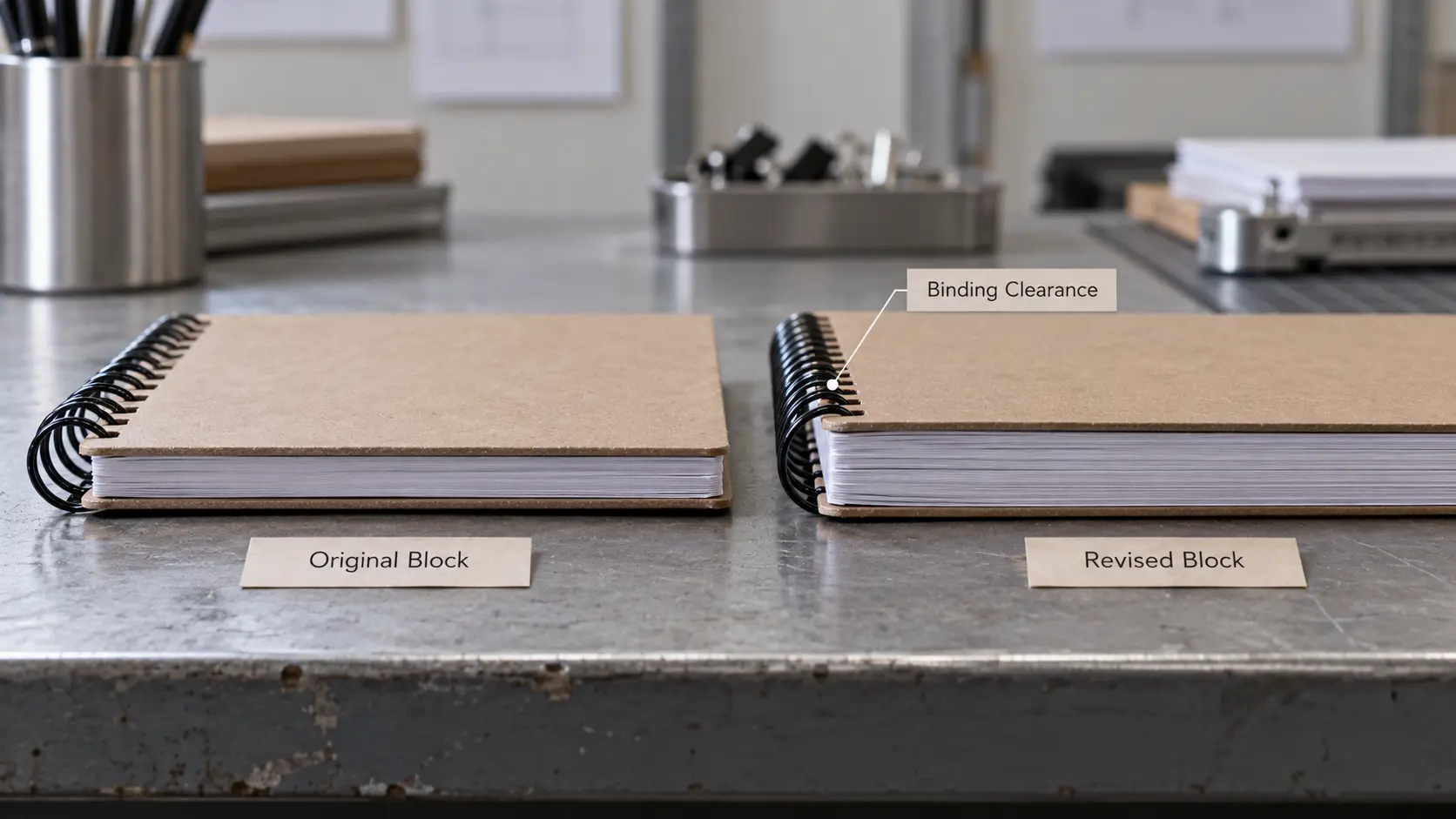
| Page count | Book-block thickness, binding size, opening, package fit | Recalculate/re-measure block + bound construction check |
| Interior artwork | Writing contrast, registration, page order, punch-safe geometry | Print proof and affected page checks |
| Cover material or finish | Color, tactility, decoration, punch edge, stiffness, package contact | Finished cover / bound-cover approval |
| Binding | Hole pattern, pitch, diameter/size, page movement, cover rotation | Binding-specific physical check |
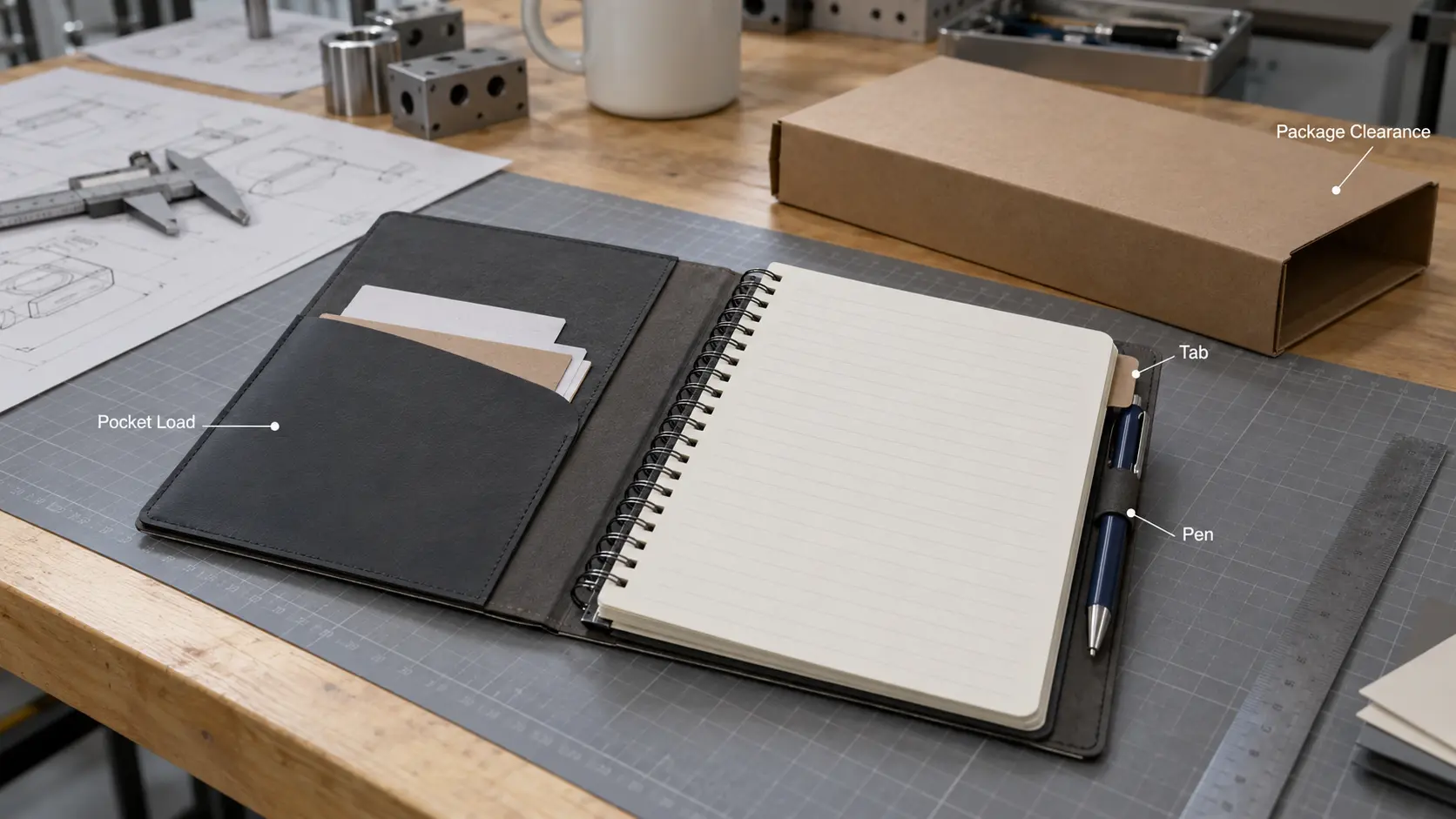
| Divider or add-on | Thickness, page turning, outer profile, closure, pocket or packaging clearance | Loaded finished-book check |
| Packaging | Surface contact, movement, exposed binding protection, fit | Physical pack-out check |
The table is a dependency map, not a universal rule that every row requires a complete new prototype. The exact revalidation depends on what changed and what the project originally approved.
A Paper Change Is Also a Construction Change
Changing paper is one of the clearest examples of why component approvals cannot always be carried forward independently.
The new stock should first be rechecked for the writing behavior the product needs. The paper-test owner covers feathering, bleed-through, ghosting, drying, surface feel and printed-area behavior. But paper also contributes to the thickness and movement of the finished book block.
So a paper revision can create two separate revalidation tasks:
- surface revalidation: does the new production paper still provide the approved writing and print behavior?
- construction revalidation: does the revised block still work with the selected binding, cover and package?
This is why preserving the old coil or Wire-O specification automatically after a meaningful paper change can be unsafe. The correct binding size depends on the actual finished block, not simply on the old page count or the name of the new GSM.
YPS's current material-development guide already explains the principle that a paper change can force another binding review. Change control turns that principle into a repeatable decision process.
A Page-Count Change Propagates Into the Spine and Package
Page count looks like a content decision. Physically, it changes the object.
When pages are added or removed, review:
- actual book-block thickness;
- binding size and working clearance;
- page movement through the full book;
- visual proportion of the spine relative to the cover;
- fit inside sleeves, cartons or boxes;
- closure position if an elastic or other closure is part of the design.
The important point is dependency. The previous cover artwork may still be correct. The previous paper writing test may still be valid. But the earlier bound-sample approval may no longer prove page movement or package fit for the revised block.
An Artwork Revision Can Be Physical Even When the Material Does Not Change
"Only the artwork changed" can mean several very different things.
A spelling correction far from trim and binding may require only document control and a new proof. Moving a recurring grid toward the punch edge changes the usable geometry. Darkening a large background area changes the writing surface. Reordering page types changes the physical sequence a user navigates.
For an interior revision, ask:
- Did content move toward trim or punch zones?
- Did print coverage change where users write?
- Did page order, section order or left/right mapping change?
- Did the number of printed sections change?
- Did the revision change any variable that affects the book block rather than only the graphic file?
If the answer is no, a targeted proof may be enough. If the answer is yes, the revised pages should be checked in the physical context affected by the change.
A Cover Revision Can Affect More Than Appearance
Changing only a cover color is different from changing the cover stack.
A revised material, lamination, wrapped-board construction or decoration can change surface feel, stiffness, thickness near the punched edge, corner behavior and the way the cover interacts with packaging. A finish change can also alter the relationship between the cover and visible binding hardware.
Map the revision to the relevant owner. If the finish family changed, recheck finish appearance and handling. If the board or wrap build-up changed, recheck rigid-cover geometry and rotation. If the surface became more sensitive to contact, recheck the package where it touches the cover.
The previous sample remains useful as a reference. It simply should not be treated as proof for a construction it did not contain.
A Binding Change Invalidates More Than the Spine Color
Spiral and Wire-O binding decisions include a physical system, not only a visual spine.
If the binding type, pitch, hole pattern, diameter/size, material or cover relationship changes, review the actual interfaces that depend on it:
- punch pattern and hole geometry;
- finished book-block thickness;
- working clearance;
- page turning;
- rigid-cover rotation, if applicable;
- divider and insert movement;
- package clearance and protection around exposed hardware.
A color-only change on the same confirmed binding construction may need a much narrower check than a pitch or diameter change. That is exactly why change control should be based on affected interfaces rather than one blanket rule.
Dividers and Add-Ons Can Change the Maximum Product Envelope
A divider, pocket, pen loop or elastic closure can add little material and still change how the notebook behaves as a finished object.
Ask whether the revision changes:
- local or total stack thickness;
- tab projection beyond the page or cover edge;
- the space needed for a pen;
- pocket load in normal use;
- closure tension or resting position;
- the notebook's maximum width, height or thickness when equipped;
- package fit.
The right proof is often a loaded sample rather than an empty one. If the feature is designed around a pen, card, document or other carried object, test it with that object or a defined equivalent.
A Packaging Change Can Reopen a Finished-Product Approval
Packaging sits outside the notebook, but it can still affect the notebook during storage and transport. A tighter sleeve, a new insert or a different box geometry can create contact at the cover, corners or exposed binding.
When packaging changes, do not automatically reopen paper or interior-print approval. Recheck the interfaces the package actually touches:
- cover contact and marking;
- spine or Wire-O clearance;
- movement inside the package;
- tab or accessory clearance;
- removal path and presentation.
The dedicated notebook-packaging owner should carry the full pack-out method once that article is published. In change control, packaging is one branch of the impact map.
Use Three Revalidation Levels Instead of "Everything" or "Nothing"
A practical change system benefits from three levels. The names can vary by company; the important part is the logic.
1. Document / proof recheck
Use when the revision does not change the physical product interfaces being approved. Examples can include a text correction, an updated legal line or a minor artwork change well inside established safe zones. Confirm the revised file and version.
2. Targeted physical recheck
Use when one or more physical attributes change but the rest of the approved construction can reasonably remain the reference. Examples can include a revised interior print density tested on the same paper, or a new foil color on the same confirmed cover construction. Recheck only the affected observations plus any direct interface.
3. Rebuilt finished sample
Use when the change alters multiple connected decisions or when a targeted check cannot reproduce the actual interaction. A meaningful paper/thickness change, new binding system, altered rigid-cover construction, major add-on change or revised package around an exposed spine can fall into this category.
These are decision levels, not fixed industry classifications. The project team should define its own release authority and acceptance criteria.
Keep a Change-Impact Record
| Field | Question to answer |
|---|---|
| Baseline version | Which approved specification/sample are we changing? |
| Revision | Exactly what changed? |
| Reason | Why was the change requested? |
| Directly affected component | Paper, print, cover, binding, add-on, packaging or other? |
| Dependent decisions | Which previously approved functions or interfaces could move? |
| Revalidation level | Document proof, targeted physical check or rebuilt finished sample? |
| Evidence | What new proof, measurement, observation or sample closes the change? |
| New approval version | What becomes the production reference after acceptance? |
A simple change-impact record makes one useful behavior unavoidable: no one can quietly substitute "close enough" for an approved decision without showing what else that substitution affects.

Release the Revision, Not the Memory of the Old Sample
Once the affected checks pass, update the production reference. The new version should point to the evidence that supports the changed condition, while unchanged approvals can remain linked to the earlier baseline where appropriate.
This is different from rebuilding the entire development history after every edit. Good change control is proportional. It preserves evidence that is still valid and reopens only the decisions a revision can actually disturb.
The broader premium notebook sample checklist is useful before first approval. Change control begins one step later: after the team already has something approved and needs to know whether that approval still describes the product it is about to make.
The Most Expensive Change Is the One Nobody Traces
Notebook development is a connected system. Paper affects thickness. Thickness affects binding. Cover construction affects punching and rotation. Add-ons affect the product envelope. Packaging affects finished surfaces and exposed hardware.
A specification revision is therefore not just a new line in a spreadsheet. It is a question about which relationships have changed.
Trace those relationships, repeat only the evidence that became uncertain, and make the revised version the new production reference. That is how a product team can keep improving a notebook without carrying obsolete approvals into the expensive part of production.


