How To Design A Rigid Cover For Spiral And Wire-O Notebooks
Leave a message
A rigid cover can make a spiral or Wire-O notebook feel more substantial, protect the page block and create a strong surface for print or decorative finishing. It also changes the mechanics of the binding.
The cover is thicker and stiffer than the writing pages. It may extend beyond the page trim. Its wrap material creates extra build-up at the edges. And because the cover is punched into the same exposed binding system, it has to rotate through the hardware without tearing around the holes or crowding the page block.
That is why a hardcover spiral notebook should not be designed by copying the construction logic of a conventional casebound journal. The two products may both have rigid boards, but the binding interface is different. In an exposed spiral or Wire-O notebook, the cover itself becomes a punched, moving component.
First Separate Casebound Hardcover Logic From Exposed-Binding Logic
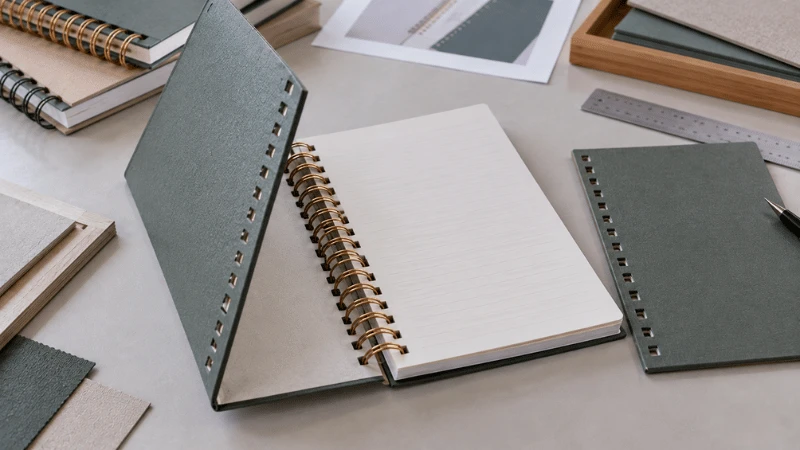
A traditional casebound book normally uses a rigid case around a sewn or glued text block, with a spine structure and joints that allow the boards to open. A spiral or Wire-O notebook instead uses a line of punched holes and an exposed binding element to connect pages and covers.
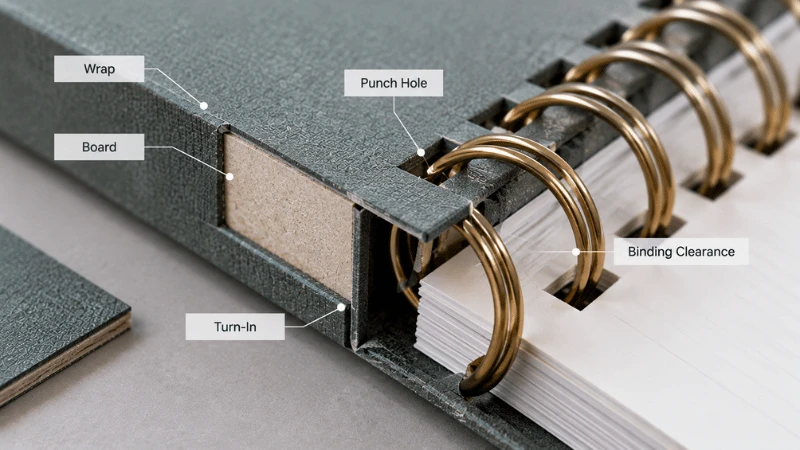
That difference changes the cover brief. There may be no conventional case spine for the cover to hinge from. Instead, the front and back covers rotate around the coil or wire through their punched holes. The important geometry sits at the binding edge: cover thickness, hole condition, distance to the edge, binding clearance and how the rigid board moves relative to the page block.
Use casebound references for visual inspiration if useful, but do not import hinge gaps, spine-board rules or cover templates into an exposed-binding product without checking the actual construction.
Treat the Rigid Cover as Part of the Binding Stack
Binding selection should be based on the finished construction, not only the writing sheets. Rigid covers, dividers, pockets and other inserts all contribute to the physical stack and can change the clearance required for comfortable movement.
The cover also behaves differently from paper because it resists bending. When it rotates around the binding, it can apply more leverage at the punched holes than a flexible sheet. A cover that is visually correct but mechanically crowded can make the first and last pages harder to reach or can concentrate stress near the binding edge.
Build the binding dummy with the intended cover construction before locking the binding size. If the board, wrap or added liner changes later, reopen the review rather than treating the change as decorative only.
Choose Board by Finished Behavior, Not by a Generic "Premium" Thickness
There is no universal board thickness that makes a notebook premium. A thicker board increases stiffness and changes hand feel, but it also increases punch difficulty, local hole geometry, finished stack thickness and the force required to rotate the cover.
The useful specification is therefore the actual approved cover construction, not a prestige adjective. Test candidate boards with the intended wrap and finishing. Judge whether the cover holds the desired shape, feels appropriate in the hand and still works with the exposed binding.
If a project changes board thickness after sampling, review more than the cover appearance. Recheck punching, binding clearance, package fit and cover rotation. The finished object has changed.
The Wrap Creates Local Thickness That a Flat Board Sample Does Not Show
A wrapped rigid cover is not a uniform slab. Cover paper, cloth, coated stock or another surface material folds around the board edges. Those turn-ins and overlaps create local build-up, especially near corners and wherever material layers meet.
At the binding edge, local build-up matters because the punch passes through the finished or partly finished cover construction depending on the production method. The exact sequence varies by process, so the buyer should not prescribe a universal method without evidence. What should be fixed is the approval state: the holes need to be clean and stable in the same cover construction that will be used for production.
Inspect the inside and outside surfaces around the punched edge. Look for lifted wrap, cracking, torn fibres, delamination or distortion that was not visible on an unpunched board swatch.
Cover Overhang Changes More Than the Silhouette
Many rigid covers extend beyond the writing pages. This overhang can protect page edges and create a deliberate proportion, but it also changes the relationship between the cover, coil and hand.
If the cover projects too far toward the binding hardware, it can reduce useful clearance or change how the cover rotates. If the writing pages sit much farther inside the cover, the user may also experience a deeper step between the first page and the cover edge.
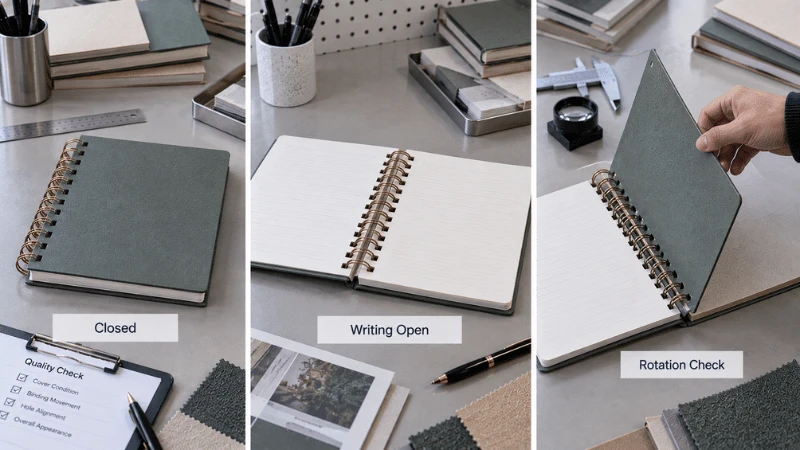
Do not use one universal overhang value. Set the visual proportion, then test it with the real binding and page block. Check the notebook closed, open on a desk and folded back to the extent the intended construction is expected to allow.
Punch the Real Cover Construction Before You Approve It
Writing paper is a poor proxy for a rigid wrapped cover. The board is thicker, the surface layer may be laminated or textured, and the punch has to create a clean hole through a much less flexible component.
A useful pre-production check uses the actual cover construction or a genuinely equivalent build. Inspect hole shape, edge condition and flatness around the punched area. Then bind it with the intended system and move the cover repeatedly through normal opening positions.
For spiral and Wire-O products, compatibility is a system question. Hole pattern and pitch must match the binding system, while binding size must suit the finished stack and allow the rigid covers and pages to move. A correct-looking hole row does not prove the assembled notebook.
Binding Clearance Must Be Checked With the Cover in Motion
Clearance is easiest to judge when the notebook is moving. Close the cover. Open it to a normal writing position. Continue through the expected rotation range. Watch the binding edge rather than only the front face.
The cover should not visibly jam against the coil or wire, pull sharply at individual holes or force the page block to move with it. The first and last writing sheets should remain accessible without the user compensating for the cover geometry.
If the product is intended to fold back on itself, prove that behavior with the actual rigid covers. Do not promise a full rotation simply because the binding style can theoretically rotate flexible pages. Rigid cover dimensions, board stiffness and hardware clearance still have to support the intended movement.
Corner and Edge Decisions Belong in the Same Physical Sample
Square and rounded corners create different visual and handling behavior, and wrap construction can behave differently at those corners. The right choice depends on the product rather than a universal rule.
Inspect whether the wrap sits cleanly around the corner, whether the board edge telegraphs through the surface and whether the finished corner remains consistent after ordinary handling. If the cover has a laminate or coated surface, check whether the edge construction exposes a vulnerable line when the cover is flexed around the binding.
These are sample observations, not reasons to invent a fixed durability cycle. Record the actual construction that passed and use it as the production reference.
Cover Artwork Needs Its Own Binding-Aware Safe Area
A rigid cover can carry a logo, foil, embossing, pattern or full-print wrap, but the binding edge is mechanically occupied space. Punch holes remove material, the cover rotates near the hardware and the user's hand repeatedly touches the area.
Keep critical artwork out of the punch row and away from areas where the binding hardware will visually interrupt it. The required distance is project-specific because hole pattern, hole size, cover overhang and binding element vary.
This is related to interior page geometry but it is not the same task. Interior pages prioritize writing space and repeated page layout. The cover must also account for board construction, wrap build-up and decorative finishing around a rigid punched edge.
Approve the Cover With a Bound-Sample Checklist
The final rigid-cover approval should happen on a complete notebook, not as a decorated board pair.
| Check | What to inspect | Failure it can reveal |
|---|---|---|
| Board and wrap | Flatness, edge build-up, corner construction and surface condition | Warp, lifted wrap or uneven local thickness |
| Punched edge | Hole shape, wrap integrity and board condition around every hole | Tearing, cracking or delamination near the binding |
| Closed geometry | Cover overhang, stack alignment and binding proportion | Crowded hardware or unbalanced cover/page relationship |
| Opening movement | Move front and back covers through normal use positions | Binding interference, hole stress or restricted access to pages |
| Artwork at binding edge | Check critical graphics after punching and binding | Logos or finishes visually damaged by the hole row or hardware |
| Final package fit | Pack the actual rigid-cover notebook | Unexpected outer size, corner pressure or binding compression |
If the board, wrap, binding element or paper stack changes, identify which checks need to be reopened. A cover sample is evidence for one construction, not for every future variation.
Keep Structural Approval Separate From Surface-Durability Auditing
Rigid-cover geometry and long-term surface behavior are related, but they are not the same Page Job. This article is about getting the board, wrap, punch and binding interface correct before production. Questions such as scuff resistance, fingerprinting, batch drift and release testing belong to a later durability and supplier-control stage.
For that next task, YPS already has a separate guide to custom notebook cover release checks. Keeping the two decisions separate prevents a surface-finish checklist from hiding a structural problem at the punched edge.
Write the Cover Brief Around the Finished Bound Object
The production brief should record the cover board and wrap construction, outside dimensions, intended overhang, corner direction, surface finish, binding system, punch pattern, finished stack and the movement the cover is expected to achieve. It should also state which physical sample becomes the reference for bulk production.
For commercial notebook programs and project-specific capability, the YPS notebook page remains the procurement destination. This guide owns a narrower question: does the rigid cover actually work as part of the exposed binding?
A hardcover spiral or Wire-O notebook succeeds when the rigidity disappears as a problem. The cover should feel intentional in the hand, but the user should not have to think about the holes, board leverage or hardware clearance every time the notebook opens.