

What is Nylon Coated Binding Steel Wire?
Leave a message
Nylon coated binding steel wire is a steel wire with a thin, coloured nylon coating, made to be bent into the twin-loop or single-spiral binding that holds a notebook, sketchbook or calendar together. The steel gives the loop its shape. The nylon gives it colour, a smooth surface for the pages to turn on, and a layer between the metal and moisture.
Binding wire and coils are the trade YPS started in, before we made a single notebook. This page explains what the wire is made of, the sizes and colours it comes in, how to check it on a finished book, and how we decide whether it belongs on a notebook at all.
What the Wire Is Made Of
The construction is simple, and each layer does one job. The figures below are the ones YPS publishes for its nylon coated galvanized steel binding wire. Another supplier's wire may differ, so read them as one manufacturer's numbers, not as an industry standard.
| Part | YPS specification | What it does in the finished book |
| Core | Carbon steel wire, galvanized by hot-dip plating or electroplating | Keeps the loop in the shape it was formed to. The zinc layer is the steel's own protection beneath the coating. |
| Coating | Nylon, 0.05–0.07 mm thick | Carries the colour and gives the smooth surface the paper slides over. |
| Wire diameter | 0.7–2.0 mm, tolerance ±0.02 mm | Thicker wire is used for larger loops and heavier books. |
| Supply form | Rolls of about 450 kg | Matters to a bindery that forms its own loops. A notebook buyer never sees it. |
Why coat the wire at all?
Earlier bindings were formed from bare plated wire: galvanized, copper plated or tin plated. Bare wire has one colour, the colour of the metal, and the metal is what the reader's hand and the paper touch. A coated wire keeps the strength of the steel and puts a layer of plastic between the metal and everything else.
Nylon suits that job. It is a plastic known for high resistance to wear, heat and chemicals, and on a binding wear is the property that counts, because every turned page slides along the loop.
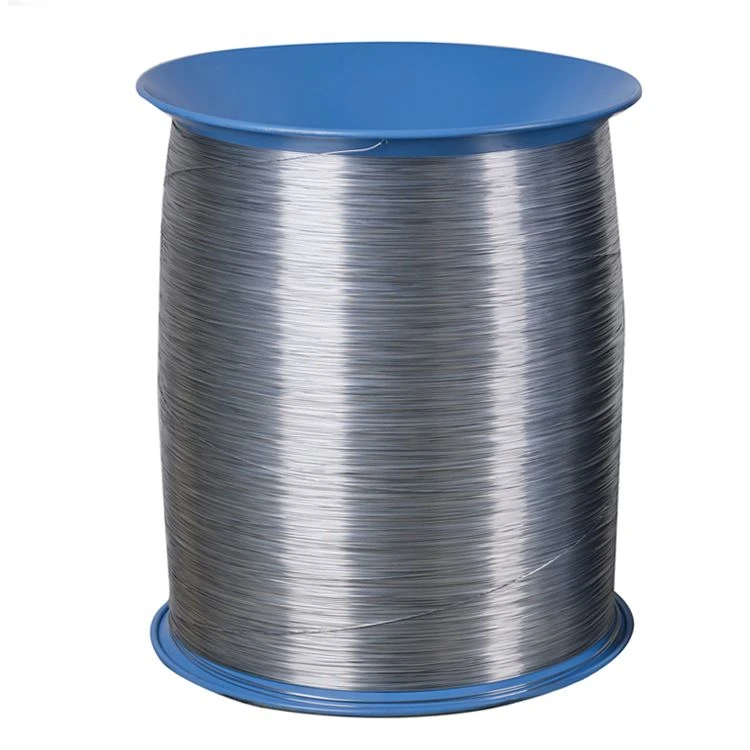
The wire reaches the forming machine on a spool like the one shown here. There it is formed into twin loops or wound into a spiral, cut to the length of the binding edge and fitted through the punched holes. At YPS the steps from wire drawing to coating to coil forming are run in-house, so the wire on a notebook is one we drew and coloured ourselves. What reaches the reader is a row of coloured rings.
Nylon or PET: Check Which One You Are Being Quoted
In the binding trade, "nylon coated" is used as a product name as well as a material description. Supplier catalogues commonly list "nylon coated wire", "NC wire" and "PET coated wire" as names for one product, and some state plainly that their nylon coated wire is made with PET resin.
The two are different plastics. Nylon is a family of polyamides. PET, polyethylene terephthalate, belongs to the polyester family. The wire described on this page is coated with nylon. If you are comparing quotations, do not assume the same of every wire sold under the name. For a notebook buyer the difference matters in three situations.
Compliance paperwork
A test report or material declaration covers a specific material. If the document says nylon and the wire is PET, the paper does not describe the product you are selling.
Material claims on packaging
If you plan to print what the binding is made of, print the polymer the supplier confirms in writing, not the catalogue name.
Repeat orders
Two suppliers quoting "nylon coated wire" may be offering different coatings. Naming the polymer keeps a reorder comparable with the sample you approved.
The practical step is short: ask the supplier to state the coating polymer and its thickness on the quotation.
The Two Shapes It Takes on a Notebook
On a notebook the same wire takes one of two shapes. A third use sits outside notebooks.
Twin loop
Also sold as wire-o or double loop wire, this is a row of paired loops closed into round rings. Each sheet hangs on its own pair of loops, so facing pages stay level with each other when the book is open. YPS forms twin-loop wire in 2:1 and 3:1 pitch, in loop sizes from 3/16 inch to 1-1/4 inch, for binding on the side or along the top.
Single spiral
One continuous coil is wound through the holes from one end of the book to the other. It turns freely through a full circle, and it is the form most people picture when they hear "spiral notebook".
Calendar hanger
Outside notebooks, the same wire is bent into the hanger that a wall calendar hangs from.
Wire diameter rises with the size of the binding. The table YPS publishes for its nylon-coated metal spiral pairs them as follows.
| Listed spiral size (mm) | Wire diameter (mm) |
| 6 | 0.8 |
| 8–10 | 0.9 |
| 12–14 | 1.0 |
| 16–28 | 1.15 |
| 30–34 | 1.3 |
These pairings belong to that product and should be confirmed on a sample. The size itself is chosen from the measured thickness of the finished book, not from the page count alone, because a change of paper changes the thickness of the block without changing the number of sheets. Our guide to spiral binding coil sizes sets out the reasoning.
Colour Is Approved Against the Cover, Not From a Chart
YPS lists this wire in three colour groups.
| Group | Colours |
| Standard | Black, white |
| Extra | Red, blue, green, orange, yellow |
| Special | Coffee, silver, gold, bronze |
Beyond these, a colour can be matched to a Pantone reference or to a physical sample, and the recipe is stored so that a reorder matches the approved one.
A colour reference alone is not enough to approve a binding. The same reference looks different on printed paper, on plastic and on coated metal. We approve wire colour with a physical sample laid against the actual cover, as described in our article on how covers and coils are approved together.
There is also a design question behind the technical one. A wire that repeats the main colour of the cover makes the spine disappear into the book. A wire that picks up a small accent from the artwork, the red of a collar or the green of a leaf, makes the binding part of the picture. Neither is right in general. It is decided book by book, with the cover on the table.
Gold is a separate decision. The coated wire is listed in gold, silver and bronze colours. Electroplated wire-o, which YPS supplies in finishes including gold and rose gold, is a plated metal finish and costs more because plating involves more processing. If a metallic spine is central to the design, compare both on a sample before choosing.
What to Check on a Finished Sample
A specification describes the wire. Only a bound sample shows whether the binding is good. These are the points worth a minute each when the sample arrives.
Bends and cut ends
Forming bends the wire sharply, and cutting exposes its end. These are the places where a coating would crack or the steel would show first.
Colour along the spine
Look at the wire in daylight, next to the cover, from the front and from the back of the book.
Shape of the loops
On a twin-loop binding the closed rings should be round and even, with no gap wide enough for a sheet to slip out.
The ends
Run a finger over both ends of the binding. Nothing should catch on skin, on a sleeve or on the lining of a bag.
Page turn
Turn pages from the front, the middle and the back, and fold the book back on itself. Pages should travel round the wire without catching, and the open book should lie flat.
Alignment with the holes
The wire should sit centred in the punched holes along the full length. On YPS notebooks, hole alignment and lay-flat are checked on every run.
Coated Wire, Plastic Coil or Plated Wire
Coated steel wire is one of three bindings we put on a notebook. The choice depends on how the book will travel and what the spine is meant to say.
| Binding | What it is | Where it fits |
| Nylon coated steel wire | Coloured nylon coating over galvanized steel, formed as twin loop or single spiral | Notebooks and planners that are used on a desk or shipped in protective packaging, where the ring colour is part of the design |
| PET or PVC plastic coil | A spiral of solid plastic filament | Books that are mailed or carried loose in a bag. Plastic flexes and recovers where a metal loop can stay bent |
| Electroplated wire-o | Twin-loop wire with a plated metallic finish | Gift editions where a metallic spine is the point and the higher cost is accepted |
The trade-off between metal loops and plastic coil in shipping is covered in more detail in our comparison of wire-o and plastic coil binding.
What to Put on the Specification
If a quotation only says "nylon coated wire, black", six things are still undecided. Each of them can be settled in one line.
Coating polymer and thickness, named by the supplier in writing.
Wire diameter and tolerance.
Form, size and pitch: twin loop or single spiral, the loop size, and a pitch that matches the punch.
Colour: a reference plus a physical sample approved against the real cover.
Documents for your market. YPS states that SGS test reports and REACH and RoHS declarations are available, with EN 71-3 and CPSIA statements where the end use calls for them. Which of these you need depends on where the notebook is sold and who it is for, so confirm the list with your own compliance contact.
A bound sample approved before the production run.
For planning, YPS quotes 3 to 7 working days for samples and 15 to 25 days for production after the sample is approved, with longer times for large quantities, complex finishing and peak seasons.
Where the Wire Sits in a YPS Notebook
YPS started in 2017 as a binding coil factory in Dongguan. The notebooks came later and grew out of that work. Because we make our own coil and wire, the binding is decided together with the punching and the cover instead of being added at the end, and its colour is matched to each cover.
An automatic line is very good at making the same book a great many times. The result is often a book that looks like every other one, and we think people tire of that. We work the other way. What we want from a notebook is that it feels natural and comfortable in the hand, as if someone had thought about the person who will use it.
The rest of the book is held to that idea. Our writing paper is smooth and lint-free, and it is tested with fountain pens for bleed-through and feathering. Inner pages can be printed edge to edge in full colour with eco-friendly, low-odour inks. Covers are offered in several materials, including scratch-resistant laminated finishes. Holes are punched clean, so the edges are smooth and little paper dust is left in the book.
One example from our own specification sheets: the YPS twin-loop hardcover student notebook is specified with 157 gsm matte coated cover paper, R8 mm rounded corners, 100 gsm inner paper printed with a 5 mm grid, a 7 mm margin on tear-out sheets, A4 and A5 trim held within ±0.5 mm, and a round-back twin-loop binding that opens flat.
Small runs are finished by hand and checked one at a time. That is slower and it costs more, and we say so. If you need a very large quantity at the lowest unit cost, an automated line will serve you better than we will.
If the notebook has to carry a brand, a collection or a gift, the YPS notebook range shows how the wire, the cover and the paper come together, and the custom notebook page sets out the options for covers, paper, binding and packaging.


