

How Wire-O Notebooks Combine Metallic Finishes and Hardcover Design
Leave a message
Wire-O® notebooks give stationery brands a visible design element along the binding edge. A gold finish can pick up a detail in the cover artwork; a wraparound hardcover can change how much of the wire appears when the notebook is closed. Those choices work best when the paper, cover and opening behavior are considered together.
For a product developer building a private-label collection, the useful question is how each choice contributes to the finished notebook. Start with the appearance you want on the shelf, then check whether the assembled sample delivers the writing experience your customer expects. YPS makes its premium notebooks primarily by hand in small batches, with manual work also involved in parts of binding-wire production. That craftsmanship belongs in the product brief alongside the metallic finish and cover design.
What Makes a Wire-O Notebook Feel Considered?
A coherent notebook carries the same design intention from the closed cover to the open page. The binding should have a deliberate relationship with the artwork, the cover should move comfortably, and the pages should turn without catching.
First, identify the binding correctly. Wire-O® is a registered trademark of James Burn International, as noted by Phoenix Binding. Twin-loop binding has paired wire loops along the punched edge. A single spiral follows one continuous helix through the holes. James Burn International identifies its Original Wire-O system as double-loop binding; the two constructions should be specified separately. (James Burn International)
This distinction matters when reviewing reference photographs. A photograph of a single spiral does not establish how a twin-loop notebook will look or open. Ask for views of the actual construction you are developing: closed front, closed back, binding edge and open spread.
Treat "premium" as a product brief that needs visible support. A metallic finish may suit the collection, but the sample still needs clean finishing, suitable paper and a usable binding. No single decorative choice establishes the value of the complete notebook.
Treat the Wire as Part of the Design
Color and sheen
Separate three decisions: the underlying metal, the finishing process and the appearance. Gold-colored wire does not establish solid brass construction. James Burn International, for example, states that its Original Wire-O products use steel. That is evidence about its own product, not a material certificate for another supplier's wire. (James Burn International)
YPS's electroplated Wire-O finishes include gold and rose gold options. Use those names as starting points for sample selection. For a complete notebook, review the finish together with the cover and paper through YPS's finished-notebook customization. A requested champagne tone or matte black finish needs its own material and process confirmation before becoming a finished-product specification.
When comparing candidates, place formed wire beside the intended finished cover. Turn both under the same lighting and decide whether the binding should blend with the cover, echo a foil detail or provide contrast. These are different design relationships; a separate attractive wire sample cannot decide between them.
Record the selected appearance against a physical reference. A screen image can communicate a direction, but it should not be the sole basis for approving reflective hardware. YPS's guide to matching covers and binding colors explains how to compare the finished components together.
Wire Diameter Is Not Loop Diameter
A larger loop and a thicker wire are different changes. Keep four fields separate in the sample specification:
| Field | What it describes | What to confirm |
|---|---|---|
| Wire diameter | The cross-sectional diameter of the metal wire itself. | The stated diameter and its measurement basis; if a gauge designation is used, identify its system. |
| Loop diameter | The size of the formed binding loop. | The proposed loop size for the assembled notebook. |
| Pitch | The spacing of repeated binding positions, commonly expressed as holes per inch. | Compatibility between the twin-loop binding and the punched page block. |
| Binding capacity | The book-block thickness the selected binding can accommodate. | Suitability for the final paper, covers and inserts. |
RENZ's wire-comb specifications list loop sizes, maximum binding thicknesses and pitches. Those are manufacturer-specific specifications; they do not provide YPS wire-diameter measurements.
For design review, compare the binding with the complete page block and covers. A large loop may simply accommodate a thicker book; it does not demonstrate a thicker wire or greater strength. If the brief calls for a stronger visual presence, request a sample that shows the proposed proportions and retain the practical page-turning check.
Choose How Much of the Binding to Show
Exposed twin-loop wire
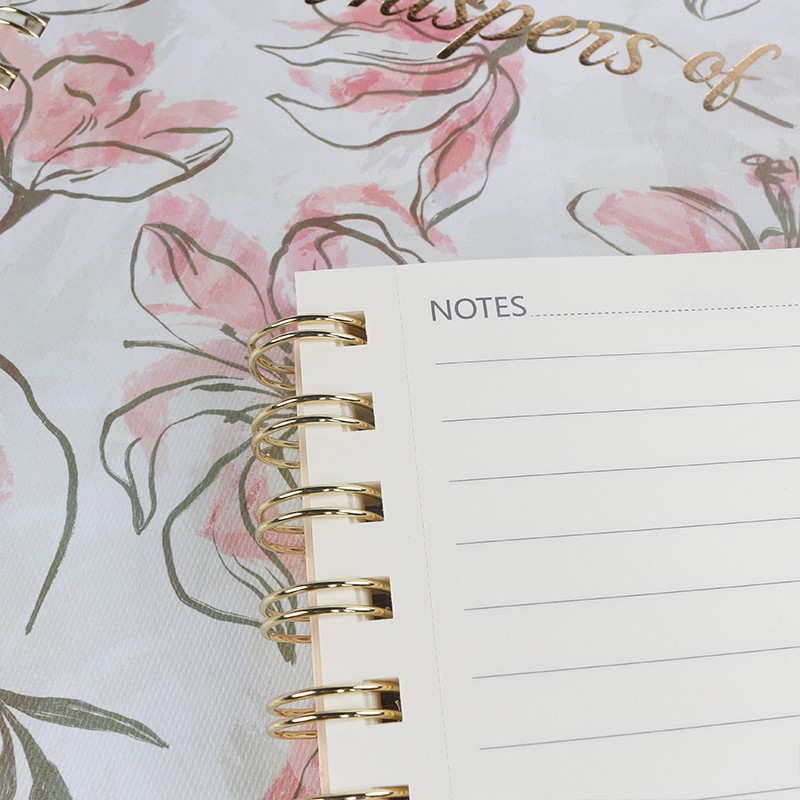
Exposed binding makes the metal part of the notebook's identity. Choose exposed twin-loop binding when the metallic wire should remain visible beside the cover artwork. Review the closed notebook from the front and back, because both views may appear in retail photography or gift presentation.
Also inspect the binding in use. Check that pages move freely, the cover clears the loops and the closed binding has no protruding wire tips or poorly closed loops that catch on pages, covers or fingers during normal handling. These are sample-review tasks, not evidence that a particular finish has passed a durability test.
Semi-concealed and concealed cases
A cased-in construction adds a wraparound cover around the wire-bound block. Consider it when a continuous cover and printable spine are central to the design. Phoenix Binding describes an arrangement in which substantial end sheets attach the block to the case, with semi-concealed or fully concealed options and a printable spine. This is an industry construction example from a commercial bindery. (Phoenix Binding)
Use the following distinctions to request comparable views:
| Construction | Appearance to review when closed | What the sample must clarify |
|---|---|---|
| Exposed twin-loop | The wire forms a visible feature at the binding edge. | Its relationship with the cover and the finished outer dimensions. |
| Semi-concealed case | The case masks part of the binding; wire may remain visible from a particular side. | Exactly what is visible from the front, back and spine. |
| Fully concealed case | The closed case covers the wire at the spine. | How the wire and case interact when the notebook is opened. |
YPS's published hardcover options include a round-back twin-wire spine. This describes a hardcover construction; it does not by itself establish semi-concealed or fully concealed binding. Ask for the closed views and an open sample rather than inferring the construction from a product name. With the case closed, compare the front, back and spine to locate any exposed wire. Then open the sample and check how the case connects to the bound block and whether the covers move freely. These views establish the construction more reliably than a single front photograph.
The same care applies to movement. RENZ describes flat opening and complete page rotation for its wire-comb binding system. An added case introduces another construction to review, so confirm the required opening behavior on the finished notebook. Lying open on a desk and folding the cover completely back are separate acceptance questions. (RENZ)
Let the Cover and Paper Support the Binding
The cover surface sets the background against which the wire is seen. Compare the actual laminated or wrapped cover with the selected hardware before approving the combination. If the concept relies on a quiet cover and a reflective binding, assess that relationship on the finished materials rather than on a digital rendering.
Specify a paper-wrapped hardcover in layers: cover board, outer wrap and surface finish. The weight of the wrapping paper is a different field from board thickness. Keeping those fields separate helps the sample match the intended stiffness, proportions and appearance.
For the writing pages, define the use before selecting the stock. A fountain-pen notebook needs a writing check with the intended pens and inks. Review feathering, bleed-through, show-through on the reverse and drying behavior under agreed conditions. Paper weight alone cannot establish that a stock will meet those expectations.
Page count and paper thickness also belong in the binding discussion. If either changes after the first sample, review the assembled book again. For a wider specification discussion, see material choices for a light luxury notebook.
A YPS Example with Gold Twin-Wire Binding
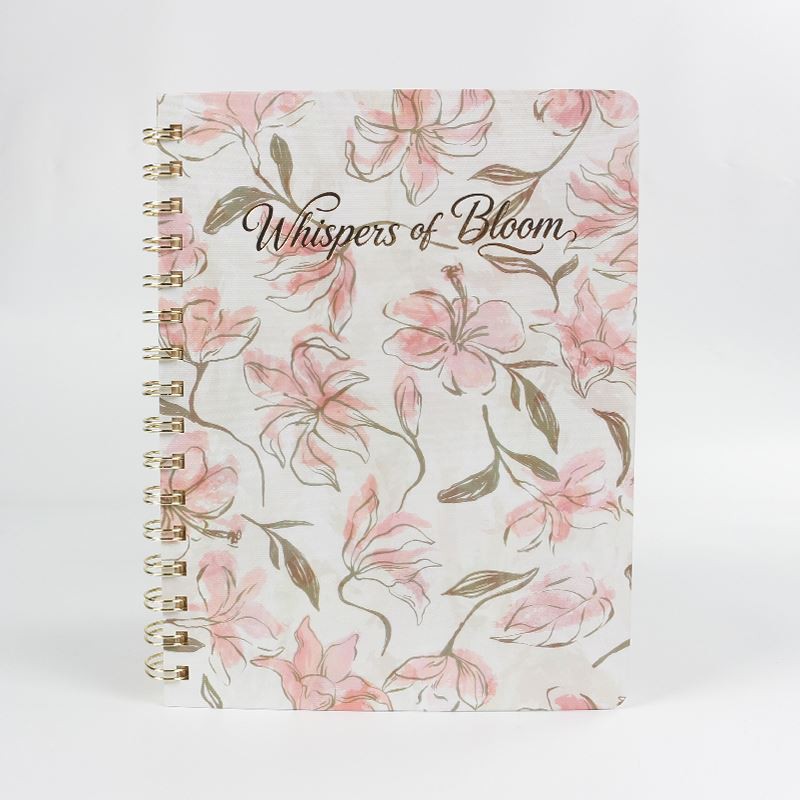
The YPS gold twin-wire hardcover notebook provides a concrete starting point. Its published 100-sheet configuration combines pink floral artwork, a paper-wrapped hardcover, electroplated gold double-loop binding and an inside-front-cover cardstock pocket. These are YPS's listed product details.
The useful design lesson is the relationship between components: the binding is visible hardware beside a decorated cover, while the pocket adds a function inside the book. A private-label version can begin with that relationship, then develop its own artwork, paper requirement and presentation. Record whether the page plan uses sheets or printed pages so that the sample brief is unambiguous.
Handwork Behind the Finished Notebook
YPS's premium notebook production is primarily manual, with finishing and inspection carried out by hand. Its binding components are made in its own workshop, and manual forming, adjustment and finishing are involved in parts of the coil-making process. Printing uses production equipment; the handcraft contribution extends to work on the binding components and the finished notebook. For a brand developing a collection, this connects the visible wire detail with the making of the complete book.
The supplied YPS twin-wire hardcover specification also shows what to look for beyond the metallic color:
| Craft detail | What YPS's supplied specification describes | What to review on the proposed notebook |
|---|---|---|
| Cover construction | 157 gsm matte coated cover paper; the product manual also describes an embossed surface treatment. | The texture, wrapped edges and corners on the finished cover; the cover board is a separate specification. |
| Paper and punched edges | 100 gsm writing paper and a punching process specified for smooth hole edges with reduced paper debris. | The writing result with intended pens, clean hole edges and free page movement. |
| Functional interior | Writable index dividers and a storage pocket. | The divider layout, writing space and pocket placement for the intended use. |
These details describe documented YPS configurations, rather than a fixed specification for every notebook. Select the features for the new design and approve them together in the finished sample. Handwork is part of the manufacturing approach; the sample establishes the agreed appearance and usability.
Review the Finished Sample Before Choosing the Specification
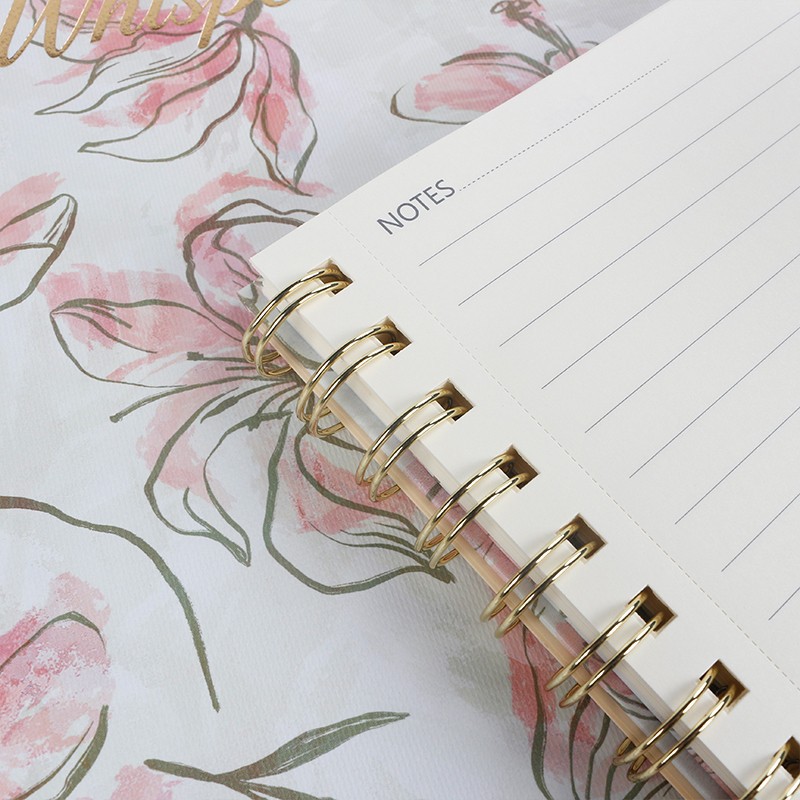
Compare the sample with the product brief in both its closed and open states. For a collection led by visible metallic hardware, prioritize the binding's appearance beside the cover. For a collection led by spine artwork, prioritize the closed front, back and spine views of the proposed case. Both paths still need a writing and page-turning review.
| Review area | Practical check | What to record |
|---|---|---|
| Binding specification | Confirm the wire material, wire diameter, loop diameter, pitch, finish and capacity for the final book block. | The agreed measurement basis, approved binding specification, document revision and physical reference sample. |
| Closed appearance | View the front, back and spine under consistent light. | Which parts of the wire remain visible and the accepted cover relationship. |
| Page movement | Turn pages near the front, middle and back; try the intended writing position. | Any catching, resistance or interference with the cover. |
| Finish and contact points | Inspect wire, punched edges and places where components meet. | Visible marks and the agreed condition of the reference sample. |
| Writing experience | Use the intended pens and inks on both sides of the selected paper. | Paper identity, pen and ink, review conditions and acceptance decision. |
| Complete outer size | Measure the assembled notebook, including projecting binding where relevant. | The measurement basis and fit in the intended packaging. |
These checks provide a development record. Formal durability claims require their own agreed methods and results. Keep the approved physical sample with the final specification, and identify changes that require another review, such as a different paper, page count, cover build or binding finish.
Develop a Private-Label Wire-O Notebook with YPS
For brands developing custom hardcover Wire-O notebooks, a useful brief connects the desired appearance with the way the notebook will be used. Include the intended customer, cover references, visible or concealed binding preference, paper and page plan, expected quantity, packaging and delivery country.
YPS brings in-house binding production and hand finishing to its finished-notebook customization, including metallic twin-wire options and round-back hardcover designs. A concealed construction request should be assessed for the particular project before it is included in the confirmed specification.
Use the YPS notebook collection to identify a reference format, then share your brief through private-label notebook development. Ask for a proposed cover, paper and binding combination to review in a physical sample, with project-specific minimum quantity and timing confirmed alongside it.


