

Pre-Punched Paper vs. Traditional Drilling: Which Is Better for Your Workflow?
Leave a message
Which Buyer Are You - Because the Honest Answer Depends on It
Two very different people open a page like this. One is assembling a single proposal at an office copier and wants the tidiest way to avoid owning a punch. The other is about to commit a season of calendar bodies or notebook runs and needs to know whether feeding pre-punched paper through a production line actually beats making the holes on the floor. Those are not the same question, and most guides answer only the first one, then quietly mislead the second.
This is written for the second reader: the production buyer weighing pre-punched paper for a full production run against keeping the hole-making in-house. If you are binding one report, buy the punched stock and move on. If you are sourcing for a print shop or bindery at volume, the decision has more moving parts than "it saves time," and two of them can turn a cost-saving order into dead inventory. It is the same buyer-side calculation we walk through when comparing wire-o and plastic coil for a production run, applied one step earlier: at the sheet, before the spine.

"Drilling" Is Probably the Wrong Word for Your Real Decision
Start with a correction that decides whether the rest of the math even applies. A paper drill spins hollow rotating bits to bore through a tall lift; a punch drives reciprocating dies to shear a specific hole shape and eject the chad below. The practical differences are speed, accuracy, and the hole you get (Printing Impressions). Drilling makes round holes, and it earns its place on ring-binder, screw-post, and thick loose-leaf work where round is exactly what you want.
Here is the nuance the office-focused guides flatten. Comb binding needs rectangular holes, so a drill is simply the wrong tool there. Wire-O is more flexible: most wire lines run square holes, but some 2:1 and 3:1 systems accept round ones, and coil rides its own round pattern. So the honest constraint is never "round holes can't be used." It is that the hole count, hole size, edge margin, and pitch have to match the specific spine you are binding. A paper drill can physically make round holes; what it is poorly suited to is reproducing the long-edge, many-hole pitch that wire and comb production demand at speed. Frame the choice as pre-punched paper versus traditional drilling and you may be pricing the wrong two options against each other. For most wire-bound and comb-bound work, your genuine fork is pre-punched paper for wire binding versus in-house die punching.

What Punching In-House Actually Costs You
The in-house route looks nearly free, because the punch is already bought and sitting there. Its real cost hides in two places: the labor at the machine, and the failures that do not surface until two stations later.
Punching is often assumed to be the slowest step on the line, but that is worth measuring rather than believing. Time a few typical orders across punching, collating, wire insertion, and closing, and see which station is actually waiting on the others. If binding is waiting on the punch, the punch is your bottleneck; if it is not, adding punch capacity buys you nothing. Where punching does bind, throughput sits below the spec sheet. Overloading a die is the fastest way to bend pins, so as a fault-control step operators drop to roughly 60–65% of a die's rated sheet count until worn pins are swapped, then hold near 70% afterward. That gap between rated and sustainable capacity is a cost the machine quote never shows.
The more expensive failures move downstream. A burr, a hole punched slightly out of registration, a lift that was not jogged square against both guides: none of it stops the punch, so it clears the wrong station and can stall later, at automatic wire insertion and closing, where one misaligned page jams the line and becomes rework. In-house punching gives you control over the whole process. It also hands you every one of those variables to manage yourself.
What Buying Pre-Punched Paper Actually Costs You
The honest ledger on the other side matters just as much, and this is where most vendor pages go quiet. Buying pre-punched binding paper carries a per-sheet premium, commonly quoted by binding suppliers in the 10–30% range over comparable plain stock, and that visible number is the least of it. Two quieter costs decide whether a bulk order pays off.
The first is pitch mismatch, the trap that turns savings into a write-off. The dangerous errors are rarely cross-system; they are same-system near-misses, such as pre-punched paper punched 2:1 when your line runs 3:1 wire, or 5:1 coil stock when you are binding 4:1. Order a pallet on the wrong pattern and it is unusable, because you cannot re-space a hole that is already cut; a wrong-pitch order at volume is not a discount you captured, it is dead stock you now store. The second is tear-out: holes sited too close to the trim edge, or stock too light for the closing force of a larger wire, tear at the perforation during binding, the same failure mode we break down in spiral binding without tearing the holes. Feed deserves its own check too. Run a ream through your actual printer first, testing the punched-edge orientation, paper weight, duplex mode, and tray stacking; grain direction affects how flat and stable the sheet stays, but it is not the single cause of a jam, so prove the specific stock rather than assume it.
The Breakeven, and the Four Variables That Move It
Here is the conclusion in one line: pre-punched paper wins when the labor and rework you avoid exceed its per-sheet premium, and in-house punching wins once your volume is steady enough to amortize that labor against a die you have already paid for. That sentence is true and nearly useless alone, because the crossover is not fixed. But you can locate your own, and the components fit on one page.
| Cost component | Buy pre-punched paper | Punch in-house |
|---|---|---|
| Paper per sheet | plain + ~10–30% premium | plain stock only |
| Labor at the hole | none | loaded hourly rate ÷ sustainable sheets per hour |
| Die wear & changeover | none | allocate per run, and again per format switch |
| Scrap / mis-punch | included in supplier pricing, subject to your quality and claims terms | your cost |
| Downstream rework | potentially lower, after incoming inspection and sample approval | varies with punch quality |
| MOQ & inbound freight | spread across the order; can erode the premium advantage | none |
| Inventory-mismatch risk | high if the pitch is wrong | none, though mis-punch scrap remains |
The rule that falls out of the table: buy when the premium, plus freight and MOQ carry, stays below your combined labor, changeover, scrap, and rework per thousand sheets; punch in-house when the reverse holds and the format is stable enough that a paid-off die keeps running without constant re-setup. Four variables move that line, and naming them matters, because a single "bind X sheets and it pays" figure hides all of them: your fully loaded labor rate at the punch (using sustainable, not rated, throughput), your format stability, your delivered premium after MOQ and freight, and your downstream rework rate. Change any one and the breakeven moves with it. For illustration only, picture a single 3:1 wire format running at a steady few thousand sheets a week: the die is cheap per sheet and the premium becomes the bigger line, so in-house punching usually wins. Break that same weekly volume into a dozen small mixed-format jobs, and changeovers plus mismatch risk swing it back toward buying pre-punched paper. Volume alone never decides it; volume at a stable format does.
Three Situations, Three Different Answers
The blanket "it depends" earns its keep only if you split it. For low or intermittent work across mixed formats, buying pre-punched paper is the clear call, and the stance worth stating plainly is that owning and staffing a punch for sporadic jobs is the more expensive habit, not the thrifty one; the machine sits idle and the labor never gets routine enough to be efficient. For steady, single-format, mid-volume work, meaning one pitch running most weeks rather than a shop that reformats daily, buying pre-punched binding paper by the case usually captures the labor savings without the mismatch risk, precisely because the format does not change under you. For high-volume production across several pitches and formats, the economics invert: keep die punching in-house on a dedicated punch for the bulk of the run, where the paid-off die and routine labor are cheapest, and lean on bought-in stock only to absorb rush jobs and overflow, including pre-punched paper for coil binding at 4:1 or 5:1 when a coil job spikes. We often recommend that hybrid rather than a pure either-or, and many of the shops we supply run one; still, confirm it against your own numbers before committing.
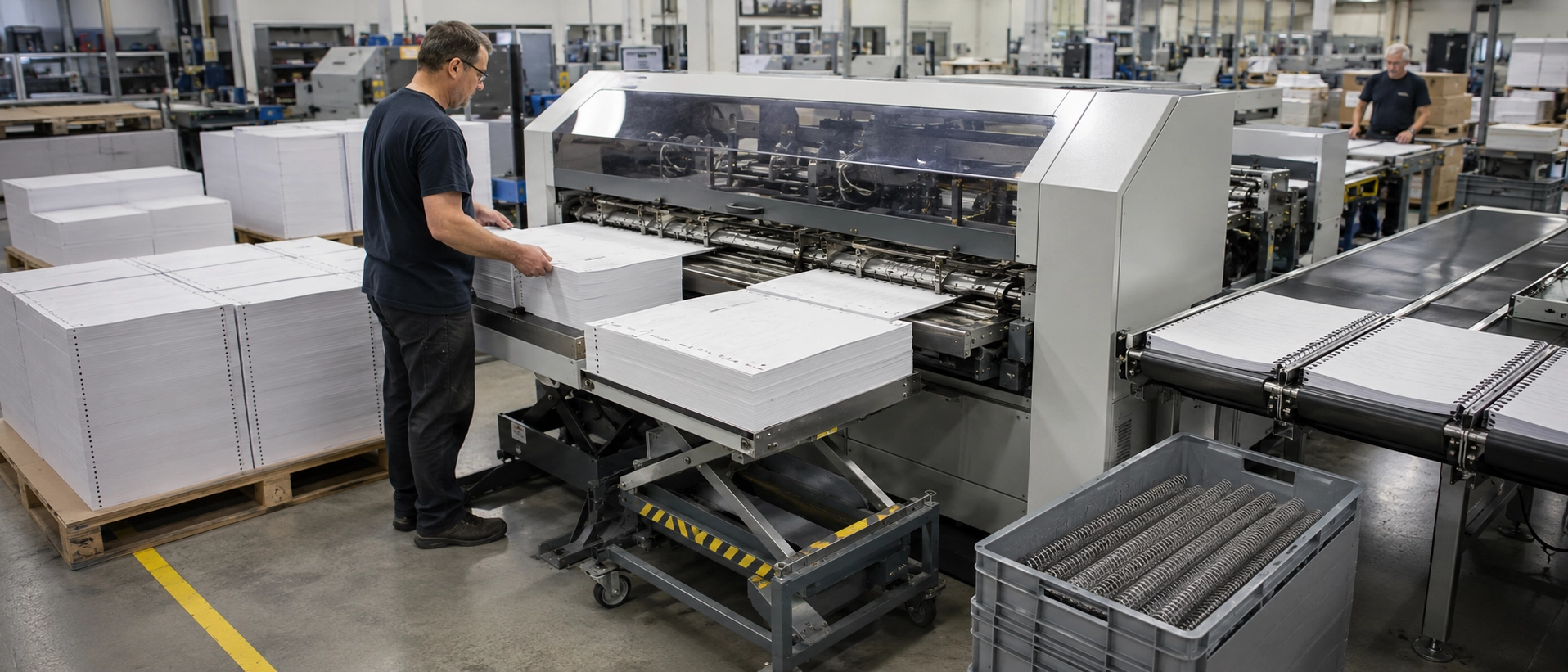
Whichever Route You Pick, the Pitch Has to Match
Every path above collapses to one non-negotiable spec: the holes have to match the spine that will carry them. Pre-punched paper is only as good as its alignment to your wire or coil, commonly 3:1 for wires up to about 9/16", 2:1 for the larger diameters, and 4:1 or 5:1 for coil, and a pattern off by one standard is a pattern you cannot use. Confirm yours against the pitch, hole count, and die on your machine before anyone quotes a pallet; the wire binding machine compatibility checks are the same ones that apply here.
That mismatch risk drops sharply, though it never fully disappears without a signed sample, when the double-loop wire and the punched pattern come from one source. We have formed our own wire and coil in-house since 2017, and one recurring issue we are asked to resolve is a buyer holding punched stock that does not fit the wire they were quoted against, usually caught at the sample stage when a 3:1 sheet meets a 2:1 wire before the pallet is released. Because we make both, we can punch stock to a pitch matched to the exact spine you are binding and prove it on a bound sample before you commit a full run, which is the cheapest possible moment to catch a pitch error rather than after a pallet lands. A matched sample should clear every one of these before the run is released:
- Hole type suits the method: round for coil and ring, die-punched square or rectangular for comb, and matched to your wire system for Wire-O.
- Pitch, hole count, hole size, and edge margin match the spine, verified rather than assumed.
- Paper weight and hole margin suit the closing force, so larger wires do not tear the sheet.
- Print orientation and grain feed cleanly through your actual printer.
- Insertion resistance, closing, and a full page-turn test all pass on the bound sample.
Get that sample approved before the pallet ships and the buy-versus-punch question stops being a gamble; it becomes a spec you have already proven. If you would like that comparison run against your own volumes and format, send us the job details - paper size, weight, pitch, hole count, weekly volume, printer model, and binding diameter - and we will sample it.
FAQ
Is pre-punched paper cheaper than punching paper in-house?
Per sheet it usually runs 10–30% more, but the saved labor and rework can offset that at volume; the crossover depends on your run size, format stability, and binding type.
Pre-punched paper vs punching in house - how do I decide?
Compare the per-sheet premium against your loaded punch labor, changeover, scrap, and downstream rework; buy pre-punched for low or mixed-format work, and punch in-house for steady single-format volume.
Can I use drilled paper for wire-O or comb binding?
Comb needs die-punched rectangular holes, and Wire-O needs holes matched to its pitch and system, so drilled round holes are generally not the right fit for either at production speed.
What should I verify before ordering pre-punched paper in bulk?
Confirm punch pattern and pitch (2:1/3:1 for wire, 4:1/5:1 for coil), hole count, sheet size, paper weight, printer feed, and MOQ plus freight against your real consumption rate.
Why does pre-punched paper sometimes tear at the holes?
Usually because the holes sit too close to the edge, the stock is too light for the closing force, or the wire is inserted with too much force; verify a binding-grade stock and margin.


