

Spiral Binding Calendar vs. Wire-O: Choosing the Right Bind for a Production Run
Leave a message
On a calendar order, the binding is the one decision that comes back as a cost when you get it wrong: a return, a reprint, or a customer who quietly doesn't reorder next season. On the floor it tends to get the least attention, often the last call made before a run ships. For anyone speccing a few thousand units of a spiral binding calendar at a time, it deserves more than that.
Part of the reason is how long the finished piece has to survive. Research from the Advertising Specialty Institute puts promotional calendars among the few branded items people keep for roughly a year, well past the seven-month average across promotional products. The bind on a calendar binding job therefore has to last twelve months of daily flipping plus everything between your bindery and the wall it ends up on: stacking, palletizing, and for a large share of orders, the mail.

How Plastic Coil and Wire-O Actually Differ
Both methods belong to the same punch-and-bind family, and at a glance a finished calendar can look similar either way. The mechanics underneath are not.
Plastic coil, the spiral most people picture, is a continuous filament wound into a long spring, threaded through a row of round punched holes, then crimped at both ends. It lays flat, rotates a full 360 degrees, and because the spine is one flexible coil, it behaves more like a spring than a frame.
Wire-O, sold as twin-loop or double-loop wire, is a pre-formed comb of paired metal loops. The loops drop through square or round holes, and a closer squeezes the C-shaped spine shut. It also lays flat and turns 360 degrees, but the spine is a fixed metal element rather than a continuous spring. That single structural difference sits under nearly every wire-o calendar binding trade-off below.
The Comparison That Drives the Decision
Most side-by-side charts stop at appearance. For a calendar that has to be produced, packed, and shipped at volume, these are the dimensions that actually move a binding decision:
| Dimension | Plastic coil | Wire-O |
|---|---|---|
| Spine material | Continuous plastic filament | Paired metal loops |
| Look | Casual, colorful | Sleek, premium, metallic |
| Page registration (fully open) | Drops ~half a hole; spreads sit slightly off | Perfect - pages align across the spine |
| Pressure / mailing durability | Flexes and springs back; resists crushing | Dents and crushes under stacking or transit pressure |
| Color range | Up to ~50 colors | Mostly black, white, silver |
| Page-count ceiling | Thicker books (up to ~2¾") | Thinner books (commonly up to ~1¼") |
| Built-in hanger | None - needs a hole or separate hanger | Integrates a hanger loop |
| Relative per-unit cost | Lower | Slightly higher |
A pattern shows up here that the usual "Wire-O is the premium one" summary hides. Wire-O wins on almost everything that happens while a calendar sits still and looks good; plastic coil wins on almost everything that happens while it is handled, stacked, or shipped. If you remember one rule when weighing wall calendar binding options, make it this: ask whether the run gets mailed or freighted. In our own order book, roughly eight in ten promotional calendar runs do, and for those coil is the right call before any other factor reaches the table. The reversal is the minority case: short, premium, display-first runs that are handled gently, where Wire-O's finish and registration earn their cost.
What the Spec Sheets Don't Tell You
Four things rarely make it onto a comparison page, and all four are where a calendar binding job goes wrong on the floor rather than on paper.

The durability paradox.
The most repeated claim in this category is that Wire-O is "more durable" than coil. As a flat statement about a spiral binding calendar it's misleading, and we say so as a maker of both. Wire-O is metal, so it feels sturdier in the hand and holds a crisper edge, but those paired loops take a permanent set under exactly the pressure a calendar order meets in transit. Stack wire-bound units in a carton, let a few cartons ride a pallet, and the spines on the lower layers come out flattened on one side; run the same calendar through automated mail sorting and the denting is worse. Plastic coil absorbs the same load and springs back to round, which is the real story behind coil vs wire binding durability once shipping is in the picture. The "less durable" coil-bound calendar is usually the one that arrives looking the way it left. The headline is easy to quote; the condition that flips it, handled gently versus shipped hard, is what decides your bind. It's a test you can run yourself: ask for samples bound both ways in your own stock, weight them like a loaded carton for a day, and see which spine comes back round.

The half-hole drop.
Open a coil-bound calendar fully and the back half settles about half a hole-pitch lower than the front, because the pages ride a continuous spiral. On a plain monthly grid, nobody notices. On a calendar with a header that crosses the spine, a two-page photo, or any symmetric branded layout, that drift becomes visible and reads like a print defect even though it isn't. Wire-O keeps perfect registration through a full turn. If your designers are building spreads that have to line up, that single detail can outrank everything on the comparison table above.
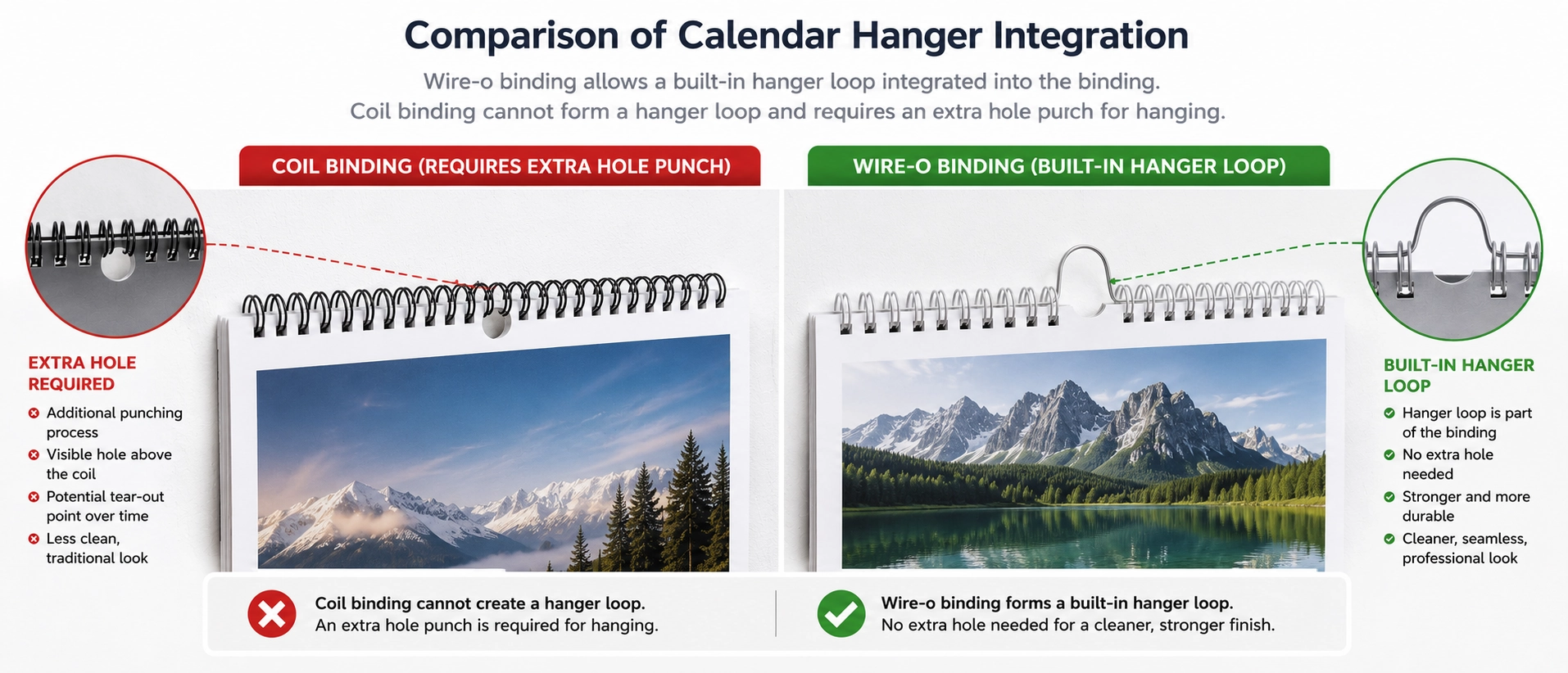
Hanger integration.
A wall calendar has to hang, and calendar hanger binding is where the two methods split on the production line, not just on the page. Wire-O lets you build a metal hanger loop into the spine, so the unit is ready to hang straight out of the carton. A coil-bound wall calendar usually needs a separately punched hole, a tack, or an added wire calendar hanger: an extra die, an extra step, and a decision about whether to stock hangers at all. Here is the rule we give customers: if the hanging method isn't locked at quote stage, default to Wire-O, because its loop is standard and needs no extra tooling. If you're set on coil for a hanging run, add one line to the job ticket before it moves, confirming hanger type and hole position, because that is the detail that otherwise surfaces only after the first box ships. The compatible hanger specs (opening width, hook gauge, weight per sheet) live on the product page.
Pitch and die mismatch.
Wire comes in 2:1 pitch (two loops per inch, better for larger or thicker calendars) and 3:1 pitch (three loops per inch, better for smaller, thinner ones), and the pitch has to match both your punch die and your closer. Specifying a pitch your existing die can't punch is the fastest way to scrap a full run of punched sheets. Two shared limits sit alongside it: you can't print on the spine of either method, and a full crossover image spanning the gutter will always show a break.
Matching the Bind to the Calendar Format
"It depends" is a non-answer, so here is where it actually lands once the generic comparison is split into the formats most orders fall into.
Start with the high-end wall calendar: fine-art photography, an architecture firm's year-in-review, anything where the object itself is the brand statement. This one is Wire-O. The metallic spine, the registration across image spreads, and the built-in hanger all justify the slightly higher cost, and these pieces are usually handled with care rather than mass-mailed.
The textbook answer reverses for a promotional wall calendar going out by the thousand, by mail, to a customer list. Here a spiral coil calendar is frequently the safer production choice, because it arrives intact where a metal spine would arrive crushed. If the brand insists on the Wire-O look for a mailed run, the real decision isn't the bind at all; it's the packaging budget needed to protect it.
Then there's the desk or planner-style calendar, which lives under a hand every working day, so plastic coil's spring is the better fit. The one spec that settles it is coil diameter. A tent-style desk calendar has to fold fully back on itself to stand, which needs a larger-diameter coil than a flat planner, and past a certain size that fold is simply outside what a Wire-O spine will do.
Turning the Decision Into a Supply List
Your production line decides the supply list more than the calendar does. Five questions, and the answers point straight at what to stock:
| If the calendar… | Lean toward | And you'll need |
|---|---|---|
| ships in volume or by mail | Plastic coil | Coil filament / spools, inserter & crimper |
| has to hang on a wall | Wire-O (or coil + hanger) | Twin-loop wire with hanger loop, or a wire calendar hanger |
| runs symmetric spreads or cross-spine headers | Wire-O | Twin-loop wire + matched 2:1 / 3:1 die |
| is thick (notes pages, daily layout) | Plastic coil | Larger-diameter coil + matching punch |
| needs many brand colors | Plastic coil | Colored coil stock |
The reason this matters for sourcing is that the two paths rarely share consumables or machinery, so a wrong call upstream means buying a die, a closer, or a spool you can't run. It is also why it pays to buy wholesale calendar binding supplies from someone who makes both formats rather than one, so you aren't boxed into a single path before the run is even specced. One cost rule helps here: for runs under about 500 units where packaging can be controlled, Wire-O's per-unit premium is easy to absorb; above that, the packaging needed to protect a mailed Wire-O run usually costs more than the binding difference it was meant to justify. For a line that is being set up or retooled, the punch-and-bind sequence is worth getting right before the first batch; our walkthrough of running a binding machine covers that step.
If your next run leans coil, the colored plastic spiral coil and filament we produce cover the diameters and color range most calendar lines ask for. If it leans metal, our nylon-coated twin-loop Wire-O in 2:1 and 3:1 pitch is built for clean, high-speed calendar binding. We make both, along with the calendar hangers and the forming and binding machines behind them, so the recommendation isn't bent toward the one product we happen to sell, and a free sample is the fastest way to settle the durability question on your own bench.
FAQ
Q: Is spiral or Wire-O binding more durable for a calendar?
A: For a calendar that gets mailed or shipped in volume, plastic coil is usually the more durable choice, because it springs back from pressure that dents a metal Wire-O spine.
Q: What is the best binding for a wall calendar?
A: For a wall calendar that's displayed and handled gently, Wire-O is usually the best binding thanks to its built-in hanger and aligned spreads; switch to plastic coil for high-volume mailed runs, where it survives transit better.
Q: Can you hang a wall calendar with spiral coil binding?
A: Yes, but coil needs a separately punched hole or an added wire calendar hanger, whereas Wire-O can integrate a hanger loop directly into the spine.
Q: What's the difference between 2:1 and 3:1 wire pitch?
A: 3:1 pitch suits smaller, thinner calendars and 2:1 suits larger or thicker ones, and the pitch must match your punch die and closer.
Q: Which method offers more color options?
A: Plastic coil offers far more colors - up to roughly fifty - while Wire-O is generally limited to black, white, and silver.
Q: How thick a calendar can each one bind?
A: Plastic coil handles thicker books (up to roughly 2¾"), while Wire-O is better kept to thinner ones (commonly up to about 1¼").


