

Branded Notebooks: The Six Spec Fields That Decide the Result
Leave a message
A workable specification for branded notebooks should lock six fields before sampling begins:
- Finished size, page count and inner-page layout
- Paper weight, finish and writing test requirements
- Paper and cover-board grain direction
- Binding type, element diameter and punch pitch
- Cover material, logo process and approved colour reference
- Quantity, packing method, delivery destination and required arrival date
Most quotation requests include the first and fifth fields. The two frequently omitted details are grain direction and binding pitch. Neither sounds important during a price comparison, yet either can cause warped covers, poor page turning or a complete mismatch between punched sheets and binding elements.
The central point is simple: buyers do not need more decorative options. They need a specification that keeps the approved sample and the production batch consistent.
Why the Specification Matters More Than the Supplier Shortlist
Branded notebooks are retained because they remain useful, and retention is what the media value rests on. ASI's 2026 Global Advertising Impressions Study, based on surveys of close to 5,000 consumers across the US, Canada, Mexico and Europe, puts a typical promotional product at roughly 3,300 brand views over its lifetime, with 85% of recipients remembering the advertiser and 78% keeping an item specifically because they find it useful. (Advertising Specialty Institute) Notebooks sit at the long end of that retention curve. ASI's own category reporting notes that most US consumers say they would keep a promotional notebook for at least a year, and 86% give the same reason: the category is practical. (ASI Research)
Product life is therefore part of the media plan. A cover that curls after two months or a coil that deforms in transit does more than create a quality complaint. It shortens the window in which the product can represent the brand at all.
The part worth being blunt about is where that cost lands. When a specification leaves a field blank, the supplier is not in breach of anything. The batch is technically correct, the invoice stands, and the person who has to explain the warped covers is the one who signed the purchase order. A competent factory can manufacture the wrong product accurately. The first defence against inconsistency is a complete branded notebooks specification; supplier evaluation comes second.
Two adjacent articles cover the ground this one deliberately skips. Buyers who want the production sequence itself, materials in and bound book out, should spec your branded notebooks correctly using the process walkthrough rather than repeating it here. For market context, our analysis of paper notebooks as long-retention brand products explains why physical stationery holds value alongside digital communication. The purchasing implication is more specific: durability, writing performance and daily usability are campaign requirements, not optional product upgrades.
Paper for Branded Notebooks: GSM Is Not a Writing Performance Specification
Higher GSM means more mass per square metre. It does not, by itself, guarantee that ink will resist feathering, bleed-through or ghosting.
Moving from 80gsm to 100gsm increases the basis weight by 25%. If the paper grade and surface treatment remain comparable, the heavier sheet will normally reduce show-through and feel more substantial. The problem is that buyers rarely compare otherwise identical papers. Fibre composition, opacity, calendering and surface sizing can change at the same time.
The counter-example is the useful part. Several well-regarded fountain-pen papers sit at 64–68gsm and still hold a wet, broad nib without bleed-through, while plenty of uncoated 100gsm stock will not. Sizing and surface treatment are doing that work, not weight. A specification that names only a GSM figure has left the decision that actually matters open, and the cheapest compliant paper on the market will be the one that arrives.
For branded notebooks used with ballpoint pens in meeting kits, a smooth 80gsm or 90gsm sheet may be sufficient. Corporate journals intended for rollerballs and fountain pens need a more demanding ink test. Art or marker applications require an entirely different paper and should not be approved from GSM alone.
Here is the practical gap: "100gsm bleed-resistant paper" is useful only when the supplier and buyer agree on what counts as acceptable bleed resistance. Without an approved pen test and a retained sample, the wording still leaves room for two very different papers.
A stronger specification reads:
100gsm writing paper, smooth surface, suitable for ballpoint, gel pen and the nominated fountain pen ink, with no visible feathering and no bleed-through under the approved test artwork. Production paper must match the signed sample.
That paragraph only has force if the supplier agrees to run the test with the pens you nominate and return the tested sheet; otherwise the condition is unenforceable and the clause is decoration. Nominate the pens by name in the same email, and ask for the reverse side of the test sheet photographed under the same light as the front.

Paper weight also changes the binding decision. Consider an A5 notebook with 192 printed pages, which equals 96 physical sheets. Increasing the stock from 80gsm to 110gsm adds approximately 89.5 grams to the book block before accounting for waste, cover or endpapers. Across 1,000 units, that is almost 90 kilograms of additional paper.
Roughly 90 kilograms per thousand books is not only a freight line. Thicker paper can require a larger coil diameter and wider cartons, so a paper upgrade should trigger a new bound-dummy review rather than a revised paper quotation.
Grain Direction Is the Field Most Buyers Never Ask For
Paper and cover-board grain should normally run parallel to the binding edge. In this orientation, pages bend more naturally as they turn, while dimensional movement caused by moisture is less likely to fight the fixed spine.
When grain runs across the spine, the book block becomes stiffer in the wrong direction. Depending on the construction, the result can include spring-back, a cover that refuses to remain closed, rippling after adhesive application or cracking near a folded spine.
Here is the variable most suppliers will not raise on their own: cutting the sheet the "wrong" way can save more than 10% of the paper on a large run. Bookbinding sources state this plainly, and note that printers routinely prioritise sheet yield over binding behaviour when they impose a job. (iBookBinding) So when a specification is silent on grain, the default is not random. It is the direction that yields the most books per sheet, which is frequently the wrong one. The factory has already run that calculation; the buyer usually has not. This is why grain belongs in the specification as a written line rather than an assumption about supplier competence.

Correct grain direction improves opening behaviour, but that conclusion depends on every paper-based component working together. A correctly oriented book block can still warp if the cover board, endpaper and laminated covering material react differently to moisture.
For case-bound or board-covered branded notebooks, the purchase specification should state:
Inner paper and cover board grain to run parallel with the binding edge. Supplier to confirm grain direction on the pre-production sample and maintain the same sheet layout for mass production.
A simple receiving check takes less than a minute. Take an unbound sheet from the production lot and bend it gently in both directions without creasing it. The direction offering less resistance usually follows the grain. For higher-value orders, confirm the result with a tear or moisture test on sacrificial material rather than relying on the bend test alone.
Bookcloth requires a slightly different judgement. Paper-backed cloth can be affected by its backing and adhesive, while woven texture may also look different when rotated. The industry does not treat cloth grain with the same unanimity as paper grain. Even where mechanical performance is acceptable in either direction, all covers in one production run should maintain the same cloth orientation for visual consistency.
The Binding Spine Should Be Designed With the Notebook
The spine is often priced as a component added after the paper and cover are selected. That sequence is backwards for spiral bound branded notebooks made to a custom specification. The binding controls page capacity, opening behaviour, transport resistance, punching geometry and a visible part of the colour system.
| Binding option | Best suited to | Main advantage | Specification risk |
|---|---|---|---|
| Twin-loop Wire-O | Corporate gifts, retail journals, presentation books | Square, orderly appearance with gold, rose-gold and other electroplated finishes | Loops can be crushed if carton protection is inadequate |
| Metal spiral coil | Training manuals, reference books, products requiring frequent page turning | Strong continuous element and 360° page rotation | Diameter and end finishing must suit the book thickness |
| PET or PVC spiral coil | Student notebooks, colourful product ranges and larger-volume programmes | Broad colour choice and good resistance to permanent bending | Material, pitch and colour tolerance must be stated |
| Case binding | Executive gifts and formal journals | Traditional closed spine and premium shelf presence | Does not provide the same 360° opening as spiral binding |
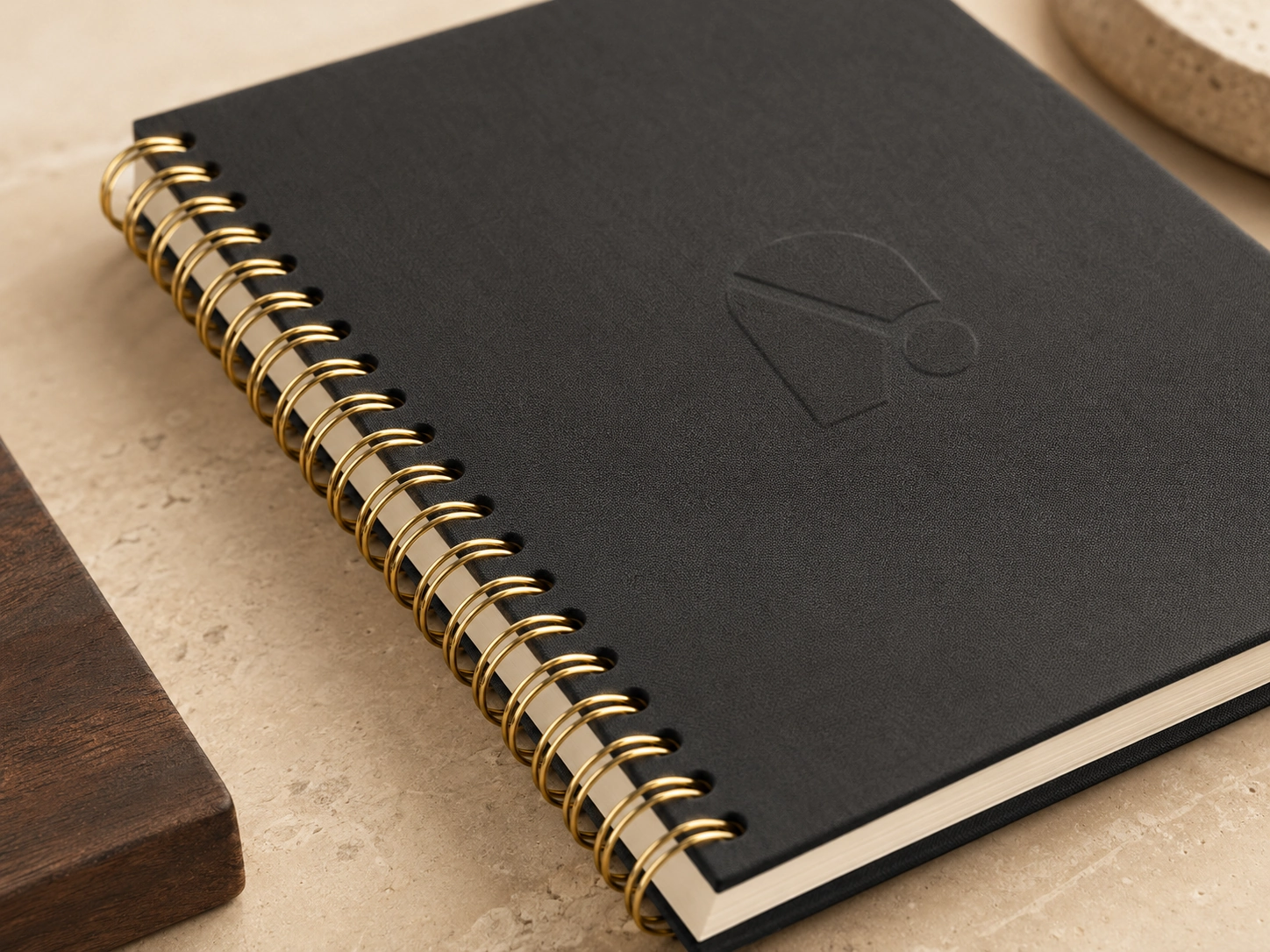
Branded notebooks for corporate gifts are usually best served by Wire-O when the spine has to coordinate visually with foil stamping. Gold or rose-gold Wire-O can repeat the foil colour and make the binding part of the design instead of hiding it as a production necessity. Buyers evaluating this direction can review the available electroplated double Wire-O binding options, or see the assembled formats in the notebook range before fixing the cover artwork.
Element diameter must follow the measured thickness of the finished book block, not page count alone. That holds provided the thickness is measured rather than estimated. Paper caliper, not weight, sets the real book block dimension, and two 100gsm papers with different bulk can land a book one coil size apart. Inserts, dividers and laminated covers move it further. YPS produces binding elements across a 6–50mm diameter range, covering approximately 30–444 sheets depending on the material and construction. The final diameter should still be approved against a physical dummy.


Pitch Is a Compatibility Requirement
Buyers specifying branded notebooks wire-o binding for the first time usually get the diameter right and the pitch wrong. Pitch describes the number and spacing of holes along the binding edge, and a coil and a punched book block must use the same pattern.
A standard plastic or metal spiral programme may use 4:1 pitch, while 3:1 patterns may be selected to coordinate with Wire-O or compatible punching systems. The exact arrangement depends on the equipment and binding element. A buyer should never assume that "A5 spiral notebook" defines the hole pattern.
The coil pitch must match the punch pattern exactly. The part most quotations omit is whether the factory supplying the loose binding element is using the same reference standard and cut length as the printer punching the pages.
This is the failure mode that survives good suppliers. When paper blocks come from one factory and binding elements from another, approving both components separately does not prove they will assemble. Neither party is wrong on its own line item, and neither carries the loss. One line in the enquiry closes it:
Confirm the punch pitch and hole pattern in writing, and supply one bound production dummy assembled from the actual punched sheets and the actual binding stock before mass production is released.
For children's publishing, end treatment deserves its own line. A 270° end bend on pre-cut Wire-O reduces exposure to sharp wire ends and is appropriate for products intended for young users. It should be specified as a safety feature, not described vaguely as "finished ends."
Match the Logo Process to the Cover Surface
Foil stamping, blind debossing and screen printing solve different branding problems.
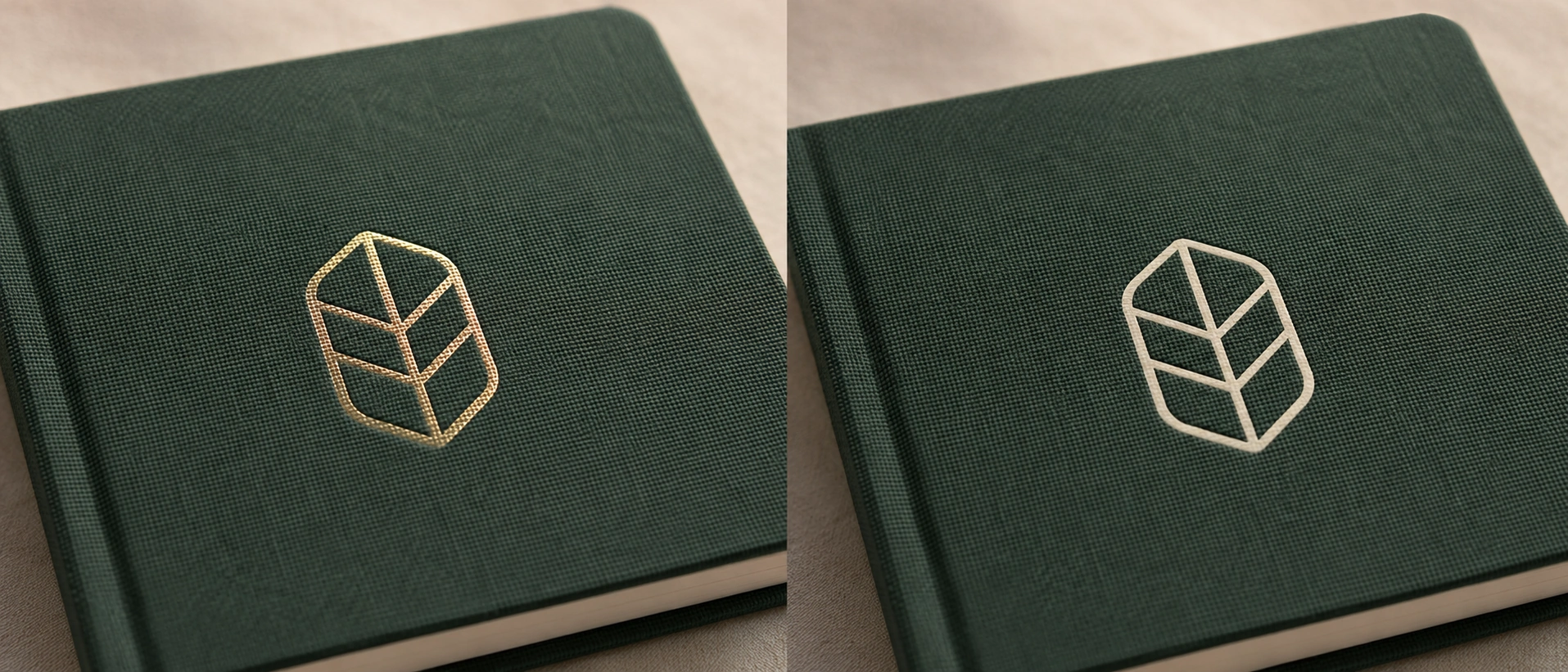
Foil stamping works well when the goal is a controlled metallic accent on smooth or moderately textured covers. Blind debossing creates a quieter premium effect and avoids introducing another colour, but shallow or very fine details can disappear on heavily textured materials. Screen printing is generally more suitable for larger solid graphics, detailed brand colours or surfaces on which a foil impression would become inconsistent.
The most attractive process on a material swatch is not automatically the most reliable process in production. Small reversed text, thin strokes and closely spaced details can fill in during stamping. Deep texture can interrupt fine foil lines. Soft padded covers can produce variable impression depth.
For custom branded notebooks with a detailed logo, submit vector artwork whenever possible and include:
- Minimum acceptable line thickness
- Minimum text size
- Pantone or other approved colour reference
- Exact logo position measured from finished edges
- Maximum placement tolerance
- A signed physical decoration sample
Approve the logo on the actual cover material rather than the artwork file. Texture changes what a fine stroke looks like under heat and pressure in a way no on-screen proof reproduces, and the interaction among artwork geometry, pressure, foil and substrate can only be settled on the production material.
Choose Between Volume Branding and Full Custom Production
A custom branded notebooks bulk order and a stock item with a logo applied are two different purchasing routes, and mixing them creates unrealistic MOQ and lead-time expectations.
| Decision factor | Stock notebook with branding | Fully custom notebook |
|---|---|---|
| Product structure | Existing size, paper and binding | Buyer-defined cover, pages, binding and packaging |
| Setup requirement | Mainly artwork and decoration setup | Material sourcing, dielines, punching and binding setup |
| Typical quantity logic | Suitable for smaller or urgent programmes | More economical when fixed setup costs are spread over volume |
| Lead-time driver | Decoration capacity and stock availability | Sampling, material approval and production scheduling |
| Best application | Events with limited design changes | Retail lines, recurring corporate programmes and private label products |
The table decides the route in most cases. The condition that overrides it is colour. If the brand requires a specific Pantone across cover, coil and packaging, the stock route stops being viable at any quantity, because stock covers and stock coils are made to their own colour ranges rather than to your palette. That single requirement moves a programme into the custom column even when volume, budget and timeline all point the other way.
The branded notebooks MOQ question has a specific factory answer: approximately 1,000 pieces per colour and specification. The reason is that tooling and colour setup are the fixed costs, not the paper. That is also why changing cover colour, coil colour or size divides the order into separate setups. An order for 1,000 books across five colours is not operationally equivalent to 1,000 identical books. YPS can assess smaller trial programmes for new lines, at a higher unit price.
Once materials, artwork and the signed sample are locked, a routine production window may be approximately 7–15 days. That is one clock. The project clock is a different one, and it starts earlier: sampling, revision, material confirmation, packaging approval and international transport all sit ahead of the arrival date. Most schedule failures come from budgeting the first clock and forgetting the second.
If the requirement involves custom inner pages, matched coil colours or private label packaging, use the custom branded notebooks project brief to provide the specification in one round. This reduces the repeated clarification that often consumes more time than production itself.
Our boundaries matter as much as our capabilities, and they are easier to check before a quotation than after. We do not present mass-produced spiral products as hand-bound leather stationery. Runs below 100 fully customised units are rarely efficient at factory level. We do not claim FSC Chain of Custody coverage for a project unless the relevant documentation and material scope have been confirmed before quotation. Any supplier unwilling to state the equivalent limits is leaving them for you to discover during production.
Five Failure Points to Close Before Purchase Approval
These checks should be completed before a purchase order is released:
- Paper approved by description only: Test production paper with the pens the recipient is likely to use, then retain a signed sample.
- Grain direction omitted: State that the inner paper and board grain must run parallel to the binding edge and verify it on the bound dummy.
- Pitch assumed from notebook size: Record the exact pitch, hole pattern and binding element, especially when punching and binding come from different suppliers.
- Logo approved only on screen: Approve the logo on the actual cover material under normal lighting, including colour, position and edge definition.
- Production time confused with project lead time: Work backward from the required arrival date and reserve time for sampling, revisions, packing and freight.
Passing all five removes the most preventable causes of rework in branded notebooks with logo wholesale programmes. It does not remove the one that survives a clean checklist: when the book block and the binding element are contracted separately, every individual approval can pass while the assembly still fails, and no single supplier owns the defect. If your programme is split across two vendors, the bound production dummy is not a formality: it is the only document that makes one party responsible for the finished book.
What a Binding Manufacturer Contributes
YPS approaches branded notebooks from the binding and coil side of production. Our current operating profile includes a 20,000-square-metre facility, approximately 150 staff, more than 90 products and exports to over 20 countries. Publishing customers include Leo Paper Group and Haiphong Stationery. Available binding capabilities include electroplated Wire-O, metal spiral elements, PET and PVC coils, custom colours and pre-cut elements. Verifiable credentials are limited to what can be checked: ISO 9001 inspection, CE-marked machinery and SGS-tested consumables, listed on our certificate page. We do not hold FSC Chain of Custody.
Three product lines make this concrete. Gift stationery can coordinate gold or rose-gold Wire-O with cover foil. Education programmes can use colour-matched PET coils for durable student ranges. That is the same route buyers take when sourcing an eco friendly branded notebooks supplier, since recyclable PET coil and a stated material scope are easier to verify than a general sustainability claim. Children's publishing can specify pre-cut double wire with a 270° end bend where exposed wire ends require closer control.
Our position is not that every branded notebook should use a spiral spine. Case binding remains the better answer for some executive programmes. However, buyers who require 180° opening, 360° page rotation, visible colour coordination or binding elements supplied to a separate assembly line benefit from working with a manufacturer that controls the coil specification directly.
The sustainability argument also needs restraint. Promotional products can perform well when carbon impact is considered against remembered exposure, but current cross-channel studies provide directional comparisons rather than product-level life-cycle assessments. Durability, material sourcing, transport and end-of-life treatment still need to be evaluated for the actual product. (Promotional Products Association International)
Frequently Asked Questions
What is the minimum order quantity for branded notebooks?
Industry MOQ ranges roughly from 50 to 1,000 units depending on how much is genuinely being customised. At factory level a run typically starts around 1,000 pieces per colour and specification, because tooling and colour setup are the fixed costs, not the paper. Smaller trial runs are possible for new lines, at a higher unit price.
How long do branded notebooks take to produce?
There are two different clocks. Stock items with a logo applied ship in days. A genuinely custom build (custom cover material, custom coil colour, custom page layout) runs about four to six weeks industry-wide, of which roughly 7–15 days is production once the specification is locked. The sampling round is what most buyers forget to budget for.
Does higher GSM paper stop ink from bleeding through?
Not on its own. Moving from 80gsm to 100gsm adds about 25% more fibre and measurably reduces show-through, but surface sizing and coating matter more: some 64–68gsm papers outperform heavier uncoated stock with fountain pens. Specify the finish, not just the weight.
Which binding is best for branded notebooks?
Wire-O suits premium visual coordination, metal spiral suits frequent handling, and PET or PVC coil suits colour-led volume programmes, provided the pitch and diameter match the punched book block.
Send a Specification Before Requesting a Price
A useful quotation request for branded notebooks can fit into six lines:
Finished size and page count:
Paper weight, finish and writing requirement:
Grain direction:
Binding type, diameter, pitch and colour:
Cover material, logo process and artwork:
Quantity, packing, destination and required arrival date:
Send those six fields with the artwork, or request a physical sample for colour, paper and binding evaluation and check the pitch and colour on your own line before committing. A comparable quotation for branded notebooks should tell you what will be made, not merely what each unit costs.


